
The cheapest column quote on your desk is almost never the cheapest column.
I have watched that lesson cost plants lakhs, one weeping tray at a time.
Choosing among the types of distillation columns is where the saving, or the bleeding, starts. Most buyers rush it.
You do not really buy a column. You buy a set of trade-offs. Those trade-offs begin with the type you pick and the internals inside it.
After thirty years around these units, I can tell you the type of decision outlives every other choice you make.
QUICK STAT
- Tray columns do most of the heavy lifting in industry. Packed columns are generally preferred for smaller diameters (typically below 600-900 mm) and for vacuum or low-pressure-drop applications.
- Turndown tells the story. Bubble caps stretch to roughly 8:1, valves sit around 4:1 to 5:1, and a plain sieve tray often gives up at 2:1 to 3:1.
- Borosilicate 3.3 glass resists most acids, solvents, and corrosive chemicals, but it is not suitable for hydrofluoric acid or hot concentrated alkalis. That is the whole reason corrosive duty leans on glass.
Five Things That Actually Matter When You Pick a Column
Before any catalog or quotation, I walk buyers through five questions. Get these right and the column type almost chooses itself.
- Batch or continuous. Your production pattern decides this before anything else.
- Trays or packing. This single choice drives height, pressure drop, and how easily you clean the unit.
- Material of construction. Corrosive or high-purity duty pushes you toward glass or glass-lined systems, not bare steel.
- Turndown range. If your feed rate swings, the wrong internal will weep or flood at the extremes.
- Separation difficulty. Close-boiling and azeotropic mixtures need more stages or a special technique, and that changes the type.
So What Is a Distillation Column, Really?
Picture a tall vessel with vapor climbing up and liquid draining back down past it.
They meet, over and over, all the way up. Each pass nudges the lighter component higher and the heavier one lower, sorting the mix by boiling point.
Each vapor-liquid contact contributes to a theoretical separation stage. Tray columns have physical stages, while packed columns achieve equivalent separation continuously. Increasing the number of stages generally improves separation, provided adequate reflux and favorable vapor-liquid equilibrium exist.
Heat goes in at the bottom through a reboiler. Cooling happens at the top through a condenser. Everything in between is about giving vapor and liquid enough contact to swap their lighter and heavier molecules.
Batch vs Continuous, the First Real Fork
A batch column takes a fixed charge, processes it, then stops for the next load. It suits small volumes, frequent product changes, and R and D work where flexibility beats throughput.
A continuous distillation column runs an uninterrupted feed and only stops for maintenance or an upset. It earns its keep on high throughput and steady products, which is why most plant-scale units run continuous.
In pharma and aromatics work, I see plenty of batch columns. The recipe changes week to week, so flexibility beats speed.
Run the same duty around the clock, though, and a continuous distillation column wins on cost per liter every time.
PRO TIP: If you make many products in small lots, do not let a vendor talk you into a large continuous train you will run at quarter load. A right-sized batch or pilot column will pay back faster and clean up between products without a fight.
The Types of Distillation Columns You Will Actually Run Into
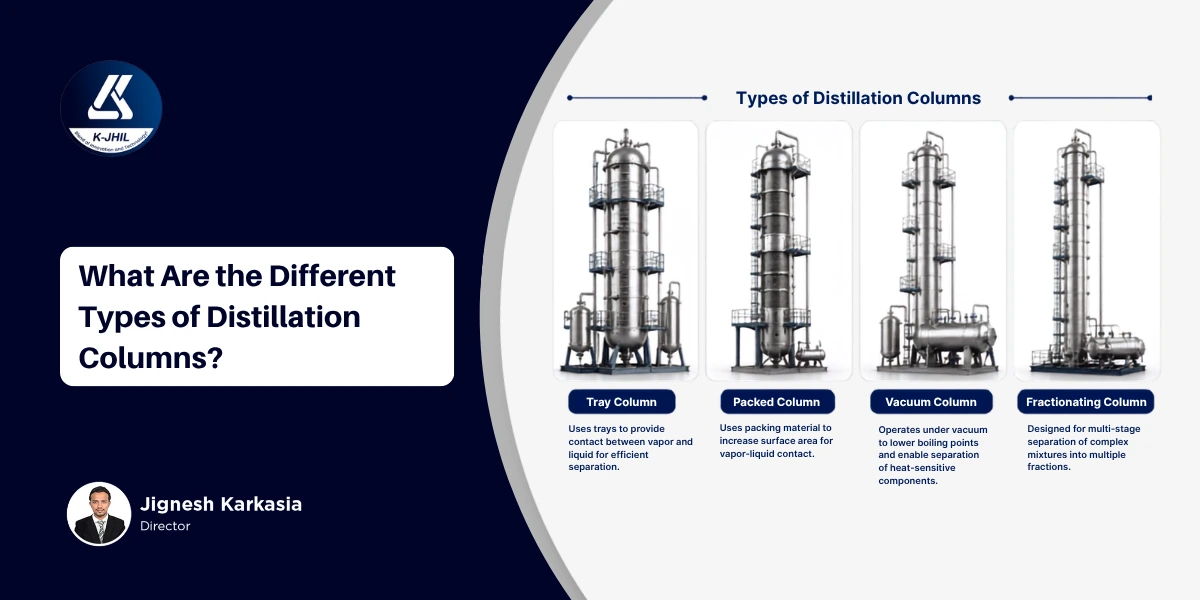
Beyond the batch and continuous split, columns get named for the job they do. Here are the types of distillation columns that show up most often on Indian plant floors.
Column Type | What It Does | Best Suited For |
Fractional | Uses many stages to split close-boiling components | Solvent recovery, aromatics, multi-product plants |
Vacuum | Lowers pressure so heat-sensitive feeds boil cooler | Pharma intermediates, high-boiling organics |
Azeotropic | Adds an entrainer to break a constant-boiling mix | Ethanol dehydration, water-organic azeotropes |
Extractive | Uses a heavy solvent to shift relative volatility | Close-boiling and isomer separations |
Reactive | Runs a reaction and separation in the same shell | Esterification, selected specialty chemistry |
Steam / Stripping | Strips volatiles using live steam or stripping gas | Essential oils, effluent and solvent stripping |
Lab columns | Vigreux and spinning band units for small batches | R and D, QC, pilot purification |
Tray Column vs Packed Column, the Choice That Decides Everything
Once you know the type, you decide what goes inside. This is where the real money and the real headaches live.
A tray column stacks horizontal plates, each acting as a separation stage. A packed column does it differently.
It fills the shell with random or structured packing for continuous vapour-liquid contact. For the full decision framework, our guide on tray column vs packed column walks through it.
My rule of thumb after years of commissioning both: trays handle solids, fouling, and high liquid loads better, and they predict more cleanly. Packing wins on pressure drop, on small diameters, and on heat-sensitive or vacuum duty.
Factor | Tray Column | Packed Column |
Best diameter | Larger columns, high liquid rates | Smaller columns, below about 600 mm |
Pressure drop | Higher per stage | Lower, good for vacuum |
Handling solids | Better, easier to clean | Fouls and channels more easily |
Predictability | Well understood, easy to scale | Sensitive to liquid distribution |
Typical cost | Higher build cost | Often shorter and cheaper to fabricate |
Types of Distillation Column Trays
If you settle on a tray column, the next fork is the tray itself.
The common types of distillation column trays differ in how they pass vapor through the liquid. That detail decides efficiency, pressure drop, and turndown.
Tray Type | How It Works | Strengths | Watch For |
Sieve | Vapor rises through plain punched holes | Cheap, simple, easy to clean | Weeps badly at low vapor rates |
Valve | Liftable caps open and close with vapor flow | Wide operating range, good efficiency | More moving parts to inspect |
Bubble cap | Caps over risers force vapor through slots | Excellent turndown, holds liquid at low rates | Costly, higher pressure drop |
Dual flow | Vapor and liquid share the same holes | Very open, handles fouling and solids | Lower efficiency, narrow range |
Chimney | Collects liquid for draw-off, not separation | Useful for side draws and feeds | Adds height without stages |
WATCH OUT: Match the tray to the duty, not the budget. A sieve tray on a service that swings to quarter load will weep, dump liquid through the holes, and quietly wreck your purity. I have seen a whole campaign written off because the cheapest tray was specified for a variable feed.
The Real Difference Between Bubble Cap, Sieve, and Valve Trays
People ask me this on almost every plant visit. The honest answer is that all three can hit similar separation if sized right, but they behave very differently when conditions move.
Sieve trays are the simplest and cheapest. They shine at steady, high vapor rates and are the most common tray you will meet, but drop the load, and they start weeping.
Valve trays add liftable caps that adjust to the vapor flow. That buys you a wider operating range and strong efficiency, at the cost of a few more parts to inspect during a shutdown.
Bubble cap trays hold a liquid seal even at very low vapor rates. So their turndown is the best of the three.
Bubble cap trays offer superior turndown, while efficiency depends on the specific design and operating conditions.
They cost more and carry a higher pressure drop. That is why they earn their place mainly in vacuum, batch, and highly variable services.
Different Types of Trays in a Distillation Column, Compared on Efficiency and Pressure Drop
When buyers push me for numbers, I give ranges, not promises, because real performance depends on the system. Still, the different types of trays in a distillation column line up in a predictable order.
Efficiency | Pressure Drop | Turndown | Relative Cost | Tray Type |
Good at design load | Low to moderate | About 2:1 to 3:1 | Lowest | Sieve |
High, stable | Moderate | About 4:1 to 5:1 | Moderate | Valve |
High, very stable | Highest | Up to about 8:1 | Highest | Bubble cap |
Read that table as a map of trade-offs, not a ranking.
The sieve tray is not worse; it is cheaper and simpler for the right job. The bubble cap is not better; it just buys stability you may or may not need.
Fractional Distillation Columns and What Goes Inside Them
Most multi-stage industrial work happens in fractional distillation columns. These pack many stages into one shell so you can split components whose boiling points sit close together.
The internals matter as much as the shell. Reboiler, condenser, reflux divider, distributors, trays or packing- all have to work as a set.
Our breakdown of fractional tower internals covers each part and why it is there.
In glass systems I design, fractional distillation columns let the operator actually see flooding or fouling start, long before a steel tower would give any warning. That visibility has saved more than one batch on a night shift.
When an Azeotrope Forces Your Hand
Some mixtures refuse to separate past a certain purity because they form a constant-boiling blend, an azeotrope. For many azeotropes, conventional distillation alone cannot achieve further separation. Alternatives include pressure-swing, azeotropic, or extractive distillation.
That is when you reach for azeotropic or extractive distillation. You add an entrainer or a heavy solvent to shift the balance.
The classic example is drying ethanol past the water azeotrope. Our explainer on fractional distillation of azeotropic mixture lays out when each route makes sense.
PRO TIP: A note on Indian pricing. A borosilicate fractional setup for a lab or QC bench usually lands somewhere between Rs 50,000 and a few lakh, depending on glass quality and the internals you pick.
Pilot and production glass systems? Several lakh, climbing into crores as capacity grows. Before you line up quotations from Vapi or Ankleshwar, get the ISO 3585 grade and the turndown spec in writing. I have watched too many buyers skip that and regret it later.
Why do Glass and Glass-Lined Columns Win in Corrosive Duty?
Most write-ups on this topic quietly assume a steel refinery tower. Walk into a pharma or specialty chemical plant, and that assumption falls apart fast.
Many corrosive acids and halogen-containing process streams can rapidly corrode carbon steel, making glass or glass-lined equipment preferable. Borosilicate 3.3 glass just shrugs, stays inert with whatever you are running, and lets the operator actually see the process.
For bigger, higher-pressure shells, glass-lined steel carries the same chemistry. Between the two, you can cover most corrosive duties and skip the exotic alloys that cost a fortune.
How to Match the Column to Your Industry?
The same column type rarely fits every plant. Here is how I steer different sectors.
- Pharma and bulk drugs. I lean toward vacuum and fractional glass columns here, since the intermediates are heat-sensitive and clean-in-place is non-negotiable.
- Agrochemicals. Aggressive feeds, so corrosion-resistant glass or glass-lined fractional units, every time.
- Perfumery and aromatics. Gentle vacuum fractionation. Push the heat and you cook off the delicate top notes the whole product is built around.
- Specialty chemicals. Product changes every few days, so flexibility wins. A tray or packed column sized for a swinging feed beats a rigid one.
WATCH OUT: Read the spec sheet, not the brochure. Two traps catch buyers again and again: an undersized reboiler that throttles the whole column, and low-grade glass sold as borosilicate 3.3 without an ISO 3585 declaration. Ask for the certificate and ask for the design turndown, in writing.
How to Tell a Well-Built Column From a Cheap One Without a Lab?
You cannot run an assay on the shop floor, but a few checks tell you plenty during a plant visit or a vendor audit.
- Glass should be clear and free of striations, with clean fire-polished flanges and no visible bubbles in the wall.
- Tray and packing supports should sit level and square, with gaskets rated for your service, not generic rubber.
- The vendor should hand over an ISO 3585 glass declaration and a stage or turndown rating without hesitation.
- Reboiler and condenser sizing should match the column duty, not just bolt on whatever was in stock.
Why the Right Column Costs More and Why It Pays Back?
A properly specified column always looks expensive on day one. The cheaper quotation usually hides its real cost in cleaning hours, lost batches, and early replacement.
I have watched plants save a few lakh on a column and then lose far more across a single year of weeping trays and off-spec product. The math is rarely close once you count downtime.
QUICK STAT
- Payback. A right-sized column usually earns back its premium inside one to two years, mostly through batches that do not go off-spec.
- Energy. Get the tray right, and the reboiler stops working overtime. Flooding and weeping are what push operators to crank the heat in the first place.
- Lifespan. Good borosilicate glass keeps going past a decade in corrosive duty. Bare steel in the same service? You are replacing it far sooner.
Key Takeaways
- Start with the big fork: batch or continuous. Everything else (fractional, vacuum, azeotropic, extractive, reactive, stripping) branches off from there.
- Trays for solids, high liquid loads, and clean scale-up. Packing for low pressure drop, small diameters, and vacuum.
- Trays trade cost against turndown. The more your feed rate swings, the more you should spend on the tray.
- Hit an azeotrope and plain fractionation stalls. You will need extra stages or an entrainer, and that changes the column.
- For corrosive, high-purity work, borosilicate glass and glass-lined columns beat bare steel. Better chemistry, and you can see what is happening inside.
Picking the Right Distillation Column for Your Setup
Strip away the tables, and it comes down to three things: your feed, your purity target, and how you run production. Pin those down, and the right column stops being a guess.
At K-Jhil Scientific, we have built borosilicate glass and glass-lined separation systems since 1990. Our work spans pharma, agrochemical, perfumery, and specialty chemical plants.
If you are weighing your options, our K-Jhil’s Fractional Distillation System page shows what a properly specified unit looks like.
Tell us your duty, and we will tell you, honestly, which of the types of distillation columns fits best, even when the answer is a simpler unit than you expected.
Contact Us to talk it through with someone who has stood next to these columns at 3 in the morning.
FAQs About the Types of Distillation Columns
- What are the main types of distillation columns?
They divide first into batch and continuous columns, then into fractional, vacuum, azeotropic, extractive, reactive, and stripping designs. Each is named for the separation job it handles. - What is the difference between a tray column and a packed column?
A tray column uses stacked plates as separation stages, while a packed column uses random or structured packing for continuous contact. Trays handle solids and high loads better, packing offers lower pressure drop and suits small or vacuum columns. - What are the different types of trays in a distillation column?
The common types of distillation column trays are sieve, valve, and bubble cap, with dual-flow and chimney trays for special duties. They differ in how vapor passes through the liquid, which sets efficiency and turndown. - Which type of distillation tray is most efficient?
Valve and bubble cap trays hold high, stable efficiency across a wide range, while sieve trays are efficient at their design load but weep at low rates. The best choice depends on how much your feed swings. - What is a fractional distillation column?
It is a multi-stage column that separates components with close boiling points by repeating vaporization and condensation many times. Fractional distillation columns are the workhorses of solvent recovery and multi-product plants. - What is the difference between batch and continuous distillation columns?
A batch column processes one charge at a time and suits small, variable production, while a continuous distillation column runs an uninterrupted feed for steady, high-throughput duty. Most plant-scale units run continuous.