
It was just past 4 a.m. when the night shift called me from a Vapi specialty plant.
Their column was flooded. Pressure had blown past every alarm. By the time I picked up, the operators had already shut the reboiler and were watching liquid back up over the top trays.
The column was six months old. Wrong internals.
Someone had specified sieve trays for a job that needed structured packing. Now there was no clean way out of it before sunrise.
A heat-sensitive reaction. A column running below 50 mbar.
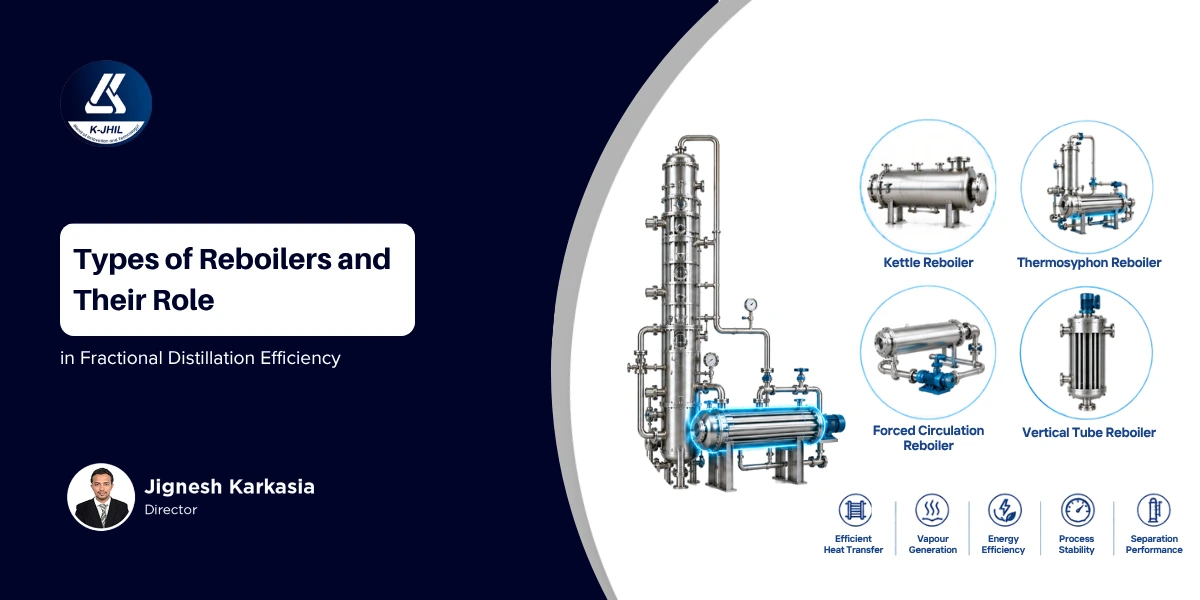
Two products that boiled four degrees apart, and anyone with a copy of Kister could have flagged the spec.
Nobody on the buying side had asked the right question.
That single call, trays or packing, decides whether your fractional distillation column behaves on a Tuesday.
I’ve seen this one mistake cause ninety-day commissioning slips, batches that went straight to the tank farm, and one client who lost a customer over it.
Thirty-plus years of these calls in, here’s how I actually think about it.
Quick answer: A fractional distillation column is the vertical separation tower that does the real work inside any fractional distillation unit. Tray (plate) columns belong in high-throughput, large-diameter, fouling-prone, or above-atmospheric service. Packed columns belong in vacuum duty, heat-sensitive products, small diameters, and tight boiling-point cuts. What really decides it isn’t cost. It’s pressure drop, liquid rate, and what your reaction will tolerate.
What Is a Fractional Distillation Column?
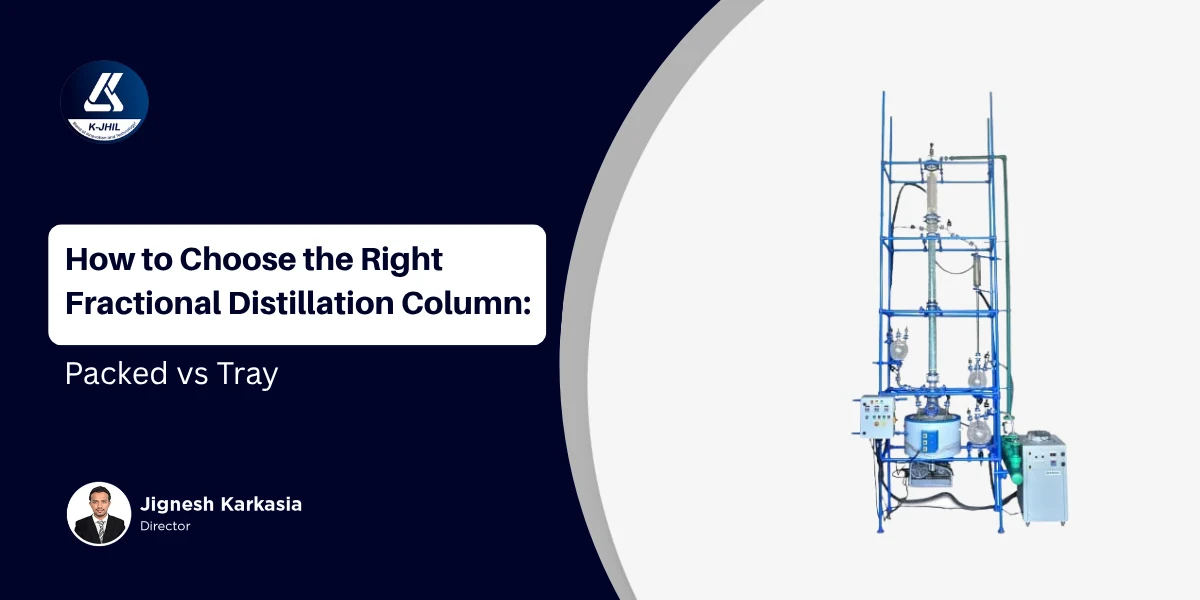
A fractional distillation column is a vertical pressure vessel that separates liquid mixtures by repeatedly evaporating and condensing them across a series of stages.
It sits between the reboiler and the condenser. Its internals create the vapor-liquid contact that drives separation.
Industry uses a fractional distillation column whenever the boiling-point gap between two products closes below twenty-five degrees Celsius. For wider gaps, a Simple Distillation System does the job without a column at all.
Inside any Fractional Distillation Unit, the two structural choices are tray columns (also called plate columns) or packed columns. That’s the choice this guide is built around.
Key Components of a Fractional Distillation Column
Five components define the column itself, regardless of internals:
- Reboiler: Generates the vapor at the bottom of the column.
- Column shell: Holds the trays or packing under operating pressure.
- Trays or packing (internals): The actual separation real estate.
- Condenser: Recovers vapor at the top into liquid product.
- Reflux drum: Returns part of the liquid product to the column for separation.
Get the shell metallurgy and the internals right, and the rest is engineered around them.
Tray Column vs Packed Column: The Core Difference
The difference between tray and packed column comes down to how vapor and liquid actually meet inside the tower.
A tray column uses horizontal plates that force rising vapor to bubble through pools of liquid. Each plate creates a discrete equilibrium stage.
A packed column uses random or structured packing that delivers continuous, distributed vapor-liquid contact from top to bottom. There are no discrete stages. Just a wetted surface that the vapor and liquid share.
Trays give you stage-by-stage separation. Packing gives you continuous separation.
Both can hit 99.9% purity in the right service. Both fail badly when they’re in the wrong one.
Types of Trays Used in Fractional Distillation Columns
Three families of tray show up in almost every project I’ve worked on. Each one solves a different problem.
1. Sieve Trays
Sieve trays are perforated plates with no moving parts. They’re the cheapest tray to fabricate and the easiest to clean.
They handle steady flow above thirty percent of design and clean up well between campaigns. Use them when feed rate is predictable and the chemistry isn’t fouling.
2. Valve Trays
Valve trays use mechanical valves that lift with vapor flow. The lifting action means the open area scales with throughput.
That gives you a turndown of 4:1 to 5:1, which is why valve trays dominate plants that swing from thirty percent capacity to full load with the season.
3. Bubble Cap Trays
Bubble cap trays trap a liquid layer even at zero vapor flow. They’re expensive to fabricate.
They’re also the only tray that handles very low liquid rates without weeping, which makes them the default choice for amine treaters and certain refinery side cuts.
Types of Packing Used in Fractional Distillation Columns
Packing splits into two camps, and the difference between them shapes everything downstream.
1. Random Packing
Random packing means individual pieces dumped into the column. Pall rings, IMTP, Berl saddles, Raschig rings.
Random packing tolerates fouling better than structured. It’s also cheaper. HETP usually runs 500 to 750 mm depending on size and service.
2. Structured Packing
Structured packing means corrugated metal or wire-mesh sheets arranged in ordered blocks. Sulzer Mellapak and Koch Flexipac are the standard references.
Structured packing delivers HETP of 250 to 400 mm in clean service and the lowest pressure drop available. It’s also unforgiving of poor liquid distribution and prone to fouling.
Packed Column vs Tray Column: Side-by-Side Comparison
This comparison sits at the heart of the packed column vs tray column decision. Treat it as a sanity check, not a decision rule, because it’s your duty that owns the answer.
Factor | Tray (Plate) Column | Packed Column |
|---|---|---|
Best Pressure Range | Atmospheric to 30 bar | Vacuum (5 to 100 mbar) |
Diameter Sweet Spot | 0.6 to 5 m and above | Below 1.5 m |
Pressure Drop | 5 to 7 mbar per stage | 1 to 4 mbar per meter |
Fouling Tolerance | Good (sieve, dual-flow) | Poor |
Turndown Ratio | 3:1 to 5:1 (valve trays) | 1.5:1 to 2:1 typical |
Liquid Hold-Up | High | Low |
Cleaning and Inspection | Plate-by-plate manway access | Distributor-level only |
Indicative Efficiency | 60 to 80% Murphree per tray | HETP 250 to 750 mm |
Capital Cost (small diameter) | Higher | Lower |
Capital Cost (large diameter) | Lower | Higher |
Reach for trays when scale, fouling, or turndown rules. Reach for packing when pressure drop, heat sensitivity, or close-boiling cuts rule.
How to Choose the Right Fractional Distillation Column in 6 Steps
Walk through these six factors in order, and the right fractional distillation column for your service usually picks itself.
Step 1: Match Operating Pressure to Column Type
Below 100 mbar absolute, lean toward packing. Above 5 bar, lean toward trays.
The middle ground is a real conversation. In vacuum service, the pressure-drop gap decides whether your product cooks at the bottom or comes out clean.
Step 2: Size by Column Diameter
Below 0.6 m, packing’s usually cheaper and easier to fabricate. From 0.6 to 1.5 m, both work.
Above 1.5 m, trays scale better. Liquid maldistribution in large packed beds is hard to fix without redistributors every five to six meters of bed.
Step 3: Check the Liquid Hold-Up
Trays carry far more liquid per unit height than packing does. For heat-sensitive products like aroma chemicals, vitamin intermediates, or several API steps, residence time at high temperature degrades the molecule.
Packing wins here every time.
Step 4: Account for Fouling Tendency
A feed with even 100 ppm of suspended solids, or chemistry that throws polymeric residue, calls for trays. Specifically dual-flow or large-hole sieve.
I wouldn’t put structured packing into a column running an aldol product without serious filtration upstream.
Step 5: Verify Turndown Range
Plant runs at thirty percent in lean months and full load in peak season? Valve trays handle it cleanly.
Random packings flood at minimum wetting around thirty percent of design, and structured packing runs even narrower.
Step 6: Specify the Right MOC for Corrosion
For HCl recovery, bromine recovery, and acetic acid streams above 80°C, borosilicate 3.3 glass beats every common metallurgy on price-per-corrosion-life.
We’ve made our own glass since 1990, and the K-Jhil columns installed in Vapi in 1998 are still in service today. Most procurement specs miss this single line on MOC.
Types of Distillation Columns Used Across Industries
The types of distillation columns that survive in real plants vary by industry. Here’s the pattern across the sectors I work with most.
Pharmaceutical and API Plants
Packed columns dominate late-stage solvent cuts. Methanol-water, ethyl acetate-water, IPA-water.
Heat-sensitive intermediates and small-to-medium diameter make packing the obvious answer. At that stage, what’s on the SCADA matters more than what’s inside the column. The 21 CFR Part 11 audit trail dominates that conversation.
Agrochem and Bulk Chemicals
Around Ankleshwar and Dahej, trays dominate. Feeds carry residue, diameters are larger, pressure runs atmospheric or low positive.
Sieve trays in glass-lined steel, or in borosilicate glass, run for years without issue.
Perfumery and Essential Oils
Vacuum operation and the need to preserve top notes make HETP and pressure drop everything. A vetiver or clove fractionator I’d build today uses structured packing with a wiped-film evaporator upstream.
Precious Metal and Acid Recovery
Bromine recovery columns and HCl absorbers run heavy corrosion duty in glass MOC.
Often as a hybrid: trays in the rectifying section, packing in the stripping. I’ll design either, but the buyer who specifies one without considering the other usually regrets it after the first audit cycle.
Plate Column vs Packed Column: When to Choose Which
The plate column vs packed column call shifts with scale and chemistry. Here’s the decision rule I use on quotes.
When Packed Columns Win
For small lab-to-pilot work below 0.6 m diameter, packed columns win on cost and efficiency. They also win on:
- Vacuum distillation below 100 mbar.
- Heat-sensitive products that can’t tolerate residence time.
- Tight boiling-point cuts under ten degrees.
- Highly corrosive duty in glass MOC.
- Energy-sensitive operations where reboiler steam matters.
When Plate Columns Win
For full-production columns running fouling-prone or high-throughput service, plate columns dominate. They also win when:
- The plant needs defined side-draw points for multi-product fractionation.
- Diameter exceeds 1.5 m.
- Operating pressure runs above 5 bar.
- Feed contains suspended solids or polymerizing components.
- Turndown demands exceed 3:1.
When a Hybrid Wins
Hybrid designs split the column. Structured packing in the stripping section for low pressure drop. Valve trays in the rectifying section for tight separation control.
We’ve built these regularly when neither pure approach fits. They show up most often in solvent recovery, acid concentration, and certain perfumery cuts.
Specifying Your Fractional Distillation Column the Right Way
That 4 a.m. call I described at the start wasn’t a vendor failure. The column was built to spec.
The spec was wrong.
The buyer had asked for “a fractional distillation column suitable for solvent recovery,” and engineering took the path of least resistance.
Trays for high throughput. Packing for vacuum and heat-sensitive cuts. Hybrid where the duty splits.
Three sentences that, asked early, save six-figure rework.
Match them to your operating pressure, fouling load, and liquid rate, and the right fractional distillation principle follows from there.
At K-Jhil, we’ve been building Fractional Distillation Units out of Vapi since 1995. Borosilicate 3.3 glass and glass-lined steel. PLC-SCADA control. 21 CFR Part 11 audit trails where the duty needs them.
The night-shift call you don’t get is worth more than the column itself.
Frequently Asked Questions
1. What Is the Difference Between Tray and Packed Column?
The difference between tray and packed column is the contact mechanism. Tray columns use horizontal plates that create discrete vapor-liquid equilibrium stages, while packed columns use random or structured packing for continuous contact across the column height. Trays suit high-throughput and fouling service, while packed columns suit vacuum and heat-sensitive duty.
2. Which Is Better, Packed Column vs Tray Column, for Vacuum Distillation?
Packed columns win for vacuum distillation. Pressure drop across structured packing runs 1 to 4 mbar per meter, compared to 5 to 7 mbar per tray. That gap decides whether heat-sensitive products survive the column or thermally degrade at the bottom of the reboiler.
3. What Is HETP in a Packed Fractional Distillation Column?
HETP, the Height Equivalent to a Theoretical Plate, measures the height of packing needed to deliver one stage of separation. Modern structured packing in clean service runs an HETP of 250 to 400 mm. Random Pall rings sit closer to 500 to 750 mm depending on size.
4. What Is Murphree Efficiency on a Tray Column?
Murphree efficiency measures how close an actual tray comes to a theoretical equilibrium stage. A well-designed sieve tray in clean service runs 60 to 80% Murphree efficiency. That means you’ll need more actual trays than theoretical stages to hit your separation target.
5. Can You Mix Tray and Packed Sections in One Column?
Yes, hybrid columns are common in fine chemicals and acid recovery service. Structured packing in the stripping section keeps pressure drop low. Valve trays in the rectifying section handle defined draw points and turndown swings.
6. How Long Does a Borosilicate Glass Fractional Distillation Column Last?
Properly specified borosilicate 3.3 glass columns routinely run twenty-five years or more in HCl, bromine, and dilute organic acid service. K-Jhil columns installed in Vapi in 1998 are still in active service today. The lifespan beats every common metallurgy in chloride and acid duty.