

Advanced Reflux Reaction Distillation
System Manufacturer
for superior chemical separation. Our reflux distillation units offer precise control, high purity output,
and scalable capacity for laboratory and industrial applications.
Reflux Reaction Distillation System
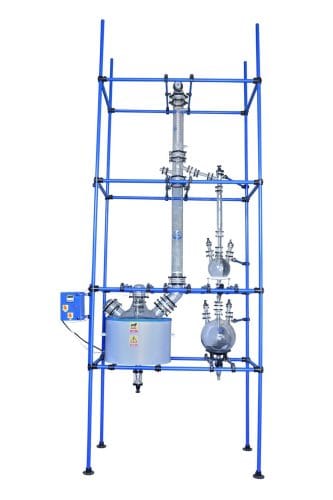
Key Features of the Reflux Distillation System
operational flexibility. Each feature contributes to superior process outcomes across diverse chemical applications.
Continuous Vapor Condensation and Reflux Cycle
High Efficiency Separation of Chemical Mixtures
Precision Temperature and Pressure Control
Corrosion-Resistant Materials for Chemical Processing
Suitable for Vacuum and Atmospheric Operations
Designed for Laboratory, Pilot, and Industrial Use
Reflux Reaction Distillation System Configurations
Laboratory Reflux Distillation Unit
- Configuration: Compact glass assembly with manual controls, precise heating, and integrated condenser.
- Suitable usage: Academic research, process development, and small-scale synthesis requiring flexibility and visual monitoring of reactions.
Pilot Plant Reaction Distillation System
- Configuration: Scaled-up system with PLC-based control, automated reflux ratio management, and enhanced instrumentation.
- Suitable usage: Process scale-up validation, clinical batch production, and intermediate-scale chemical manufacturing.
Industrial Reflux Distillation Column
- Configuration: Large-capacity system with full automation, continuous feed capability, and integrated safety interlocks.
- Suitable usage: Commercial chemical production, petrochemical processing, and high-volume solvent recovery operations.
Applications of Reflux Reaction Distillation Systems
Chemical Solvent Purification
Recovery and purification of solvents to high purity for reuse in manufacturing processes.
Organic Synthesis Reactions
Controlled reaction environments with simultaneous product removal to drive equilibrium-limited reactions.
Pharmaceutical Compound Processing
Purification of active pharmaceutical ingredients (APIs) and intermediates under precise conditions.
Petrochemical Distillation Processes
Separation of hydrocarbon fractions and purification of specialty chemicals.
Research Laboratory Chemical Reactions
A versatile platform for developing and optimizing new synthetic routes.
Fine Chemical Production
High-purity manufacturing of specialty chemicals, fragrances, and intermediates.
deliver reliable performance across pharmaceutical, petrochemical, and fine chemical applications.
How the Reflux Reaction Distillation System Works
Feed mixture enters reactor or distillation column
Raw materials or reaction mixture are charged into the jacketed reactor vessel.
Heating a chemical mixture generates vapor
Controlled heating raises the temperature, causing volatile components to vaporize.
Vapor rises and condenses in the reflux condenser
Hot vapor travels to the overhead condenser, where cooling converts it back to liquid.
Condensed liquid is returned to the reactor as reflux
A portion of the condensed liquid is recycled back into the reactor, enabling multiple purification cycles.
Separation and purification of components occur
The continuous reflux cycle progressively enriches the desired components, with the purified product collected via distillate take-off.
Why Choose Us
backed by superior manufacturing standards. We provide customized system design,
automation integration, and process optimization expertise for reliable industrial performance.

K-Jhil Promise in Quality

Innovative Approach

Automation Expertise

Trouble-Free Processes

Tailored Process Solutions

Customer-Centric Approach
K-Jhil Promise in Quality
Innovative Approach
Automation Expertise
Automation Expertise
Tailored Process Solutions
Customer-Centric Approach
Reflux Reaction Distillation System FAQs
What is reflux distillation?
Reflux distillation is a separation technique where vapor from a boiling mixture is condensed and returned to the original vessel. This continuous cycle enables multiple vaporization-condensation stages, significantly improving separation efficiency, especially for components with closely spaced boiling points.
How does a reflux reaction distillation system work?
The reflux distillation process involves heating a chemical mixture in a reactor. Vapor rises to a condenser, where it is cooled and returned as liquid reflux. This cycle enriches the concentration of volatile components, enabling precise separation and purification while allowing simultaneous reaction and distillation.
What industries use reflux distillation equipment?
What is the role of reflux in distillation columns?
Reflux provides the liquid flow down the distillation column that contacts rising vapor. This countercurrent interaction enables repeated vaporization and condensation, achieving the high separation efficiency required for components with similar boiling points.
What are the advantages of reflux distillation in chemical processing?
Advantages include: higher product purity for close-boiling mixtures; the ability to combine reaction and separation in a single unit; reduced processing time; lower energy consumption compared to multiple passes; and enhanced control over exothermic reactions through controlled reflux.