
Reliable Liquid-Liquid Extraction
System for Chemical Separation
Our liquid-liquid extraction unit delivers high mass transfer efficiency across pharmaceutical, chemical, and industrial applications.
Liquid-Liquid
Extraction System
Our liquid-liquid extraction equipment is engineered for applications where distillation is impractical, such as separating heat-sensitive compounds, handling azeotropic mixtures, or processing components with close boiling points. The system operates on principles of thermodynamics, hydrodynamics, and mass transfer to achieve refined separation with minimal energy consumption. Unlike energy-intensive distillation, our chemical extraction system offers gentle processing that preserves thermally sensitive components while delivering high-purity extracts. Available for both batch and continuous operations, our systems are designed for pharmaceutical purification, chemical processing, metal recovery, and solvent recycling applications.
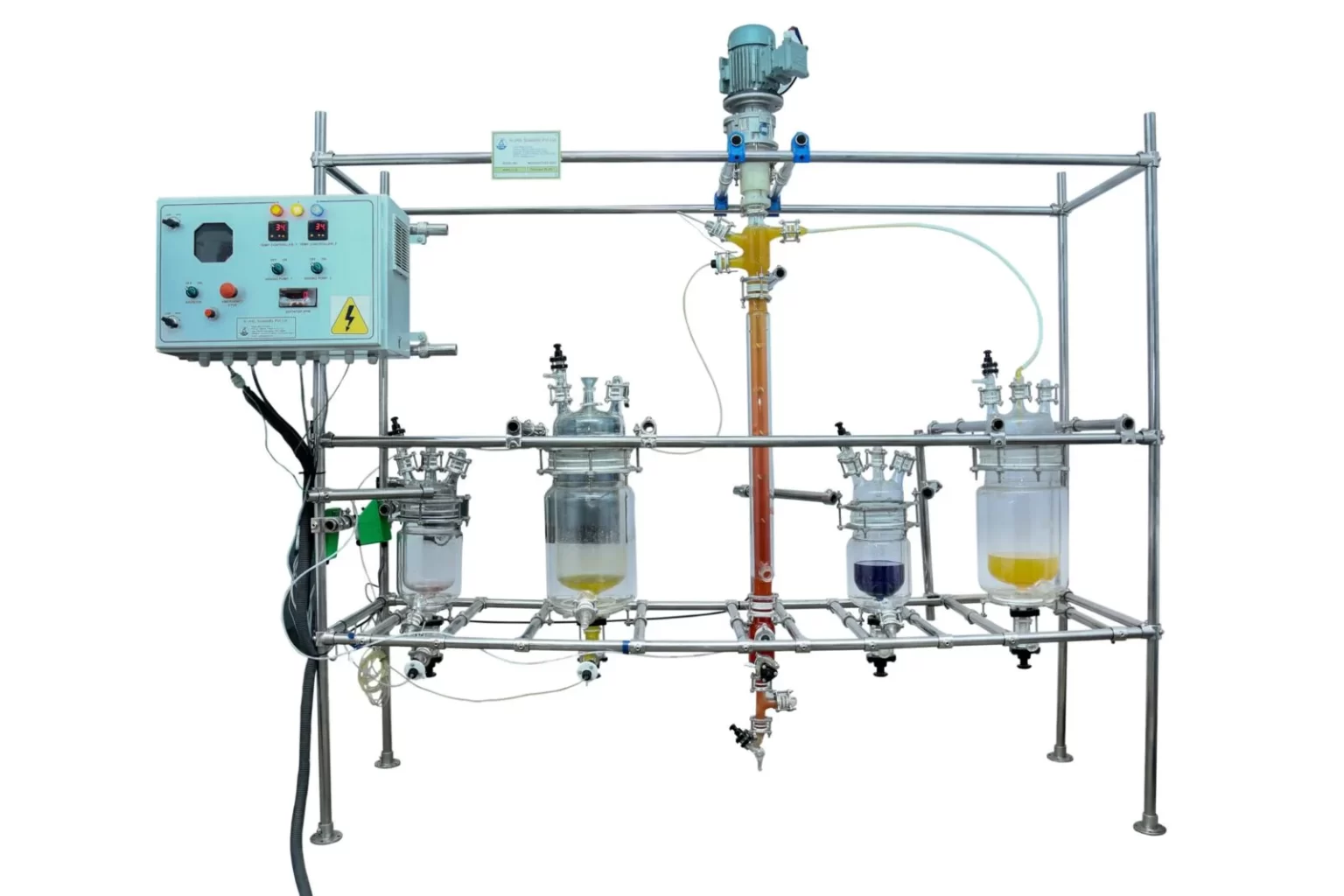
Key Features of Liquid-Liquid Extraction Equipment
Each feature addresses specific separation challenges across diverse industries.
High Efficiency Solvent Extraction
Advanced Phase Separation Design
Low Energy Consumption Compared to Distillation
Flexible Batch or Continuous Operation
Corrosion-Resistant Construction
Modular and Scalable System Design
Liquid-Liquid Extraction Plant Configurations
Laboratory Liquid Extraction System
- Configuration: Compact glass or small-scale stainless steel unit with manual controls.
- Suitable usage: Research and process development, solvent screening, and small-batch sample preparation.
Pilot Scale Extraction Unit
- Configuration: Scaled system with PLC-based control, flow monitoring, and data logging capabilities.
- Suitable usage: Process optimization, scale-up validation, and clinical batch production.
Industrial Extraction Plant
- Configuration: Large-scale continuous system with full automation, integrated solvent recovery, and advanced process control.
- Suitable usage: Large-scale chemical production, commercial pharmaceutical manufacturing, and high-volume metal recovery operations.
Applications of Liquid-Liquid Extraction Systems
Pharmaceutical Compound Purification
Isolation of active pharmaceutical ingredients (APIs), removal of impurities, and recovery of high-value intermediates from reaction mixtures.
Chemical Product Separation
Purification of organic chemicals, removal of color bodies, and separation of reaction by-products in fine chemical manufacturing.
Solvent Recovery Processes
Recovery and recycling of valuable solvents from process streams, reducing chemical consumption and waste disposal costs.
Metal Extraction and Hydrometallurgy
Selective extraction of copper, uranium, rare earth elements, lithium, and precious metals from leach solutions.
Wastewater Pollutant Removal
Removal of dissolved organic compounds, phenols, oils, and heavy metals from industrial effluent before discharge.
For efficient, low-energy compound separation, K-JHIL’s liquid-liquid extractor delivers reliable performance
across pharmaceutical, chemical, metallurgical, and environmental applications.
How the Liquid-Liquid Extraction System Works
Feed liquid introduction
The feed stream containing the target compound enters the extraction system at a controlled flow rate.
Addition of extraction solvent
An immiscible extraction solvent is introduced, typically in countercurrent flow to maximize the mass-transfer driving force.
Mixing and mass transfer stage
Intimate contact between phases, via agitation or static mixing, allows the target compound to transfer from the feed phase to the solvent phase according to its partition coefficient.
Phase separation of extract and raffinate
The mixed phases flow to a settling zone where gravity separation creates distinct layers. These are the extract (solvent with the target) and the raffinate (depleted feed).
Recovery of purified compound
The extract phase is discharged for downstream solvent removal and product recovery, while the raffinate is discharged for further processing or disposal.
Why Choose Us
With deep expertise in chemical separation equipment, K-JHIL delivers custom designs for liquid extraction processes.
Our liquid extraction equipment manufacturer solutions provide reliable performance, advanced engineering,
process optimization, and comprehensive installation and technical support.

K-Jhil Promise in Quality

Innovative Approach

Automation Expertise

Trouble-Free Processes
Tailored Process Solutions

Customer-Centric Approach
K-Jhil Promise in Quality
Innovative Approach
Automation Expertise
Trouble-Free Processes
Tailored Process Solutions
Customer-Centric Approach