

High-Performance Jacketed Glass
Reactor System Manufacturer
Jacketed Glass
Reactor System
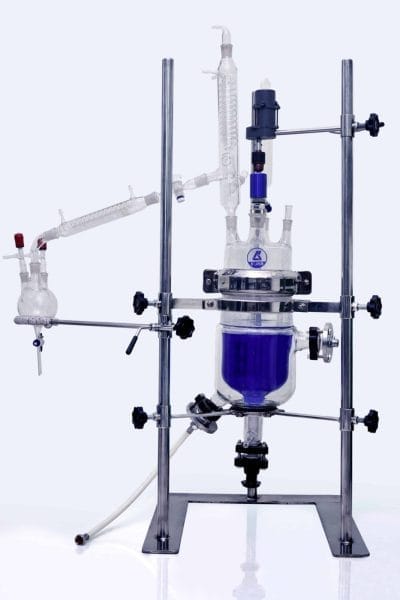
Key Features of Jacketed Glass Reactor Unit
Each feature contributes to superior process outcomes across demanding chemical applications.
Precise Heating and Cooling Control
High Chemical Resistance Borosilicate Glass
Excellent Visibility of Reaction Process
Vacuum and Pressure Operation Capability
High-Efficiency Mixing and Agitation
Modular and Customizable Design
Jacketed Glass Reactor System Configurations
Laboratory Glass Reactor System
- Configuration: Compact benchtop unit with manual controls, integrated heating/cooling circulator, and complete glass assembly.
- Suitable usage: Small-scale R&D reactions, method development, and academic research requiring flexibility and visual monitoring.
Pilot Scale Jacketed Reactor
- Configuration: Scaled system with PLC-based control, automated temperature regulation, and enhanced instrumentation for data logging.
- Suitable usage: Scaled system with PLC-based control, automated temperature regulation, and enhanced instrumentation for data logging.
Industrial Glass Reactor System
- Configuration: Large-capacity unit with full automation, continuous process integration, and advanced safety interlocks.
- Suitable usage: Continuous production applications, commercial manufacturing, and high-throughput chemical processing.
Applications of Jacketed Glass Reactor Systems
Pharmaceutical API Synthesis
Controlled reaction environments for active pharmaceutical ingredient development and production.
Fine Chemical Manufacturing
Precision synthesis of specialty chemicals, intermediates, and high-value compounds.
Polymer and Catalyst Reactions
Polymerization studies, catalyst testing, and material synthesis with precise thermal control.
Crystallization and Extraction Processes
Controlled cooling crystallization and solvent extraction with real-time visual monitoring.
Chemical Process Development
Optimization of reaction parameters, scale-up studies, and process validation.
performance across pharmaceutical, chemical, and research applications.
How the Jacketed Glass Reactor System Works
Charging of reactants into the glass vessel
Raw materials, solvents, and catalysts are loaded into the reactor through the top port under controlled conditions.
Temperature control via jacket circulation
Temperature-controlled fluid circulates through the double jacket, precisely maintaining the setpoint for heating or cooling reactions.
Mixing and reaction process
Variable-speed agitator ensures uniform mixing, heat distribution, and mass transfer throughout the reaction vessel.
Monitoring and parameter control
Real-time observation through transparent glass combined with sensors for temperature, pressure, and pH enables precise process management.
Product discharge and collection
Completed reaction mixture is discharged through the bottom valve for downstream processing or final collection.
Why Choose Us
with custom reactor configurations. Our systems ensure reliable performance for chemical processes,
backed by comprehensive engineering support and installation assistance.

K-Jhil Promise in Quality

Innovative Approach

Automation Expertise

Trouble-Free Processes

Tailored Process Solutions

Customer-Centric Approach
K-Jhil Promise in Quality
Innovative Approach
Automation Expertise
Automation Expertise
Tailored Process Solutions
Customer-Centric Approach
Jacketed Glass Reactor System FAQs
What is a jacketed glass reactor?
A jacketed glass reactor is a vessel with a dual-layer glass construction. Temperature-controlled fluid circulates through the outer jacket to precisely heat or cool the reaction mixture in the inner vessel, enabling controlled chemical synthesis, mixing, and crystallization.
How does a double-jacketed glass reactor work?
The double jacketed reactor uses a circulating temperature control unit (heating/cooling bath) to pump fluid through the jacket surrounding the reaction vessel. This fluid transfers heat to or from the reaction mixture, maintaining uniform temperature throughout the process, while the transparent walls allow visual monitoring.
What industries use glass reactor systems?
Key industries include pharmaceutical manufacturing (API synthesis), fine chemical production, polymer research, specialty materials development, and academic laboratories conducting organic synthesis and process development.
What temperature range can the reactor operate in?
Our systems accommodate a wide operating range, typically from -20°C to +200°C, depending on the circulating fluid used. Custom configurations can extend this range for specific low-temperature or high-temperature applications.