

Advanced Reactive Distillation System Manufacturer
Our reactive distillation equipment delivers high conversion, superior selectivity, and reduced operational costs.
Reactive Distillation System
Our reactive distillation system is designed to overcome equilibrium limitations in reversible reactions by continuously removing products as they form, shifting the equilibrium toward higher conversion. This process intensification approach delivers exceptional benefits: reduced capital investment, lower energy consumption, improved product yield, and enhanced selectivity. The technology is particularly effective for reactions such as esterification, etherification, and hydrolysis, where traditional batch processing would require multiple steps and extensive purification.
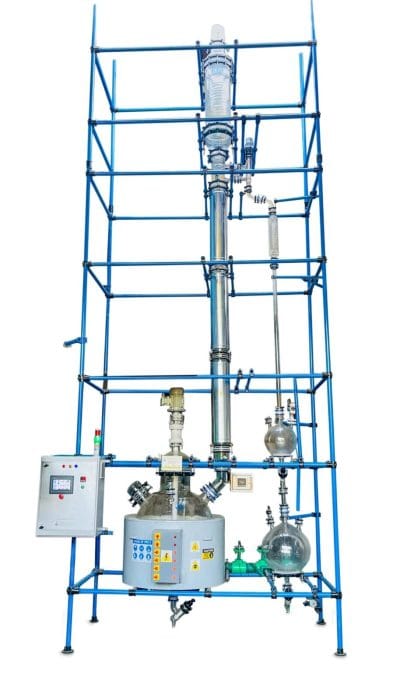
Key Features of Reactive Distillation Equipment
Each feature contributes to superior outcomes across diverse chemical manufacturing applications.
Single Unit Performing Reaction and Separation
Reduced Energy Consumption in Chemical Processing
High Conversion and Product Selectivity
Compact and Space-Saving System Design
Integrated Catalyst Bed for Reaction Control
Efficient Heat and Mass Transfer Performance
Reactive Distillation System Configurations
Laboratory Scale Reactive Distillation Unit
- Configuration: Compact glass or stainless steel column with manual controls and integrated catalyst section.
- Suitable usage: Process development, catalyst screening, and feasibility studies for new reactions in R&D environments.
Pilot Plant Reactive Distillation System
- Configuration: Scaled system with PLC-based automation, variable catalyst loading, and comprehensive instrumentation.
- Suitable usage: Process scale-up validation, optimization studies, and small-batch production of specialty chemicals.
Industrial Reactive Distillation Column
- Configuration: Large-capacity column with full SCADA integration, continuous feed capability, and automated product take-off.
- Suitable usage: Commercial chemical manufacturing, high-volume production of esters, ethers, and fine chemicals.
Applications of Reactive Distillation Systems
Esterification Reactions for Chemical Production
Synthesis of methyl acetate, ethyl acetate, butyl acetate, and other esters with simultaneous product separation.
Etherification and Alcohol Dehydration Processes
Production of MTBE, ETBE, and other ethers; dehydration of alcohols to alkenes.
Production of Specialty Chemicals
High-purity manufacturing of fragrances, flavors, and fine chemical intermediates.
Pharmaceutical Intermediate Manufacturing
Synthesis of high-value intermediates with tight purity specifications.
Petrochemical Reaction Separation Processes
Recovery and purification of olefins, aromatics, and other hydrocarbon derivatives.
Fine Chemical and Solvent Processing
Production of high-purity solvents with integrated purification.
unmatched efficiency across pharmaceutical, petrochemical, and specialty chemical applications.
How the Reactive Distillation System Works
Feed reactants enter the reactive distillation column
Liquid reactants are introduced at strategic points along the column, typically above or within the catalyst section.
Catalytic reaction occurs inside the column
As reactants flow through the catalyst-packed section, chemical transformation takes place under controlled temperature and pressure.
Simultaneous vapor-liquid separation process
Heat applied to the reboiler generates vapor that rises through the column, contacting descending liquid.
Reaction products separated during distillation
Products with lower boiling points are continuously removed in the distillate, driving the reaction toward completion.
Final purified product collected from column outlets
High-purity product is recovered from distillate or bottoms streams, ready for downstream use or storage.
Why Choose Us
distillation equipment backed by superior manufacturing standards. We provide custom system design,
process automation integration, and reliable after-sales support for optimized industrial performance.

K-Jhil Promise in Quality

Innovative Approach

Automation Expertise

Trouble-Free Processes

Tailored Process Solutions

Customer-Centric Approach
K-Jhil Promise in Quality
Innovative Approach
Automation Expertise
Automation Expertise
Tailored Process Solutions
Customer-Centric Approach