
Fractional distillation is widely used in petroleum refining, chemical processing, and alcohol production, often involving multi-stage separation and multiple product streams.
It is an extremely important separation process. This is particularly true for industrial needs.
Even the fractional distillation unit is a complex piece of equipment in its own right.
But once you understand each part, understanding it becomes much easier.
To help you understand the job of each component, I have created this guide. With this, you will understand how these parts enable liquid separation.
Let’s begin by first understanding the basics.
How Does a Fractional Distillation Unit Function?
Before we get into the components, let’s first understand the entire system.
The fractional distillation unit’s working principle is quite simple. Fractional distillation is based on repeated vaporization and condensation (vapor-liquid equilibrium), allowing separation of components with close boiling points.
As the liquid boils, it turns into vapor. Vapor rises through the column and undergoes repeated condensation and re-vaporization, improving separation efficiency.
You might be thinking, “Isn’t that just simple distillation?” No, because fractional distillation goes a step beyond.
The main benefit of a fractional distillation system is that it allows even liquids with similar boiling points to separate.
It uses a tall column that alternates between evaporation and condensation. This allows a more effective separation.
The column operates with a temperature gradient, with higher temperatures at the bottom and lower temperatures at the top. This allows different components to condense at different heights within the column.
Moreover, fractional distillation also allows a much higher purity of the separated liquids.
Main Components of a Fractional Distillation Unit
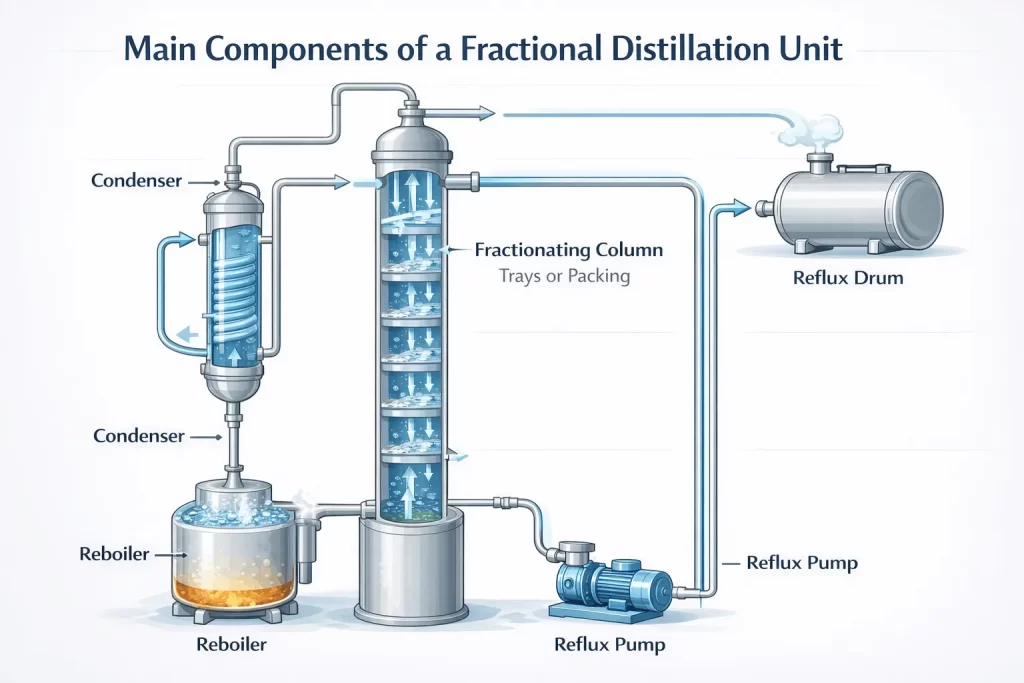
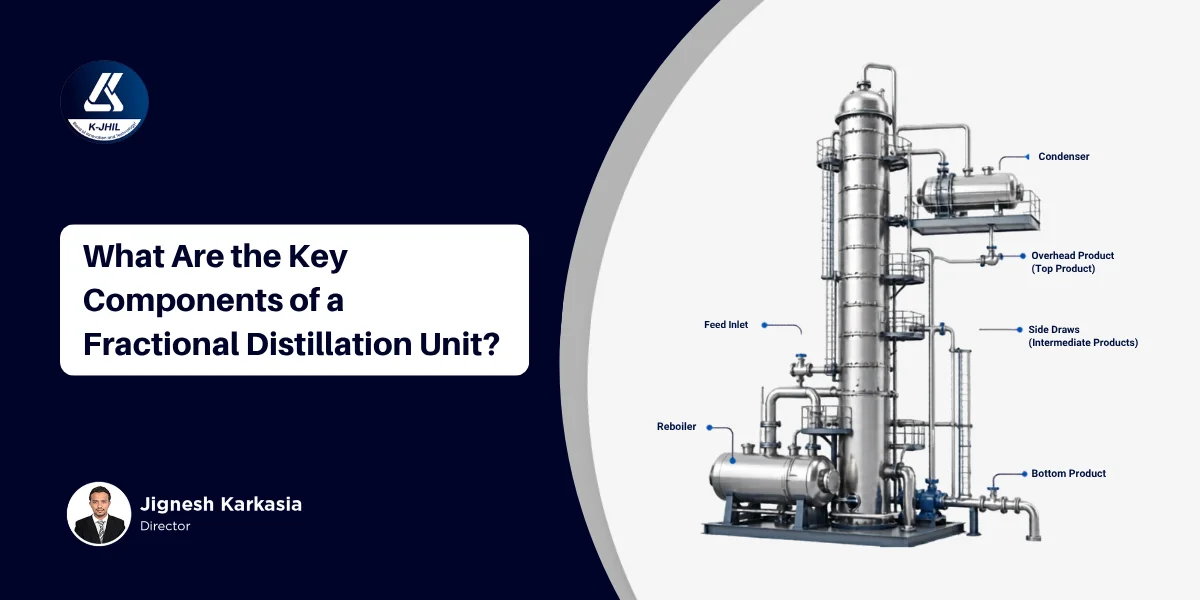
Here are the key parts of fractional distillation equipment:
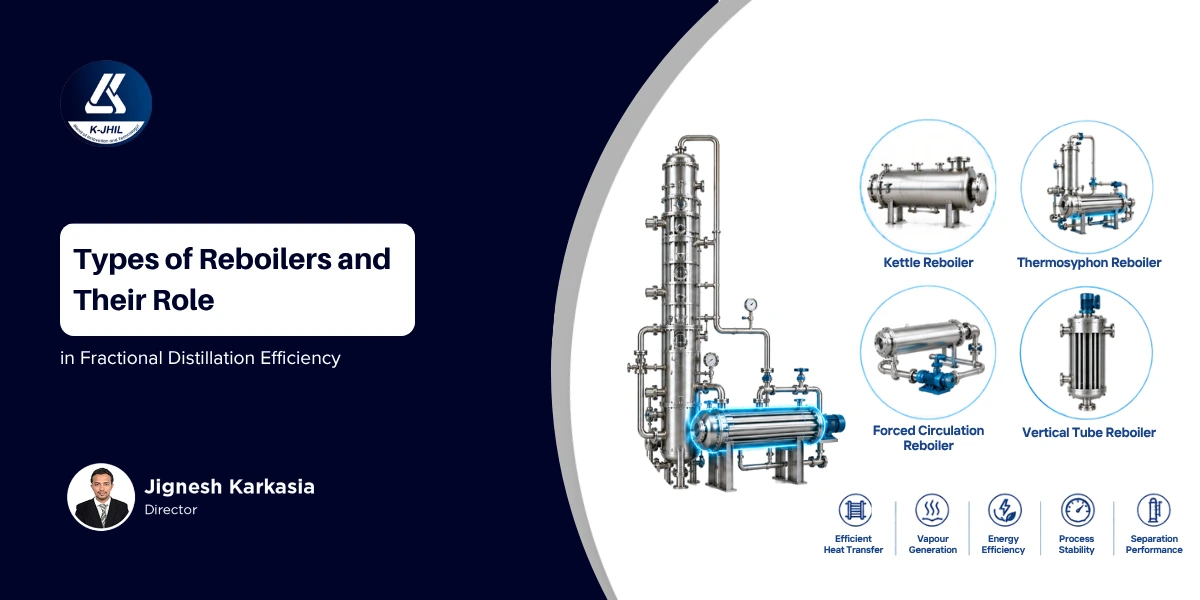
Reboiler
A reboiler is the heat source that sits at the bottom of the system.
The primary job of this reboiler is to heat the liquid mixture until it begins to boil.
The reboiler uses steam, thermal oil, or electrical heating to vaporize the liquid mixture.
A reboiler is a very important tool in this process. Without enough heat, the separation cannot even begin.
Feed Inlet
The feed inlet introduces the mixture into the column at an optimal stage based on its composition. This ensures efficient separation by allowing the feed to enter at the correct temperature and concentration zone within the column.
Fractionating Column
This is the main tall tower where the actual separation happens.
The fractionating column provides space for vapor and liquid to interact. It provides a large surface area for more effective extraction in chemistry.
In this column, vapor continues to rise as liquid trickles slowly down. This creates a more effective extraction of the target compound.
Everything about the column is thus tuned to maximize purity levels of the separated liquid.

Column Internals: Trays or Packing
It is important to note that distillation columns come in various designs. The main types based on the material used within the column include:
Type | How It Works | Best For |
Trays | Perforated plates with weirs and downcomers that control liquid flow while vapor bubbles through. | High liquid flow rates, easier to clean |
Packing | Packing provides a high surface area for vapor-liquid contact, improving mass transfer efficiency and separation performance. | Lower pressure drop, better separation efficiency |
Even distillation column trays have different designs. These include:
- Sieve Trays: Have holes to help vapor pass through
- Bubble Cap Trays: Use caps to force vapor through liquid
- Valve Trays: Provides a good balance between cost and efficiency
For packing materials, many different types of elements are used. This can be either metal rings or even structured patterns.
Structured packing provides better separation but usually costs more.
Condenser
In fractional distillation, any condenser sits mainly at the top of the column.
The main job of this condenser is to cool the vapors rising within the column. This turns them back into a liquid for separation.
Condensers can be total or partial, depending on whether all or only part of the vapor is condensed.
Cooling water or coolants are used to make this possible. These run through tubes to remove heat and help in the condensation process.
Reflux Drum
This is a unique vessel that collects the condensed liquid given by the condenser.
From there, the reflux drum collects condensed liquid and splits it into reflux (returned to the column) and distillates the product.
Often, some liquid is also flown down into the column as “reflux”. Reflux returns a portion of condensed liquid back to the column to improve separation efficiency.
Reflex Pump
This is the main pump that sends the reflux liquid back to the column. It ensures a steady flow of liquid within the trays or packing.
How the Fractional Distillation Unit Works Using These Parts:
- Feed enters the column
- The reboiler heats the mixture to generate vapor
- Vapor rises through trays or packing
- Repeated vapor-liquid contact improves separation
- The condenser cools vapor at the top
- The reflux drum splits the liquid into reflux and product
- The reflux pump returns a portion of liquid back to the column
- Distillate is collected at the top
- Bottom product is removed from the base
Product Streams
Separated components are collected as:
- Distillate (top product)
- Bottoms (residue at the base)

Conclusion
A fractional distillation unit is a very carefully balanced system.
That means that even a small part failure can ruin the entire system. At the very least, such issues can lead to a decline in purity levels.
To avoid maintenance issues or quality problems, use only a trusted supplier.
My recommendation? Consult and partner with K-Jhil Scientific for your fractional distillation unit.
With multiple decades of industrial experience, they are your best choice for industrial lab equipment.
Each product manufactured by this industry titan undergoes rigorous testing and meets strict standards.
Moreover, their world-class team is always ready to provide support. Whether it’s installation or after-sales needs, K-Jhil has got you covered!
So, are you ready to get your own fractional distillation system? Contact K-Jhil Scientific today to discuss your exact requirements!
FAQs
1. What is a fractional distillation unit used for?
A fractional distillation unit separates liquid mixtures into individual components based on boiling points. It’s used to refine crude oil, purify chemicals, and make spirits like whiskey and vodka.
2. What is the main working principle of a distillation unit?
The distillation unit’s working principle is simple: heat the mixture until it boils. The lowest-boiling component vaporizes first. That vapor rises, cools, and condenses back to liquid for collection.
3. What does the condenser do in fractional distillation?
The condenser in fractional distillation cools the hot vapor rising from the column. It turns vapor back into liquid so it can be collected. Cooling water or another coolant flows through the condenser to remove heat.
4. What are distillation column trays, and why are they important?
Distillation column trays are the plates inside the column where vapor and liquid meet. They create many small mixing steps that help separate closely boiling components. Common types include sieve trays, bubble cap trays, and valve trays.
5. What is included in a typical fractional distillation system?
A fractional distillation system includes a reboiler (heat source), a fractionating column with trays or packing, a condenser, a reflux drum, and product collection points. All these parts work together to efficiently separate mixtures.