
Engineered Azeotropic Distillation
Unit for Chemical Separation
close-boiling mixtures. Our azeotropic distillation system enables efficient
solvent dehydration and high-purity chemical recovery for industrial applications.
Azeotropic
Distillation Unit
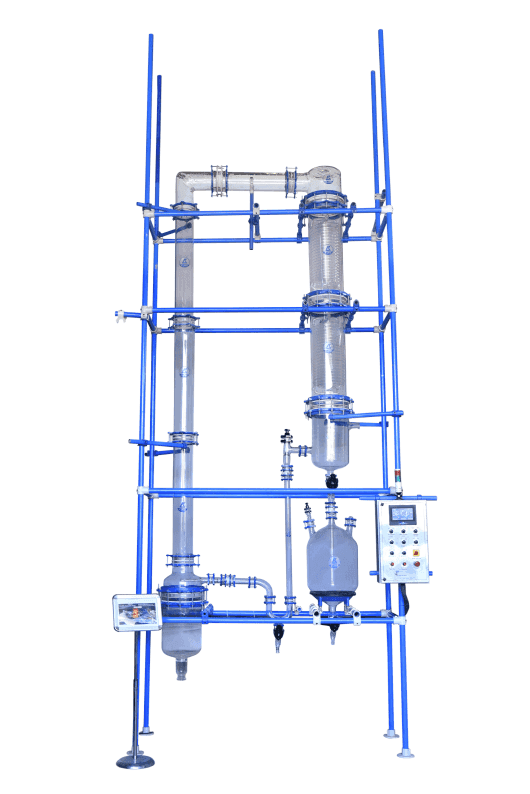
An azeotropic distillation unit is a specialized separation system designed to break azeotropes. These are mixtures in which the vapor and liquid compositions are identical, making them impossible to separate by conventional distillation. Our azeotropic distillation apparatus overcomes this limitation by introducing a third component, known as an entrainer, which alters the vapor-liquid equilibrium and enables clean separation of the target components.
The azeotropic system operates by feeding the azeotropic mixture into a distillation column along with a carefully selected entrainer. The entrainer selectively interacts with one component, breaking the azeotrope and allowing the desired component to be purified through sequential vaporization and condensation stages. This technology is essential for applications such as ethanol dehydration (breaking the ethanol-water azeotrope), solvent recovery from complex mixtures, and purification of pharmaceutical intermediates.
Key Features of Azeotropic Distillation Equipment
and industrial reliability. Each feature addresses specific challenges in azeotrope breaking.
High Efficiency Separation of Azeotropic Mixtures
Precise Temperature and Pressure Control
Corrosion-Resistant Construction Materials
Efficient Heat Transfer and Condensation System
Automated Process Monitoring
Custom Design for Industrial Applications
Azeotropic Distillation Unit Configurations
Laboratory Scale Distillation System
- Configuration: Compact glass or small-scale stainless steel unit with manual controls for entrainer addition.
- Suitable usage: Azeotrope characterization, entrainer screening, and process development for new applications.
Solvent Recovery
- Configuration: Scaled system with PLC-based control, automated entrainer feed, and data logging capabilities.
- Suitable usage: Process validation, scale-up studies, and small-batch production for specialty chemicals.
Extract Pure Chemicals
- Configuration: Large-capacity continuous system with full automation, integrated entrainer recovery, and advanced process control.
- Suitable usage: Commercial solvent dehydration, bulk chemical purification, and high-volume pharmaceutical production.
Applications of Azeotropic Distillation Systems
Ethanol Dehydration and Alcohol Purification
Breaking the ethanol-water azeotrope to produce anhydrous alcohol (99.5%+ purity) for fuel, pharmaceutical, and industrial use.
Chemical Solvent Recovery
Purification of solvents from complex mixtures where conventional distillation fails due to azeotrope formation.
Pharmaceutical Compound Purification
Isolation of high-purity drug intermediates and final products from azeotropic reaction mixtures.
Petrochemical Processing
Separation of hydrocarbon azeotropes and purification of specialty chemicals in refining operations.
Specialty Chemical Production
High-purity manufacturing of fine chemicals, fragrances, and flavors requiring azeotrope breaking.
Industrial Solvent Separation
Recovery and purification of solvents from mixed waste streams with close-boiling components.
reliable performance across chemical, pharmaceutical, and industrial applications.
How the Azeotropic Distillation Process Works
Feed mixture enters distillation column
The azeotropic mixture (e.g., ethanol-water) is fed into the distillation column at the optimal entry point.
Entrainer is introduced into the system
A carefully selected entrainer (such as benzene, cyclohexane, or toluene) is added to alter the vapor-liquid equilibrium.
Vapor-liquid equilibrium changes
The entrainer selectively interacts with one component, breaking the azeotrope and creating new separation pathways.
Separation by azeotropic distillation
Components separate based on their new boiling-point differences; the entrainer forms a low-boiling ternary azeotrope that is removed overhead.
Condensation and product recovery
The purified target component is collected from the column bottom, while the entrainer is recovered and recycled for continuous operation.
Why Choose Us
With deep engineering expertise in chemical process systems, K-JHIL delivers custom azeotropic
distillation solutions backed by high-quality manufacturing. Our reliable industrial equipment
provides efficient separation for the most challenging azeotropic mixtures.

K-Jhil Promise in Quality
Innovative Approach
Automation Expertise
Trouble-Free Processes
Tailored Process Solutions
Customer-Centric Approach
K-Jhil Promise in Quality
Innovative Approach
Automation Expertise
Automation Expertise
Tailored Process Solutions
Customer-Centric Approach
Azeotropic Distillation Unit FAQs
What is azeotropic distillation?
Azeotropic distillation is a specialized separation technique used to break azeotropes. These are mixtures where components have identical composition in both liquid and vapor phases, making them impossible to separate by conventional distillation. It uses an additional component (entrainer) to alter the vapor-liquid equilibrium.
How does an azeotropic distillation unit work?
What industries use azeotropic distillation equipment?
What is an entrainer in azeotropic distillation?
An entrainer is a third component added to an azeotropic mixture to alter its vapor-liquid equilibrium. Common entrainers include benzene, cyclohexane, toluene, and diethyl ether. The entrainer is selected based on its interaction with the target components and is typically recovered and recycled within the system.