
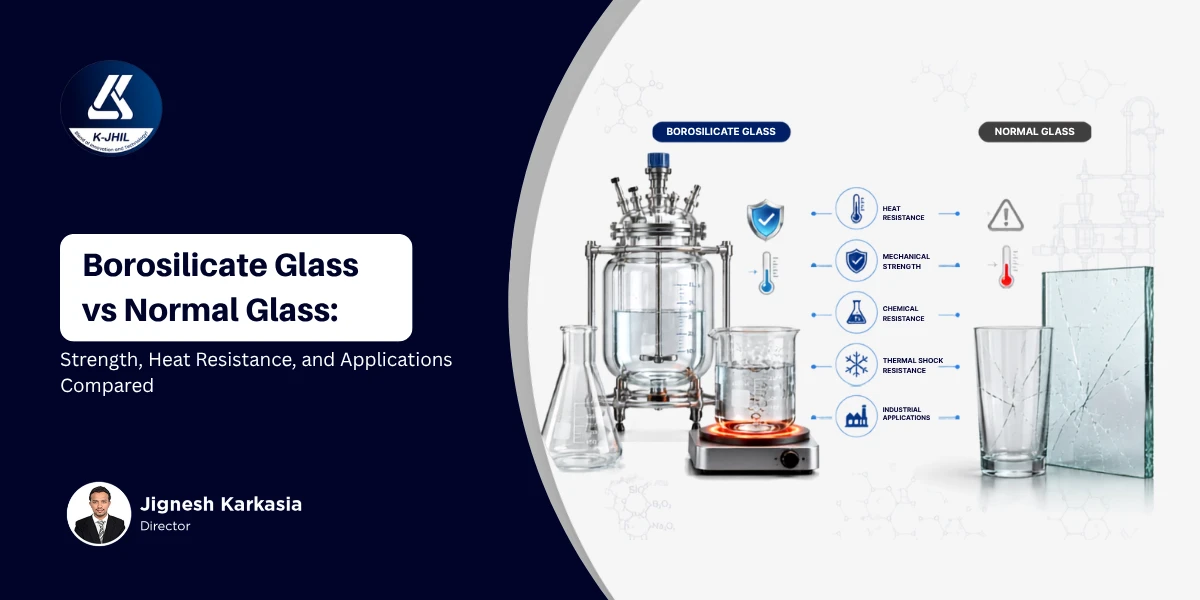
Strip the borosilicate glass vs normal glass debate right down and one number runs all of it: how far the glass grows when it gets hot. Borosilicate hardly stirs, maybe a third of what soda-lime does, and the reason is the 13% or so of boron trioxide baked in.
Picture it on the bench. A borosilicate beaker takes a 160 degree jump and could not care less; cheap glass can split at a 40 degree one. Which is why labs and plants grab borosilicate on reflex, and why nobody should overpay for it in a window or a water glass.
Borosilicate costs more. Every buyer who calls me already knows that bit. What they actually want settled is whether the extra rupees buy them anything on the job sitting in front of them.
That hangs entirely on what the glass has to put up with. I have bought it for plain windows and for reactors, two jobs about as far apart as they come, and the grade that is right for one is either a waste or a hazard in the other.
Five Things That Actually Matter
Forget the brochure language. Boil it down and five things decide the whole thing.
- Thermal shock. A borosilicate vessel rides out a 160 degree swing; soda-lime can quit at 40 to 60.
- Acids and solvents slide off borosilicate. Soda-lime they slowly eat, until it goes milky.
- Heat and pressure together? Borosilicate keeps its shape. Soda-lime is a lot softer about it.
- Nothing bleeds out of borosilicate into what it holds, which is the whole reason drug makers trust it.
- Soda-lime wins on price, flat out, and for the right job that is the only argument worth having.
So What Is Borosilicate Glass, Really?
The Composition That Changes Everything
At heart it is silica glass with boron trioxide stirred into the mix. The everyday low-expansion recipe runs near 80% silica, 13% boron trioxide, a few percent sodium or potassium oxide, and a little alumina to round it off.
Boron is the one pulling the load. It clamps the structure down so the glass barely swells under heat, and almost everything else borosilicate does well falls straight out of that.
The Grade You Actually Need
The history is a footnote. What matters when you are speccing equipment is the grade: borosilicate stamped 3.3, named after that expansion figure and held to the ISO 3585 standard. It is what we build our glass reactors and chemical process systems from at K-Jhil Scientific, because on real plant duty nothing lighter holds up.
QUICK STAT: Call it 80% silica and 13% boron trioxide. That sliver of boron is doing nearly all of the work, and it is the single thing that lets borosilicate out-handle ordinary glass on heat and chemistry at once.
What Normal Glass (Soda-Lime) Actually Is
Say normal glass and you almost certainly mean soda-lime. Silica, soda, lime, melted cheaply and by the ton, and it is something near 90% of all the glass ever poured.
It is everywhere, and fair enough. Windows, bottles, jars, the tumbler in your hand, the windscreen on your car, because it is cheap to make and cheap is mostly what those jobs ask for.
The Difference Between Borosilicate Glass and Normal Glass
The difference between borosilicate glass and normal glass really starts with that soda and lime. They drag the melting point and the cost down, which is handy, and they shove thermal expansion up, which is not. Cheap and easy to pour, quick to crack once it heats, that is the bargain you strike.
PRO TIP: Quote lands on your desk saying just glass, no grade? Treat it as soda-lime. Anybody selling the real thing labels it, because they paid for it and want the credit, so a silent spec sheet has already told you what it is.
Types of Borosilicate Glass You’ll Run Into
It is not one single material. Two expansion grades cover nearly everything you will meet across Indian labs and plants.
Grade | Thermal Expansion | Where You See It |
Borosilicate 3.3 | 3.3 x 10^-6 /K | Lab glassware, glass reactors, pipeline, pharma plant |
Borosilicate 5.0 | ~5.0 x 10^-6 /K | Pharma vials, ampoules, syringes sealed to metal |
Neutral / Type I | Low, USP-graded | Injectable drug containers |
For process and lab gear, 3.3 is the one to care about. The 5.0 family mostly exists so glass can be fused to metal in pharma packaging.
You will also see glass sold as neutral or USP Type I. That is a different classification, hydrolytic resistance, which measures how little the surface gives up to water, not how far the glass expands. Type I covers borosilicate, including both 3.3 and 5.0, which is why injectable containers are specified that way.
Borosilicate Glass vs Normal Glass Full Comparison
This is the side by side I hand new procurement staff. Some write it borosilicate glass vs regular glass, same question. Read the numbers as ballpark, since they drift a bit maker to maker.
Property | Borosilicate 3.3 | Normal (Soda-Lime) |
Main additive | Boron trioxide (~13%) | Soda + lime |
Thermal expansion | 3.3 x 10^-6 /K | ~8 to 9 x 10^-6 /K |
Thermal shock tolerance | ~160 C | ~40 to 60 C |
Max continuous use | ~450 to 500 C | Below ~110 C |
Softening point | ~820 C | ~700 C |
Chemical durability | ISO 719 Class 1 | Moderate, etches over time |
Acid resistance | Excellent (except HF) | Fair |
Relative cost | Higher | Low |
Belongs in | Lab, pharma, process | Windows, bottles, tumblers |
The Real Difference Between Borosilicate and Soda-Lime
Keep one word out of all this and keep expansion. Strip the table back and nearly every row is just a knock-on effect of how much each glass swells as it warms.
Thermal Expansion
Soda-lime grows roughly three times more. Warm one face faster than the other and it pulls itself apart, which is thermal shock, and that is what does in the cheap stuff.
Chemical Resistance
Borosilicate holds its ground against acids, salts, and solvents; soda-lime gives way slowly. Park a reagent in storage for a few months and that gap is the entire ballgame.
Cost
On price soda-lime wins hands down, and so it should, that being its job. Borosilicate only earns its premium when the work genuinely asks for it.
Strength and Durability, Compared Honestly
I am not going to sell it as bombproof. On raw hardness there is little between it and soda-lime, so scratch resistance is not the reason to buy it. What it does hold is its shape when heat and load turn up at the same moment.
Drop it, though, and it breaks like any glass on earth. The toughness is against heat and chemistry, not against a tile floor or a clumsy elbow.
Across the audits I have walked, when borosilicate failed it was almost never the glass. A bad clamp, careless heating, a fake passing itself off as 3.3. Show it a little respect and it runs for years.
Borosilicate Glass for High Temperature Applications
Thermal Shock Resistance
Here ordinary glass simply bows out. Borosilicate 3.3 typically withstands thermal shocks of around 160 degrees under standard test conditions, though real performance depends on wall thickness, geometry, and manufacturing quality. Soda-lime can give way at a 40 to 60 degree gap, roughly what hot water into a cold jar will do to it.
Continuous Operating Temperature
Borosilicate 3.3 is generally suitable for continuous service up to about 450 to 500 degrees, and that is a separate property from its 820 degree softening point. It shrugs off being autoclaved again and again, which is what carries it through endless steam sterilization.
WATCH OUT: A big melting number does not make soda-lime heat-proof. Yes, it melts up near 1400 degrees, but it has gone soft and untrustworthy a long, long way before that. The temperature you can work at and the temperature it melts at are nowhere near each other.
QUICK STAT: Borosilicate 3.3 brushes off about a 160 degree shock. Soda-lime caves near 40 to 60. Roughly a 3x margin, bought with one tweak to the chemistry.
Chemical Resistance, and Where Borosilicate Still Fails
What Borosilicate Resists
On standing up to chemicals it is about as good as glass gets, ISO 719 Class 1 if you want it on paper. Water, the bulk of acids, salts, solvents, none of it lays a finger on the glass, which is exactly why reagent bottles, condensers, and reactors are cut from it.
Soda-lime cannot keep that up. Acids, and honestly enough rounds of hot water, etch the surface, fog it, and shed traces into whatever you are keeping in there.
What Still Attacks It
It is not bulletproof, and you want the limits before they find you. Hydrofluoric acid goes straight through it, and hot phosphoric acid and hot strong caustic get there too.
WATCH OUT: Glass does not mean chemically untouchable. Run hydrofluoric acid, hot phosphoric acid, or hot strong caustic and even borosilicate ends up on the losing end, so that job wants a different material altogether.
Is Borosilicate Glass Safe for Food and Health?
Yes, and this is not kitchen fluff. The glass is non-porous and inert, so it picks up no stains or smells and lets nothing of itself leak into your food or drink.
It is the same reasoning behind injectable-drug vials. That is the same borosilicate 3.3 we build reactors and process equipment from, so if it is clean enough for a drug, it is clean enough for anything you eat or drink.
Soda-lime is fine too for cold and room-temperature use. Heat and acid are the catch, where it can etch and shed a little silica over enough rounds. Hot fills, acidic media, or anything held in storage for long, and borosilicate is the safer call.
Borosilicate vs Tempered Glass, a Quick Note
People keep asking how it stacks up against tempered glass. Honestly, different tools for different jobs.
Tempered is usually soda-lime that has been heat-treated so it is strong on impact and breaks safely, which is why it lands in shower screens and phone faces. Snag is, it still expands plenty and still hates a thermal shock.
Borosilicate owns heat and chemistry. Tempered owns impact and safe breakage. Lab and process work, borosilicate; a car window, tempered.
Borosilicate Glass Uses in Laboratory
Common Laboratory Glassware Made from Borosilicate
Walk into a working lab and nearly everything glass on the bench is borosilicate. The borosilicate glass uses in laboratory work stretch across pretty much any vessel that has to meet heat, harsh chemistry, or a tolerance you cannot miss.
- Beakers and flasks that go straight onto hot plates and burners.
- Reagent bottles holding acid for months on end without clouding.
- Condensers and distillation trains cycling hot to cold and back again.
- Class A volumetric ware, where a thermal shift would throw the calibration.
It comes down to consistency, plain and simple. Good laboratory glassware in 3.3 behaves the same through every heat, cool, and wash, and that sameness is the one thing repeatable work cannot do without. Soda-lime in those spots cracks, clouds, or quietly skews the answer.
Top Brands You’ll See in the Indian Market
A rough map of the names you will meet sourcing in India. Field notes, not a recommendation.
Brand | Known For |
Borosil | First to bring borosilicate to India; lab and kitchen glass |
Schott (German) | Original borosilicate; premium lab and pharma tubing |
Budget lab brands | Affordable general glassware; quality varies by batch |
K-Jhil Scientific | Industrial borosilicate process equipment and glass reactors |
Local unbranded | Cheapest; grade often unverified |
Why Process and Pharma Equipment Is Almost Always Borosilicate
Glass Reactor Systems
A glass reactor system has to come through an exothermic batch, jacket heating, and a parade of rough reagents without leaching a thing into the product. Only 3.3 manages that, which is why every credible line of glass reactors out there is built from it.
Pharma and Specialty Chemical Plants
Same tale for a laboratory glass reactor in process development and pilot work. Once the glass has to hold a pharma intermediate worth real money, the material has stopped being a question. Size, jacket, and capacity are all that is left to settle.
How to Tell the Two Apart Without a Lab
Weight, Clarity, and Price Checks
A certificate is not always within reach. Three quick checks get you most of the way on the floor.
Weight first, since for the same size and wall borosilicate sits a shade lighter. Then the edge against the light, where cheap glass often throws a green or blue cast and borosilicate stays clear. Price last, because the genuine article is never the cheapest thing on the rack.
WATCH OUT: The con I see most is soda-lime dressed up as borosilicate, sold at a borosilicate price. On the shelf they look identical; the gap only shows the first time real thermal stress hits. When it matters, buy from a named maker and get the grade and standard in writing.
How to Care for Borosilicate Glass
It is a forgiving material, but a few habits stretch its life out. Take it up and down in temperature slowly when you can, and never set a hot vessel straight onto cold metal.
Clean it with a soft sponge rather than a scourer, so the surface keeps its skin. And steer it well clear of hydrofluoric acid and hot strong caustic, which chew through even good 3.3.
PRO TIP: Check for chips before any heat or pressure job. A little edge chip gathers stress and turns even real 3.3 into a crack waiting to happen, so pull damaged pieces out of service early.
Why Borosilicate Costs More (and Why It Pays Back)
The price gap is real and it is earned. Borosilicate melts up near 1650 degrees where soda-lime goes at about 1450, the raw materials run dearer, and the furnaces work far smaller loads.
Per piece, sure, you pay more. The sum flips once replacements, downtime, and spoiled batches go on the sheet, because a cheap beaker failing mid-reaction costs you the product and the cleanup, not just a beaker.
Every troubled line I have helped shift onto proper 3.3 paid the difference back inside a year, on dropped failures alone. The price tag is the smallest piece of the real cost.
QUICK STAT: Borosilicate melts near 1650 degrees, soda-lime near 1450, and in far smaller furnace runs. That energy-and-scale gap, not some markup, is most of what you pay extra for.
The Five Things to Remember
- That low expansion, 3.3 against soda-lime’s 9 or so, is the whole story; a 160 degree shock is nothing to it while soda-lime quits around 40 to 60.
- It laughs off nearly every chemical bar the awkward three, HF, hot phosphoric, hot caustic; soda-lime etches with time.
- Labs, pharma, chemical plants all default to it, and it autoclaves happily up to about 500 degrees.
- Windows, bottles, a cold glass of water, soda-lime, there is cheaper and perfectly fine.
- You win the extra cost back in failures that never happen, downtime you never eat, and product that stays clean.
Picking the Right Borosilicate Glass for Your Setup
So the Borosilicate Glass vs Normal Glass call rarely turns tricky once the duty is clear. Heat, chemicals, purity, or precision point to borosilicate. Cold, cheap, and decorative, soda-lime is fine.
The real work is finding genuine 3.3 from a maker who will stand behind it, which counts most in process and pharma, where a failure costs far more than the glass.
If you are specifying lab or plant equipment and want it in verified borosilicate 3.3, K-Jhil Scientific has been making industrial glass equipment and chemical processing systems since the 1980s. Worth a call before your next reactor or line hands you a problem.
Borosilicate Glass vs Normal Glass: FAQs
1. What is the main difference between borosilicate glass and normal glass?
Boron. Put about 13% boron trioxide into the glass, and it expands a third as much as soda-lime when heated, and that small change is what keeps it from cracking when the temperature jumps.
2. Is borosilicate glass stronger than normal glass?
On heat and chemicals, easily. On a drop onto a hard floor, not really, because both shatter. So tougher, yes, just not in every sense people mean by the word.
3. Can borosilicate glass go in the oven and microwave?
It can, no trouble. The same glass works at 500 degrees in a lab, so a home oven barely registers for it.
4. Is borosilicate glass safe for food and drink?
Completely. It soaks up no flavors and sheds nothing into what you put in it, which is the exact reason injectable drugs are stored in the stuff.
5. Why do laboratories use borosilicate glass?
Because it does not flinch. Heat it, chill it, dose it with acid, sterilize it on repeat, and it behaves the same way every time, and that sameness is the whole point in science.
6. What does borosilicate 3.3 mean?
The 3.3 is its expansion coefficient, 3.3 millionths per degree. The grade takes its name from that figure and is checked against ISO 3585.
7. Does borosilicate glass break easily?
From heat or chemicals, no, and that is the point of it. From a sharp knock or an old chip, yes, the same as any glass ever made.
8. Is normal glass cheaper than borosilicate?
Much cheaper. Plainer ingredients, far less melting energy, which is why soda-lime is what fills shelves and window frames.
9. Can borosilicate glass resist all chemicals?
Nearly all of them. The three that beat it are hydrofluoric acid, hot phosphoric acid, and hot strong caustic.
10. How can I tell borosilicate from normal glass?
Weigh it, tilt the edge to the light for a green or blue tinge, and clock the price. None of that is proof on its own, so when it matters, get the grade in writing.
11. Is borosilicate glass good for chemical reactors?
It is what they are built from. You get heat tolerance, inertness, and a see-through wall to watch the batch, all in one material.