

Simple Distillation System Manufacturer
for Laboratory & Industrial Use
on boiling point differences. Our simple distillation unit serves laboratory research, solvent recovery,
and industrial chemical processing applications.
Simple Distillation System
A simple distillation system is a fundamental separation technology used to purify liquids or separate components from a liquid mixture based on differences in their boiling points. The process involves heating the liquid mixture in a distillation flask until the more volatile component vaporizes, then passing the vapor through a condenser where it cools and returns to liquid form for collection as purified distillate.
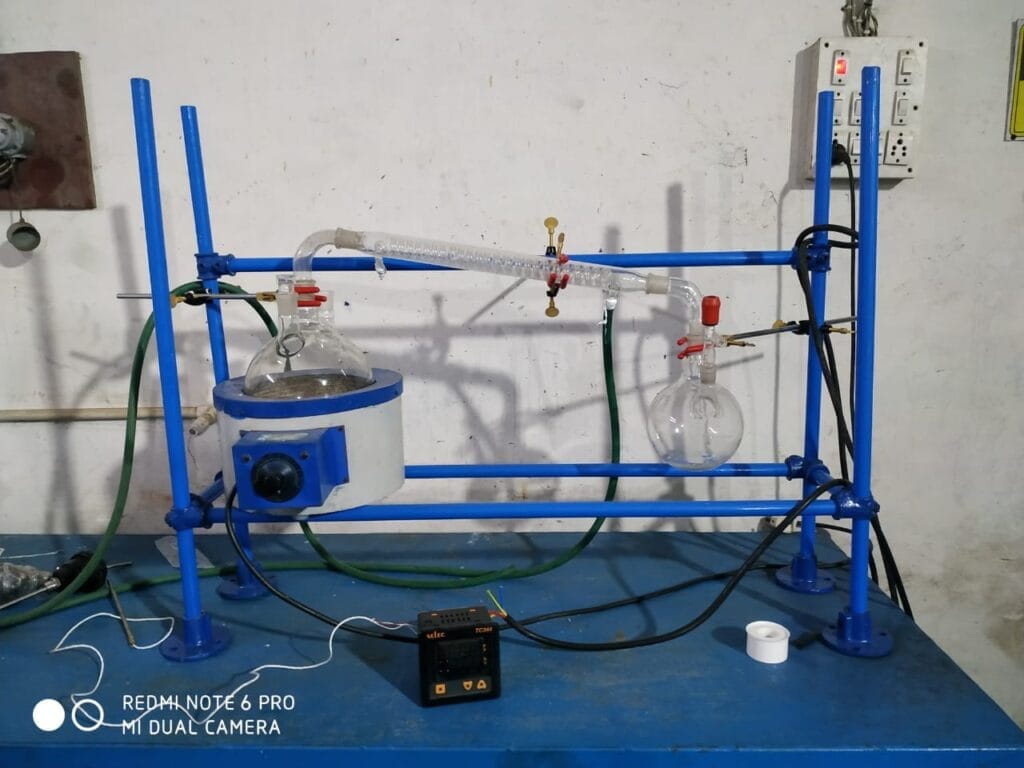
Our simple distillation setup comprises core components, including a heating mantle or oil bath, a distillation flask, a fractionating column (optional), a condenser, and a receiving flask. This straightforward yet effective simple distillation system is ideal for separating liquids with a significant boiling-point difference (typically greater than 25°C) or for purifying non-volatile contaminants from a volatile liquid.
Widely used in chemical, pharmaceutical, and educational laboratories, our systems offer reliable performance for solvent recovery, purification, and small-scale production with minimal complexity.
Key Features of the Simple Distillation Unit
Each component is selected to ensure efficient separation and long service life.
Efficient Separation of Liquid Mixtures
Simple and Easy-to-Operate Distillation Setup
High-Purity Solvent Recovery Capability
Corrosion-Resistant Construction Materials
Suitable for Laboratory and Pilot Plant Operations
Energy-Efficient Heating and Condensation Process
Simple Distillation System Configurations
Laboratory Simple Distillation Setup
- Configuration: Compact benchtop unit with manual heating control and glass condenser assembly.
- Suitable usage: Academic research, quality control labs, and small-scale solvent purification, where flexibility and ease of use are priorities.
Pilot Scale Distillation Unit
- Configuration: Scaled-up system with enhanced heating capacity and larger glass or glass-lined components.
- Suitable usage: Process development, scale-up studies, and small-batch production requiring intermediate volumes.
Industrial Simple Distillation System
- Configuration: Heavy-duty construction with automated temperature control, continuous feed capability, and integrated safety systems.
- Suitable usage: Commercial chemical manufacturing, bulk solvent recovery, and production environments demanding consistent throughput.
Applications of Simple Distillation Systems
Chemical Solvent Purification
Recovery and reuse of spent solvents from chemical reactions and cleaning processes.
Laboratory Research and Experiments
Purification of reaction products and separation of liquid mixtures in R&D settings.
Pharmaceutical Compound Purification
Isolation of active ingredients and removal of volatile impurities from drug intermediates.
Separation of Volatile Liquids from Impurities
Removal of non-volatile residues from solvents and liquid products.
Water Purification and Distilled Water Production
Production of high-purity distilled water for laboratory and industrial use.
Small-Scale Chemical Manufacturing Processes
Batch distillation for specialty chemicals, fragrances, and fine chemical production.
delivers consistent results across laboratory, pilot, and industrial applications.
How the Simple Distillation System Works
Liquid mixture is fed into the distillation flask
The solution containing volatile and non-volatile components is charged into the boiling vessel.
Heat is applied to initiate boiling
Controlled heating raises the temperature to the boiling point of the more volatile component.
Lower-boiling component vaporizes first
The component with the lower boiling point transitions to the vapor phase, leaving less volatile components behind.
Vapor passes through the condenser and cools
Hot vapor travels through the condenser, where cooling water or air removes heat, causing condensation.
Condensed liquid is collected as purified distillate
The now-liquid purified component drips into the receiving flask for collection and further use.
Why Choose Us
backed by quality manufacturing standards. We provide customized distillation system design, automation capabilities,
and comprehensive engineering support for reliable laboratory and industrial performance.

K-Jhil Promise in Quality

Innovative Approach

Automation Expertise

Trouble-Free Processes

Tailored Process Solutions

Customer-Centric Approach
K-Jhil Promise in Quality
Innovative Approach
Automation Expertise
Automation Expertise
Tailored Process Solutions
Customer-Centric Approach
Simple Distillation System FAQs
What is a simple distillation system?
A simple distillation system is a separation apparatus that purifies liquids by heating a mixture to vaporize the more volatile component, then condensing and collecting it as purified distillate. It is used when components have significantly different boiling points.
How does simple distillation work?
The simple distillation process involves heating a liquid mixture in a distillation flask until it boils. The vapor rises, enters the condenser, cools, and returns to a liquid state, then is collected as a purified product. Non-volatile components remain in the distillation flask.
What is the difference between simple and fractional distillation?
Simple distillation is suitable for separating liquids with boiling point differences greater than 25°C. Fractional distillation uses a fractionating column to achieve multiple vaporization-condensation cycles, enabling the separation of liquids with closely spaced boiling points.
What industries use simple distillation equipment?
Key industries include chemical manufacturing (solvent recovery), pharmaceuticals (purification), food and beverage (flavor isolation), laboratories (research), and water treatment (distilled water production).
What are the advantages of simple distillation?
Advantages include straightforward operation, low equipment cost, minimal maintenance, energy efficiency in suitable applications, and the ability to achieve high purity when boiling-point differences are sufficient.