

Reliable Vacuum Ejector System Manufacturer
An advanced vacuum ejector system utilizing the venturi principle for reliable vacuum generation.
Our ejector system for vacuum applications delivers consistent suction for chemical, pharmaceutical,
and industrial processes with no moving parts.
Industrial Vacuum
Ejector System
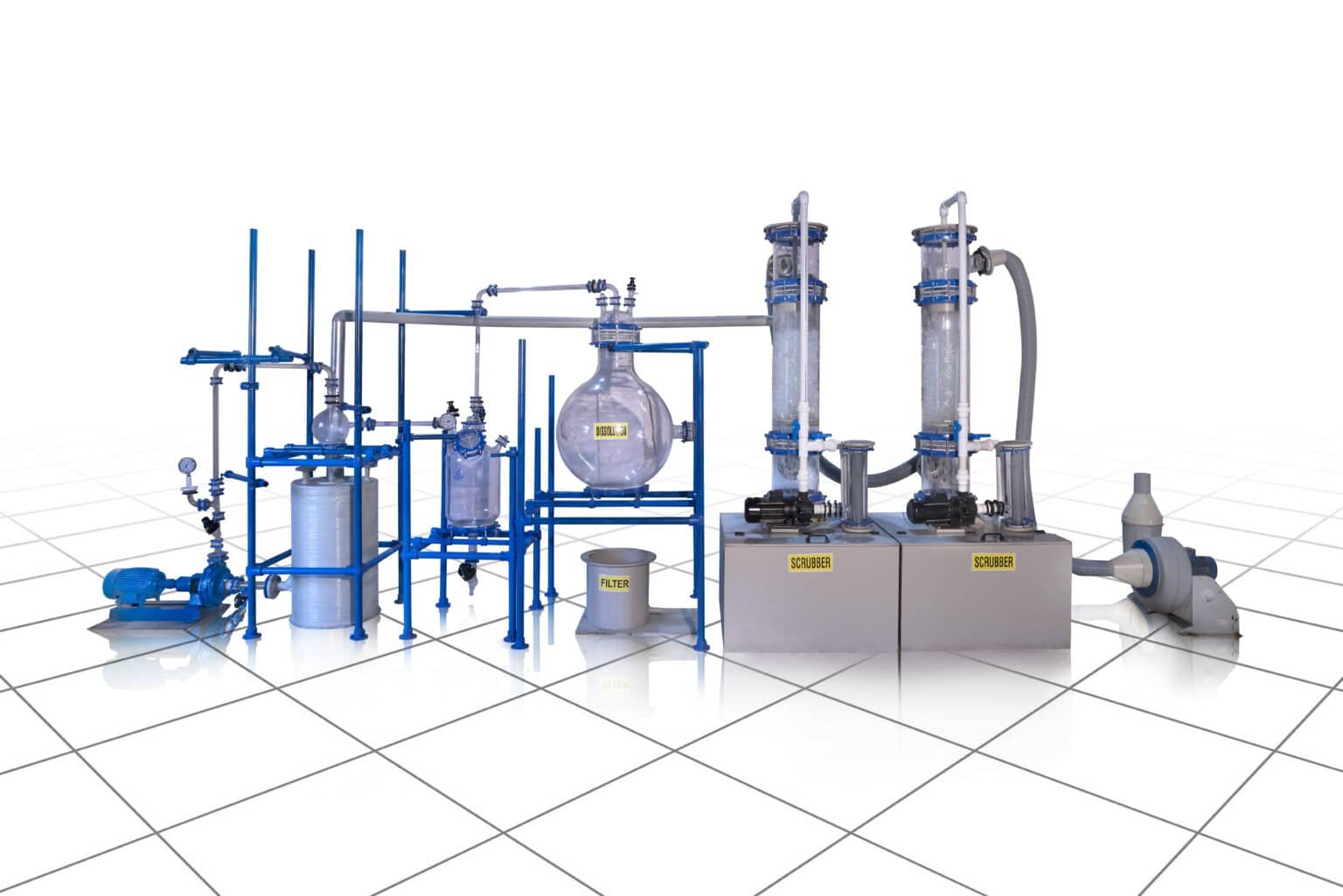
Key Features of the Vacuum Ejector System
The benefits of this technology translate directly to reduced downtime and lower total cost of ownership.
Compact and Lightweight System Design
High Reliability in Industrial Environments
Corrosion-Resistant Industrial Construction
Adjustable Vacuum Levels and Flow Rate
Energy Efficient Vacuum Generation
Suitable for Liquid, Gas, and Vapor Handling
Vacuum Ejector System Configurations
Single Stage Vacuum Ejector Unit
- Configuration: Simple single-nozzle design with one mixing and diffuser stage.
- Suitable usage: Applications requiring moderate vacuum levels, such as material handling, suction lifting, and simple transfer operations.
Multi-Stage Vacuum Ejector System
- Configuration: Multiple ejector stages connected in series with inter-condensers.
- Suitable usage: High-vacuum applications, including vacuum distillation, evaporation, and drying processes in chemical and pharmaceutical plants.
Liquid Driven Vacuum Ejector
- Configuration: Uses high-pressure liquid (water or process fluid) as the motive medium instead of steam or air.
- Suitable usage: Ideal for sump evacuation, tanker unloading, and pumping of mixed-phase streams.
Applications of Vacuum Ejector Systems
Petrochemical Processing Operations
Recovery of hydrocarbon solvents from refinery and petrochemical process streams.
Electronics and Precision Cleaning Industries:
Recycling of high-purity cleaning solvents used in circuit board manufacturing and component degreasing.
Waste Solvent Management and Recycling
Centralized treatment of mixed or single-solvent waste streams for volume reduction and resource recovery.
Food Processing
Vacuum packaging and gentle product handling.
Degassing & Drying
Removal of dissolved gases and moisture from materials.
Semiconductor Manufacturing
Wafer handling and vacuum chamber operations.
performance, from simple material handling to complex multi-stage distillation applications.
How the Vacuum Ejector System Works
High-pressure fluid enters the ejector nozzle
Motive fluid (steam, compressed air, or liquid) at elevated pressure enters the converging-diverging nozzle.
Fluid accelerates, creating a low-pressure zone
As the fluid expands through the nozzle, its velocity increases dramatically, creating a low-pressure region (a vacuum) at the suction port.
Process gases or vapors are drawn into the ejector
The pressure differential entrains suction gases into the high-velocity motive stream.
Mixing occurs inside the ejector chamber
Motive fluid and suction gases mix thoroughly, exchanging momentum and energy.
Diffuser converts velocity into pressure for discharge
The mixture passes through a diverging diffuser, where kinetic energy is converted back to pressure energy, allowing discharge to the atmosphere or to the next stage.
Why Choose Us
We combine customized engineering with process automation capabilities, ensuring your industrial
vacuum equipment performs reliably across demanding chemical and pharmaceutical applications.

K-Jhil Promise in Quality

Innovative Approach

Automation Expertise

Trouble-Free Processes

Tailored Process Solutions

Customer-Centric Approach
K-Jhil Promise in Quality
Innovative Approach
Automation Expertise
Automation Expertise
Tailored Process Solutions
Customer-Centric Approach
Vacuum Ejector System FAQs
What is a vacuum ejector system?
How does a vacuum ejector work?
What industries use vacuum ejector systems?
Key industries include chemical processing (distillation, evaporation), pharmaceutical manufacturing (solvent recovery, drying), food processing (vacuum packaging), semiconductor manufacturing, and any application requiring reliable, maintenance-free vacuum generation.
What is the difference between a vacuum ejector and a vacuum pump?
A venturi vacuum ejector has no moving parts, operates using fluid dynamics, requires minimal maintenance, and handles corrosive or saturated gas streams effectively. A mechanical vacuum pump uses moving parts (vanes, pistons, or rotors), requires lubrication, and is more sensitive to contaminants and moisture.
What are the advantages of venturi vacuum ejectors?
Advantages include: no moving parts for zero maintenance; ability to handle corrosive, wet, or particle-laden gases; compact size; no lubrication requirements; explosion-proof by design; and reliable operation in harsh industrial environments where mechanical pumps would fail.