
What do decaf coffee, penicillin, and perfume have in common with each other?
All of them are created using the liquid liquid extraction (LLE) process!
LLE is one of the most commonly used chemical processes that we use to separate desirable compounds from naturally occurring substances.
But what is the principle of LLE? What are the uses of liquid-liquid extraction? And how exactly does it work?
Those are exactly the questions we will answer in this blog.
Dive in to find out how LLE works!
Liquid Liquid Extraction Procedure: Table of Contents
- What is Liquid Liquid Extraction?
- The Core Principle of Liquid Liquid Extraction
- Liquid Liquid Extraction Examples and Applications
- What is the Liquid Liquid Extraction Procedure?
- Get Your Liquid Liquid Extraction System from K-Jhil
- Liquid Liquid Extraction Procedure: FAQs
What is Liquid Liquid Extraction?
Liquid-Liquid Extraction (also called LLE) is a technique that we use to separate two liquids with different properties from one another.
To understand how it works, imagine that you have mixed a spoonful of honey into your tea.
Once it has dissolved and disappeared into your tea, it seems impossible to extract the honey back, right?
That is exactly the kind of problem that we can solve with the liquid-liquid extraction procedure.
So, how does liquid-liquid extraction work? Let us find out:
TL;DR: How Does Liquid Liquid Extraction Work?
Liquid-liquid extraction usually involves using a “helper” liquid to selectively extract one specific substance out of a mixture.
This helper, called a solvent, is chosen specifically because it doesn’t mix with the original liquid (like oil and water).
However, it does (and must) have a strong attraction for the specific compound you want to remove.
So, in a lab setting or a large factory, the goal of liquid-liquid extraction remains the same:
To separate a desired product or remove an unwanted material from a liquid mixture by giving it a new liquid with which to mix.
The Core Principle of Liquid Liquid Extraction
The liquid-liquid extraction principle is very simple:
Like dissolves like.
What does that mean?
Consider the following:
There is a mixture of different liquids. Molecules of each liquid are dissolving with each other and forming a new liquid compound. Now, you want to extract only a specific compound from these.
So, you introduce another liquid to the mix with which the target compound can dissolve.
This is the entire trick – the new liquid will be the most attractive compound for the target liquid.
That is how liquid liquid extraction applications work!
For a broader process-level view, this liquid liquid extraction process guide shows how the same principle is applied in practical industrial workflows.
Liquid Liquid Extraction Examples and Applications
Liquid-liquid extraction is one of the most commonly used extraction processes across several industries.
It is especially important when methods like distillation are too energy-intensive or would end up damaging the product itself. There can also be a case when other processes simply won’t work! In those cases, LLE is your only option.
Let us take a quick look at some of the most common uses of liquid-liquid extraction:
1. Pharmaceuticals
Liquid liquid extraction is used to purify antibiotics (Penicillin is the best example) from the complex fermentation broths in which they are usually grown.
2. Food & Beverage
Decaffeination is one of the most famous liquid liquid extraction examples.
Here’s how it works:
You wash green coffee beans with a solvent (like ethyl acetate or supercritical carbon dioxide).
The solvent will attract the caffeine and create a compound that you can separate from the water containing the aroma of coffee.
As a result, the solution will be drained of all the caffeine, leaving behind just the flavor compounds without the caffeine!
3. Wastewater Treatment
Another very important application of liquid liquid extraction is its use in wastewater treatment. It is used to remove heavy metals (like copper or mercury) from industrial wastewater to meet environmental standards.
4. Perfume and Essential Oils
Lastly, LLE is also used to isolate delicate fragrance compounds. Here, liquid liquid extraction plays the same role as it does for removing caffeine from coffee.
In this case, the compounds are removed from natural plant materials without using heat that could destroy their aroma!
These liquid liquid extraction applications show the critical role played by the process in helping us create pure products and safeguard the environment.
What is the Liquid-Liquid Extraction Procedure?
While the principle is simple, the liquid-liquid extraction procedure is a meticulous process that ensures maximum separation and purity. In a laboratory setting, this is typically done using a piece of glassware called a separatory funnel. Here’s a breakdown of the key steps:
Step 1: The Setup
The process of LLE begins with a simple placing of the initial liquid mixture (called the feed) into a separatory funnel.
This funnel looks like a pear-shaped glass vessel with a stopper at the top and a tap (called a stopcock) at the bottom.
The separatory funnel is specially designed to hold two immiscible liquids together and facilitate their separation as easily as possible.
Step 2: Introducing the Solvent
Next, we introduce a solvent to the same funnel.
But this won’t just be any random solvent.
Rather, we deliberately choose the solvent because it will not mix with the feed. Plus, it must also have a higher affinity for the desired compound.
Once we have added the solvent, we securely shut the funnel.
Step 3: The Vigorous Mixing
This is where the magic happens: we shake the funnel vigorously to create a vast surface area where the two liquids can interact and interchange their molecules.
So, this action is not just simple stirring.
Instead, we are creating a situation where the target compound can move from the feed into the solvent.
Remember, if you are following this process, you should vent the funnel occasionally (by opening the stopcock).
This will ensure that any pressure in the build-up in the form of volatile gases is released.
Step 4: The Settling Phase
Once the mixing phase is done, we move on to the settling phase.
For this, the funnel is placed upright in a ring stand to rest.
All you have to do is let gravity take over: the two liquids will automatically begin to separate based on their densities.
As a result, you will see the formation of two distinct layers.
The denser liquid will settle at the bottom, while the less dense liquid will float on top.
Depending on the liquids and their densities, this can take from a few seconds to several minutes.
If you want to visualize the settling and phase split more clearly, this article shows how separatory funnel works in a simple and practical way.
Step 5: The Separation
Once the layers are perfectly clear, we perform the last step in the process: separation.
To do this, you can simply remove the stopper and carefully open the tap at the bottom to drain the denser (bottom) layer out into a separate collection flask.
Next, close the tap just before the top layer starts draining.
Lastly, pour out the top layer through the top of the funnel.
As a result, you will be left with two separate solutions:
- The raffinate: the original feed liquid, now depleted of the extracted compound.
- The extract: the solvent, now rich with the desired compound you were targeting.
You can repeat this process as many times as necessary to ensure the complete extraction of the desired compound.
Get Your Liquid Liquid Extraction System from K-Jhil
Liquid-liquid extraction is one of the simplest and yet the most versatile chemical processes that involves only physical and mechanical forces.
However, that does not mean that you can successfully perform LLE processes with just any equipment.
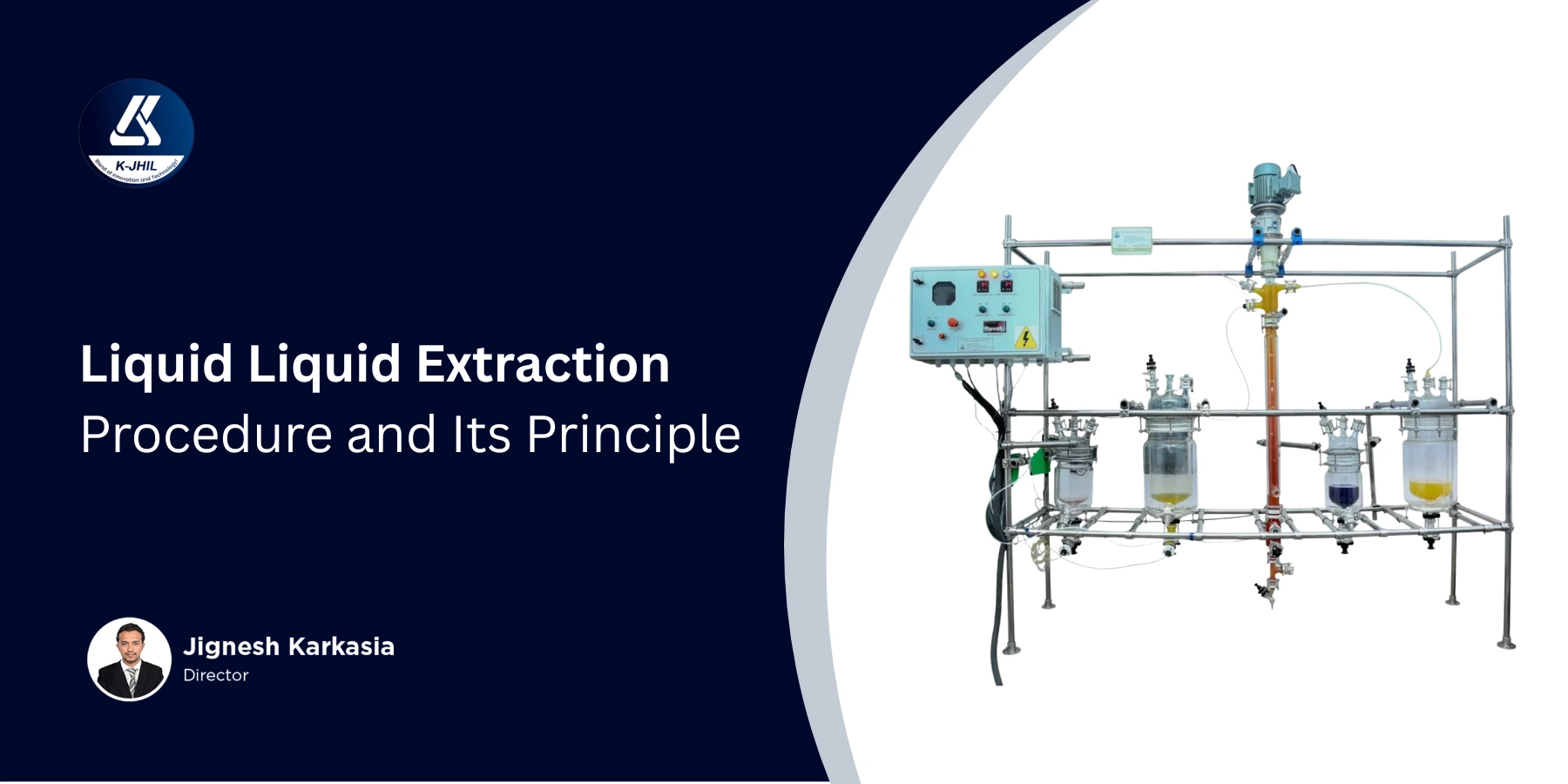
What you will need is a robust Liquid Liquid Extraction system by your side.
And that’s exactly where we come in!
At K-Jhil, we have successfully manufactured tailored LLE systems for market leaders across a wide range of industries.
So, if you, too, want a reliable LLE system for your operations, why not connect with us?
We will understand your requirements, send you the schematics for a tailored system, and work with you to manufacture it to your specifications!
Liquid Liquid Extraction Procedure: FAQs
1. What are common liquid liquid extraction examples?
Famous examples of the LLE process include decaffeinating coffee and purifying penicillin.
2. What are the main liquid liquid extraction applications?
Key liquid liquid extraction applications span a wide range of industries, such as pharmaceuticals, food processing, and wastewater treatment.
3. Where can I get a liquid-liquid extraction system?
LLE systems are usually tailor-made for specific applications. However, you can also get an LLE system that is made for standard operations. At K-Jhil, we offer both standard and tailor-made LLE systems for our clients.