
Are you currently working in chemical or pharmaceutical manufacturing?
Then you must know just how tricky high-temperature reactions can become.
For optimal performance, you need to handle both heat and corrosion of your equipment.
Moreover, you also need to see what is happening inside in real time.
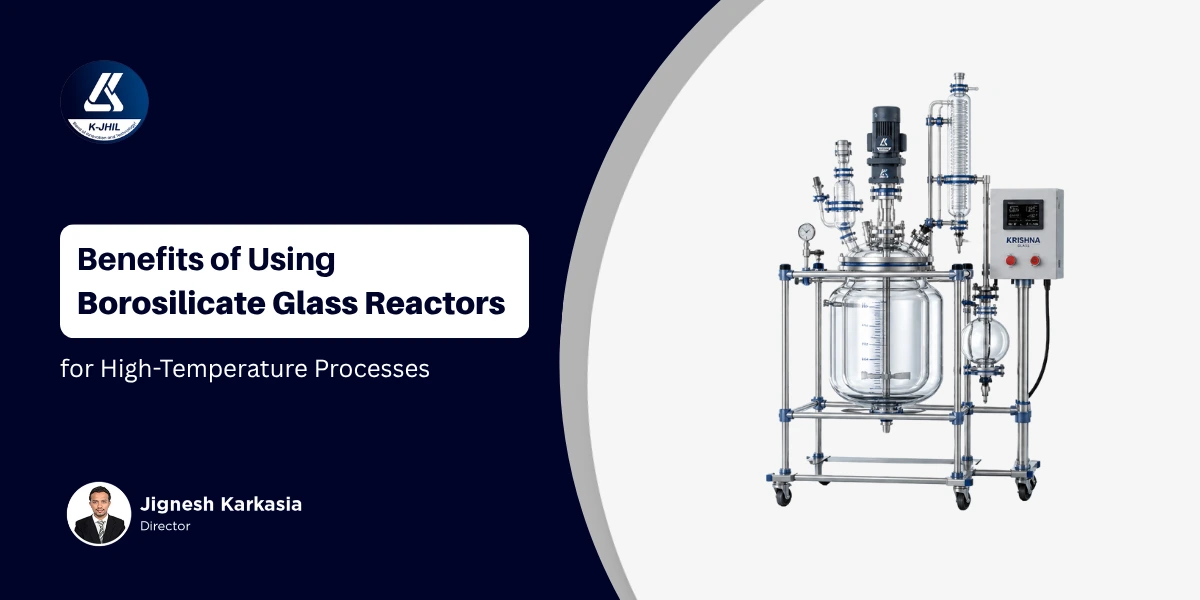
That is exactly what using borosilicate glass reactors helps you in achieving. It functions as a chemically resistant reaction vessel with integrated process controls, while offering the transparency and durability required for demanding applications.
Let us explore exactly how borosilicate glass enables high-temperature reactions.
What Makes Borosilicate Glass So Special?
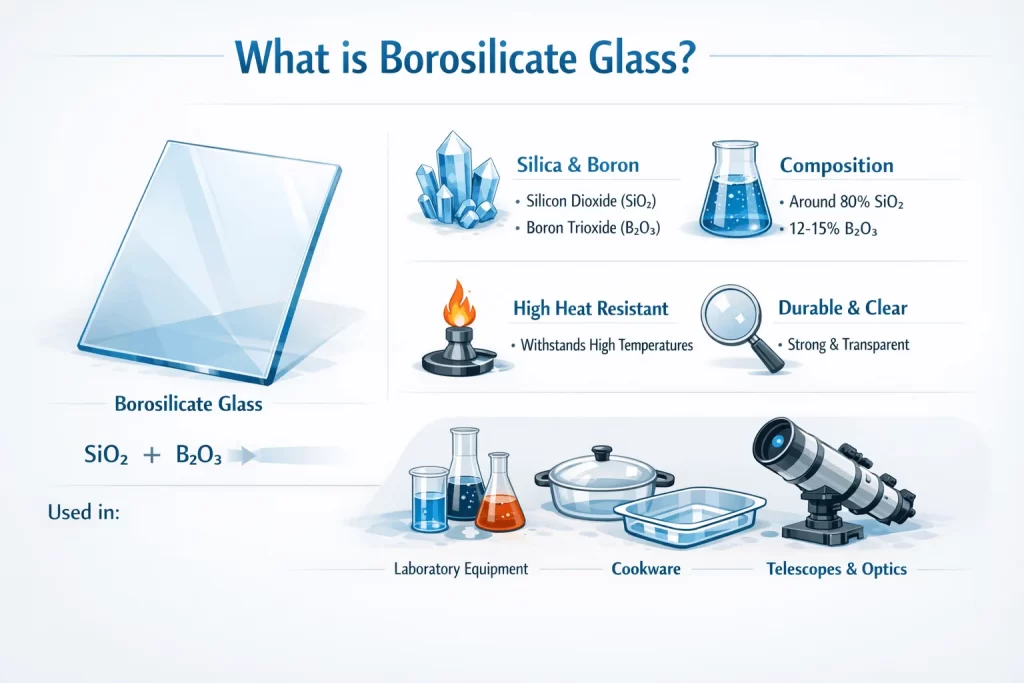
To understand its unique benefits, you must first get familiar with the material itself.
The secret ingredient to borosilicate glass is “boron trioxide”. This is the element that provides a normal glass chamber with remarkable benefits.
At the center of these benefits is thermal shock resistance. With this, borosilicate glass can withstand sudden temperature changes.
Key Benefits of Borosilicate Glass for High-Temperature Reactions
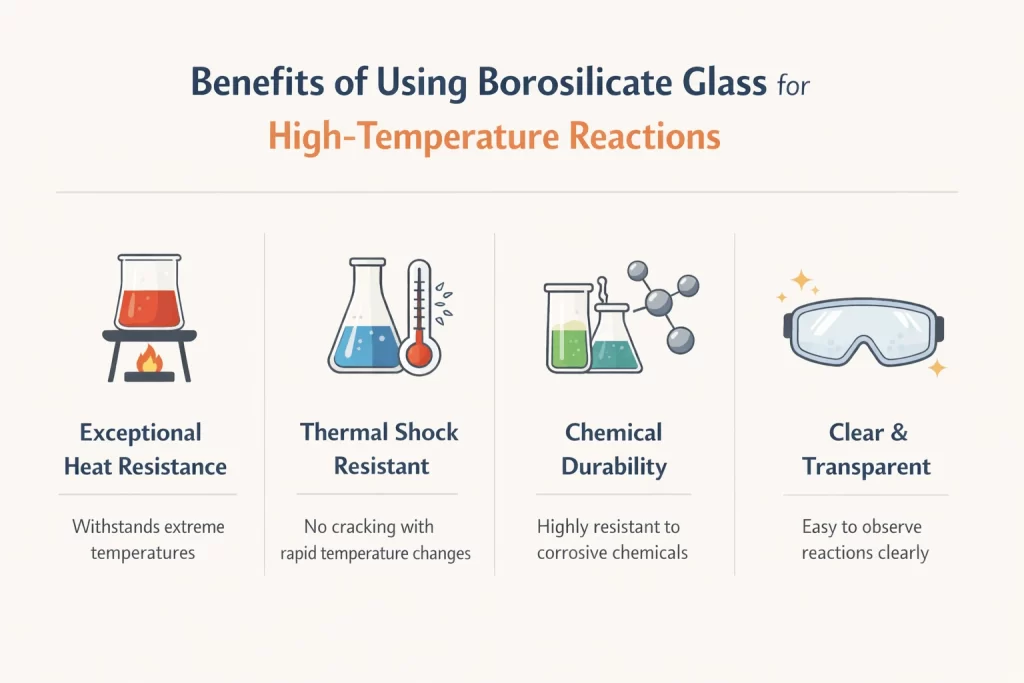
Here are the benefits that make borosilicate glass ideal for high-temperature reactions:
Excellent Thermal Shock Resistance
This is the primary benefit of using borosilicate glass reactors over others.
Using borosilicate, the reactor can handle quick temperature changes. Reactions that need rapid heating or cooling can be easily performed using them.
Moreover, a jacketed glass reactor system further stabilizes these reactions. They have hot or cold fluid circulating throughout the outer jacket.
As the glass expands or contracts with each reaction, a jacketed glass reactor system circulates hot or cold fluid through the outer jacket, helping maintain a uniform temperature and reducing thermal stress during reactions.

Full Visibility During Your Reactions
One of the biggest drawbacks of using a metal reactor is the lack of visibility into its operation.
In contrast, glass lets you see everything in real time. This means you can easily watch:
- Color changes
- Foaming
- Unexpected complications
- Crystallization
Thus, the visibility offered by borosilicate glass reactors can be very useful.
Excellent Resistance Against Chemicals
Borosilicate glass is very resistant to most acids and salt solutions. It is a very chemically stable environment that does not harm your purity levels.
It also means that you don’t have to worry about corrosion or contamination.
Just be aware that hydrofluoric or hot phosphoric acid can damage it. Make sure you use other reactors for such reactions.
Wider Temperature Range
Borosilicate glass can easily oscillate between very cold and hot temperatures.
Borosilicate glass reactors can typically operate safely at continuous temperatures of up to ~200–230°C. While higher temperatures may be tolerated, they are only suitable under controlled, low-stress conditions and are not typical for standard reactor operations.
Borosilicate glass’s wide temperature range thus makes it ideal for most reactions. It can support everything from chemical reactions to distillation processes.
Borosilicate glass reactors are best suited for atmospheric or low-pressure operations and are not recommended for high-pressure systems.
Non-Contaminating Surface
Metal reactors are often notorious for leaching metal ions into reactions. This can compromise the purity of your final product.
With glass, you don’t have to worry about this. Its highly inert surface minimizes contamination and reduces the risk of unwanted reactions with your materials.
For food applications and pharmaceuticals, this purity can be a lifesaver. With borosilicate glass, your reactions can be extremely clean and safe.
Comparison: Glass vs. Metal Reactors
Let’s look into how borosilicate glass reactors compare against traditional metal versions:
Feature | Borosilicate Glass | Stainless Steel |
Visibility | Clear, full view | Opaque, cannot see inside |
Thermal Shock | Excellent (typically up to ~150–170°C, depending on design and operating conditions) | Good, but metal can warp |
Chemical Resistance | Excellent for most acids and solvents | Can corrode with strong acids |
Temperature Range | -50°C to 230°C (continuous) | Higher range possible |
Contamination Risk | Very low, with inert surface | Low, but metal ions can leach |
Cost | Moderate | Higher for equivalent corrosion resistance |
Common Applications of Borosilicate Glassware Reactors
So, what can you actually achieve with borosilicate glass reactors?
Let’s look at the most common borosilicate glass uses:
Chemical Synthesis
Using the reactor to create new compounds using controlled heating.
Distillation
Purifying different products using either heat or condensation
Extraction
Using glass reactors as liquid-liquid extraction systems using solvents
Crystallization
Growing purified crystals by using controlled cooling
Polmerization
Suitable for small to medium-scale controlled polymerization processes, particularly where precise temperature control and visibility are required.
Pharmaceuticals
Developing drug ingredients using sanitized and non-reactive conditions

Conclusion
Using borosilicate glass reactors can help you gain the thermal stability you require for most reactions.
They also provide incredible visibility and chemical resistance. This puts them well ahead of other metal reactors.
If you are looking for a stable environment for your high-temperature processes, look no further.
Be it for pharmaceuticals or chemical development, borosilicate glass reactors are the best choice!
Now, all that is left is choosing a high-quality glass reactor that supports your everyday use. Thankfully, I can help make your choice a whole lot easier!
Consider partnering up with K-Jhil Scientific, one of India’s largest borosilicate glass manufacturers. Their specialization in engineering jacketed glass reactors is known globally for its reliability.
No matter your use case, K-Jhil can build a borosilicate glass reactor for you. Their solutions comply with international standards and include 24/7 after-sales support.
So, are you ready to upgrade your high-temperature industrial processing? Contact K-Jhil today and receive the reactor that perfectly fits your every requirement!
FAQs
1. Why is borosilicate glass good for high-temperature work?
Borosilicate glass can handle sudden temperature changes without cracking. It withstands swings up to 170°C. That’s why it’s perfect for processes that heat up and cool down quickly.
2. How hot can a borosilicate glass reactor get?
You can safely use borosilicate glassware up to 230°C for regular work. For short periods, it can handle 400°C. It also works well at very cold temperatures.
3. What is a jacketed glass reactor used for?
A jacketed glass reactor has an outer jacket where you circulate hot or cold liquid. This gives you excellent temperature control—great for making chemicals, growing crystals, or distilling products.
4. Who makes good borosilicate glass reactors in India?
There are several trusted borosilicate glass manufacturers in India. K-JHIL Scientific is one example, with decades of experience and building custom reactors for pharma and chemical companies.
5. Where do people use borosilicate glass reactors?
Common borosilicate glass uses include making medicines, chemical synthesis, distillation, and extraction. People choose glass because it lets them see inside and won’t react with or contaminate their products.