
Whether it’s the decaf coffee that won’t keep you up at night or the penicillin that helps you fight diseases, both of them are products of precision Liquid-Liquid Extraction.
And chances are that they were both produced in a Separatory Funnel.
But how exactly does a Separatory Funnel Work?
And why should you get one? Is it the only way to perform Liquid-Liquid Extraction?
Whether you’re a student or a professional, I’m going to explain everything you need to know about how Separatory Funnels work and how they enable Liquid-Liquid Extraction processes.
Here’s everything you need to know:
How Separatory Funnels Work: Table of Contents
- What is Liquid-Liquid Extraction?
- What is a Separatory Funnel?
- Separatory Funnel Diagram
- How to Use a Separatory Funnel for Liquid-Liquid Extraction?
- Why Should You Use a Separatory Funnel for Liquid-Liquid Extractions?
- Common Problems of Separatory Funnels (& How to Troubleshoot Them)
- Get Leak-Proof Separatory Funnels from Kjhil!
- How Separatory Funnels Work: FAQs
What is Liquid-Liquid Extraction?
Liquid-Liquid Extraction is a chemical process you can use to separate and extract pure chemicals from impure compounds.
Here’s how it works:
You dissolve two liquids – one that contains the chemical you want to extract and the other that can absorb the desired chemical – into an instrument.
The key is that both of these liquids should be such that they don’t mix together, like oil and water.
One compound – usually, the original mixture – holds the chemical, while the other extracts the desired chemical.
But why does this happen?
Because the second liquid (say, ether) is a better solvent for the chemical than the first liquid (say, water). Sometimes, you can also increase the extractability of a solvent by adjusting the pH or salt concentration.
After shaking, the two liquids separate into different layers based on their density.
Plus, the denser liquid sinks, which allows you to easily drain both liquids individually into test tubes, flasks, or beakers!
To go deeper into the mechanism, this article on liquid liquid extraction procedure and principle explains why a solute moves from one liquid phase to another.
Applications of Liquid-Liquid Extraction
To help you understand the advantages of LLE as a solvent extraction technique, let me quickly give 3 real-life applications of liquid-liquid extraction:
- Penicillin Purification: Scientists add an organic solvent (like amyl acetate) to a fermented broth of penicillin and water. The solvent extracts Penicillin and is then drained into a separate beaker.
- Environmental Cleanup: You can add solvents like Hexane to extract oil from water after an oil spill. Hexane binds to oil, forming a layer that floats on water, from where it can be skimmed off easily.
- Decaffeinating Tea: Industrial producers often mix brewed tea with ethyl acetate, which extracts all the caffeine from the tea. They then remove the acetate layer, leaving only aromatic tea minus the caffeine!
As you can see, LLE is like a “chemical magnet” that pulls out only what you want from a messy mix, using two liquids that don’t mix. It’s the best solvent extraction technique you can use to obtain high-purity chemicals, especially when you’re dealing with volumes between 50mL and 5 Litres.
Next, let’s find out how a separatory funnel helps you with LLE, and when it’s the best option for LLE processes!
What is a Separatory Funnel?
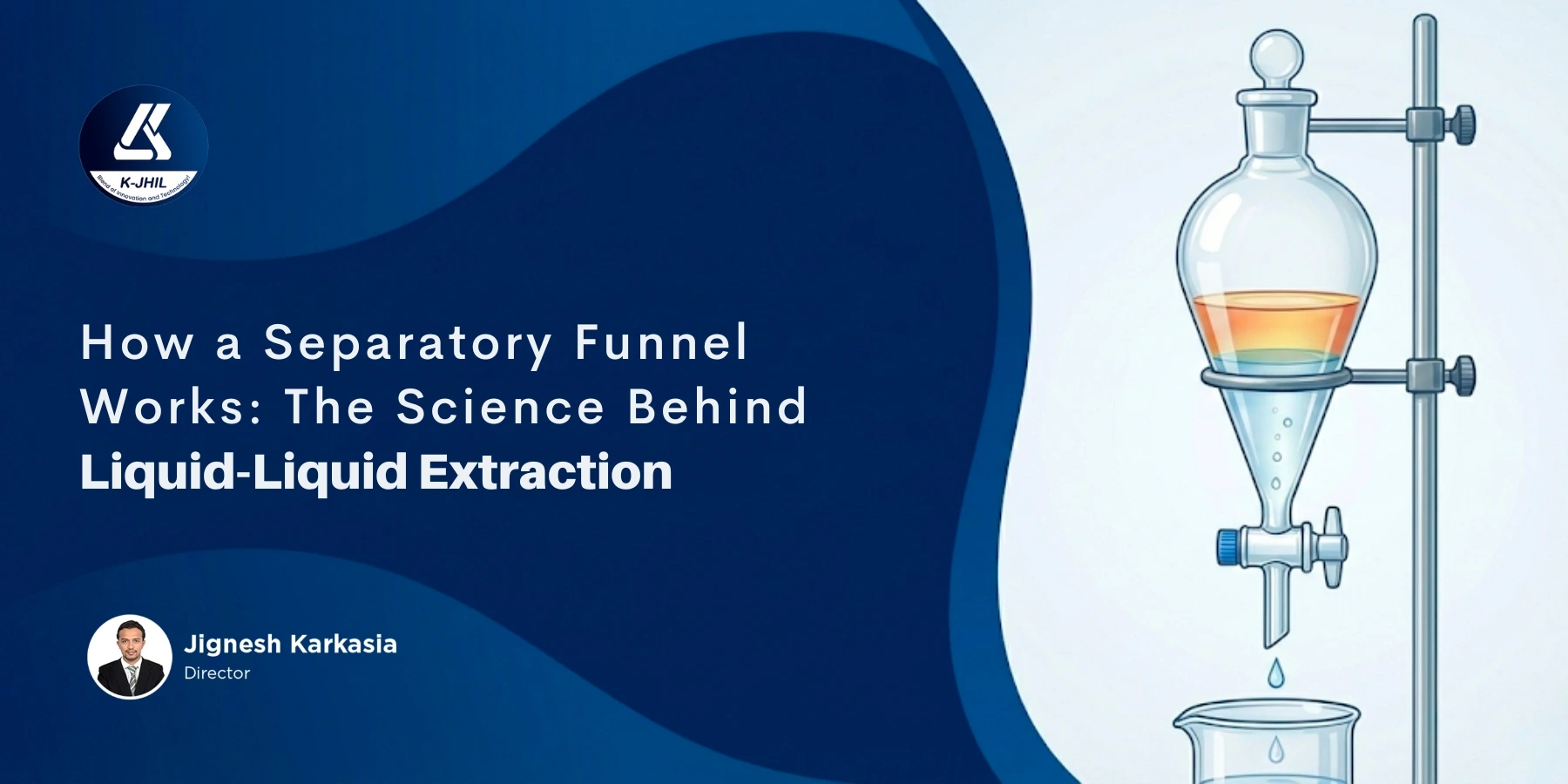
A separatory funnel is a pear-shaped glass or plastic instrument with a tap at the bottom. Its main function is to split two unmixable liquids into clean layers so that you can separate them easily.
Think of it like a chemical strainer: you can use it to drain one liquid minus the other!
Separatory Funnel Diagram – Key Components
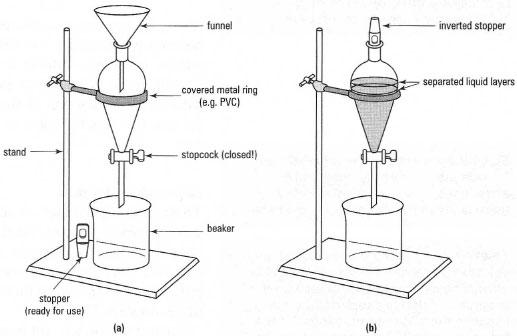
Key Components of a Separatory Funnel
There are four key components of every separatory funnel. Let me show you how they work:
- Funnel Body: This will hold the mixture of unmixable liquids.
- Stopcock: The “tap” of a separatory funnel, which (like a faucet) helps you control the drainage of the liquids.
- Stopper: The “seal” that secures the top of your separatory funnel during the shaking process.
- Ring Stand Clamp: Keeps your separatory funnel steady during the mixing process.
Scroll below for an illustrated separatory funnel diagram!
Is a Separator Funnel Used Only for Liquid-Liquid Extraction Processes?
No, a separatory funnel does have applications beyond liquid-liquid extraction systems, but it’s mostly used for lab-grade LLE processes. Here are two other applications of separatory funnels:
- Washing: Separatory funnels can help you remove impurities from a liquid, for instance, by rinsing a chemical from water.
- Dividing Emulsions: You can use a separatory funnel to separate soapy water into different layers.
Now that we’ve understood what a separatory funnel is, let’s explore how you can use it for liquid-liquid extractions!
Separatory Funnel Diagram
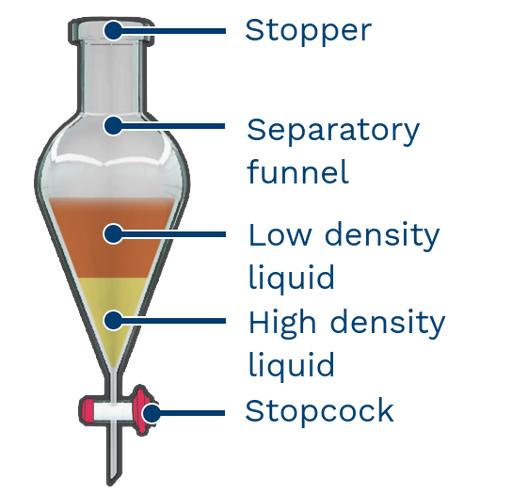
How to Use a Separatory Funnel for a Liquid-Liquid Extraction System?
Here’s a four-step process you can follow to use a separatory funnel for liquid-liquid extraction:
- Pour the Mix: Add both liquids into the separatory funnel’s body.
- Shake the Mixture Well: Next, shake the mixture thoroughly so that the target chemical is transferred to the solvent.
- Let it Settle: Once the solvent has extracted your desired chemical, wait for the mixture to settle so that the two liquids form separate layers in the funnel.
- Drain the Bottom: Lastly, open or release the stopcock so that the heavier or denser layer will naturally drain into a separate beaker!
Pro Tip: If you notice that there’s a build-up of fumes during the shaking phase, open the stopper (at the top) to release the fumes!
For a wider process view beyond lab glassware, this liquid liquid extraction process guide explains how the same separation logic is scaled in industry.
Why Should You Use a Separatory Funnel for Liquid-Liquid Extractions?
Using separatory funnels is not the only way to accomplish liquid-liquid extractions. You can also use:
- Test tubes for tiny volumes.
- A pipette if you want to manually remove layers.
- Centrifuges for large-scale LLE processes.
- Mixing-settling tanks in factories.
So, why should you use separatory funnels for liquid-liquid extractions?
Well, there are four reasons why I highly recommend using them:
- Precision: A separatory funnel lets you drain layers drop by drop, so you don’t have to compromise the quality of your extracted chemicals.
- Speed: Separatory funnels can achieve extraction faster than a beaker.
- Safety: While the separatory funnel’s glass surface will prevent corrosion, the manual control over the stopper helps you eliminate fume build-up.
- No Power Needed: All the work is done by gravity, so you don’t need pumps or electricity for either mixing or drainage!
Simply put, separatory funnels are the Swiss Army knives of the liquid-liquid extraction process!
They combine mixing, separating, and draining in one tool, giving you control without requiring any electrical power.
Pro Tip: For leak-proof extractions, use Kjhil’s funnels that feature PTFE stopcocks and reinforced glass.
Common Problems of Separatory Funnels (& How to Troubleshoot Them)
In this section, I’m going to recount three common problems that you might face when trying to use separatory funnels for liquid-liquid extraction:
Problem #1 – Emulsions
The problem of emulsion occurs very soon after you’ve mixed your unmixable liquids together.
If you notice that they’re not forming clear layers and are instead mixed in a milky or frothy mess, you can be sure that your mixture has emulsified!
How to fix this problem:
- Just add a pinch of salt to your mix.
- Or, gently swirl the mixture to break the emulsion.
Remember, just gently stir the mixture: don’t shake it!
Problem #2 – Incomplete extraction
If your solvent layer doesn’t change either its color or its consistency, it might not have grabbed all of the target compound.
In other words, your extraction process has (unfortunately) not been successful.
In my experience, the best thing to do in such cases is to repeat the process with a fresh batch of solvent.
Problem #3 – Leaky Stopcock
The third type of problem is when your mixture sneaks out around the tap, even when it’s closed!
Here, you’ve done nothing wrong: it’s your separatory funnel that’s not up to the standard.
To fix this problem, you can upgrade to a PTFE-coated stopcock for a tighter seal!
Many of these troubleshooting issues also appear in the liquid liquid extraction process at a larger scale, especially when phase separation is poor.
Get High-Quality Separatory Funnels from K-Jhil!
In this blog, I’ve shown you how you can use separatory funnels for flawless liquid-liquid extraction.
To recap, while you can use pipettes or beakers or centrifuges for LLE, separatory funnels help you leverage the complete advantages of liquid-liquid extraction without compromising quality or control or requiring any external energy.
So, if you want to get started with your LLE processes but don’t know where to get the perfect separatory funnel, connect with us at K-Jhil!
We specialize in engineering high-quality separatory funnels backed by premium materials to ensure that your extraction process proceeds as smoothly as possible…
And if you think that you need an even more scalable instrument, speak with our LLE experts to find an instrument that aligns with your operational requirements!
How Separatory Funnels Work: FAQs
1. What’s the difference between liquid-liquid extraction and using a separatory funnel?
Liquid-liquid extraction (LLE) is the chemical process of separating compounds using two immiscible liquids, while a separatory funnel is the specialized lab equipment that makes this process easier and more precise. Think of LLE as the “recipe” and the funnel as the “perfect kitchen tool” for executing it.
2. Can I perform the liquid-liquid solvent extraction technique without a separatory funnel?
Yes – if you want to extract small volumes of chemicals, you can use test tubes and pipettes, and industries use centrifuges or mixer-settlers. However, separatory funnels will give the best balance of precision, safety, and convenience for most lab-scale extractions, especially if you’re working with volumes of 50mL-5L.
3. Why do I need to vent the separatory funnel after shaking?
You need to vent (by briefly opening the stopper) your separatory funnel during the liquid-liquid extraction process to release pressure from volatile solvents like ether that can vaporize during shaking. If you forget to vent your separatory funnel, you risk building dangerous pressure that could blow the stopper off. Always point the funnel away from your face when venting.
4. How do I know which layer contains my extracted compound?
The target compound will be in the solvent layer that best dissolves it. To identify layers:
– Check densities: Water is usually denser than organic solvents.
– Add a drop of water to see which layer it joins.
– Consult solubility charts for your specific compound.
5. What should I do if my liquids won’t separate into clean layers?
If you see a cloudy emulsion instead of clear layers, follow one of the following steps:
– Wait longer, as some mixtures require 30 minutes or more.
– Add brine or salt water to break your emulsion.
– Try gentle swirling instead of shaking.
– Use a different solvent that’s more suitable for extracting the target chemical.
If you notice persistent emulsions even after repeated processes, your mixture or emulsion may need centrifugation!