
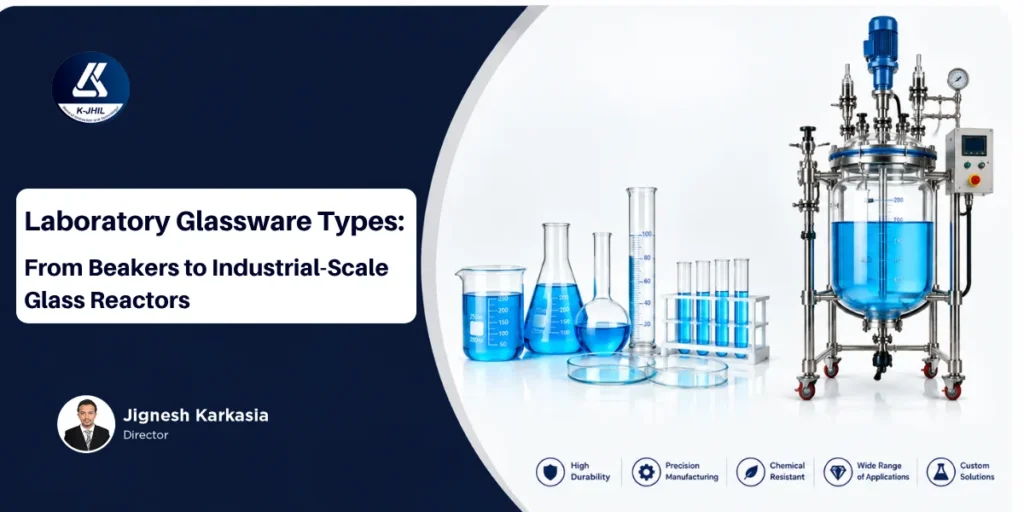
Laboratory glassware types fall into a few groups by what they do: measuring and volumetric ware (volumetric flasks, pipettes, burettes, graduated cylinders), mixing and heating vessels (beakers, Erlenmeyer and round-bottom flasks), containment and storage (bottles, vials, test tubes), and separation and distillation glass (funnels, condensers, distillation trains).
Scale that same borosilicate up and you reach process glass, glass reactor vessels and jacketed reactors that run a plant. Most of it is 3.3 borosilicate for its heat and chemical resistance, and the volumetric pieces are made to per-type product standards, with ISO 4787 covering their testing and calibration.
Walk any lab and the glass tells you what happens there. Volumetric flasks on a rack point to careful analysis. A jacketed reactor behind a screen is a different story, that work left the bench years ago.
The pieces look familiar, but each type exists for one job. Use the wrong one and it costs you accuracy, a batch, or a cracked vessel.
This guide runs the whole line, from the beaker on a student bench to the industrial glass reactor on a plant floor, grouped by what each does. We build the process end ourselves, so the reactor talk here is from the floor, not a catalog.
Market-research estimates for the global laboratory glassware market run into the low single-digit billions of dollars, but the figures and growth rates vary widely by report and by how the category is defined, so confirm against a named current report before publishing. Borosilicate stays the dominant material across most types.
The Main Laboratory Glassware Types
Strip back the catalog and these types sort into five working groups. Get the group right and the specific piece mostly follows.
Group | Types | Main Job |
|---|---|---|
Measuring and volumetric | Volumetric flasks, pipettes, burettes, graduated cylinders | Accurate volume |
Mixing and heating | Beakers, Erlenmeyer flasks, round-bottom flasks | Hold, mix, heat, react |
Containment and storage | Bottles, vials, test tubes | Hold and store samples |
Separation and distillation | Funnels, separatory funnels, condensers, distillation apparatus | Separate and purify |
Process and industrial | Reactor vessels, jacketed reactors, distillation units | Run reactions at scale |
That last row is where most guides stop short. The same borosilicate that makes a beaker makes a reactor, so the types run in one continuous line from bench to plant.
Borosilicate Glass Equipment: What Labware is Made Of
Before the shapes, the material, because it decides most of what the glass can take. Much serious laboratory glass equipment is 3.3 borosilicate, though not all, since pharma packaging uses Type I neutral glass, some work uses quartz, and plenty of labware is now plastic.
Borosilicate 3.3 shrugs off thermal shock and resists most acids and solvents that would attack ordinary soda-lime, which is why it is the default for labware and process glass. Its resistance still depends on the chemical and the conditions, and hydrofluoric acid, hot phosphoric acid, and hot strong alkalis attack it.
Quartz only earns its keep where you need UV transparency or serious heat, and it charges for the privilege. Soda-lime covers storage, packaging, and much general labware, including many reagent bottles; it is just not the glass for thermal cycling or aggressive chemistry.
Our explainer on borosilicate glass properties covers the composition and why the 3.3 grade earns its place. It also carries standards like ISO 3585 that define the glass itself, not just the shape.
Volumetric Glassware for Measuring and Titration
When the number matters, you reach for volumetric glassware. Accuracy is the whole point here, and it is the one group where the standards stop being optional.
Type | Best Use | Typical Accuracy | Standard |
|---|---|---|---|
Volumetric flask | One exact volume for analysis | Class A tolerance (certificate optional) | ISO 1042 (ISO 4787 to calibrate) |
Graduated cylinder | Rough to moderate volumes | Around 1 percent | ISO 4788 |
Volumetric pipette | Single measured transfer | Tightest transfer accuracy | ISO 648 |
Graduated pipette | Variable-volume transfer | Looser than single-volume | ISO 835 (ISO 4787 to calibrate) |
Burette | Controlled titration delivery | To about 0.05 mL | ISO 385 |
For measuring ware, the tolerance class, and a calibration certificate where the work needs traceability, matter more than the brand on the box. Class A marks a tighter tolerance than Class B; a certificate, batch or individual, is specified separately, not implied by the class.
Common Types of Lab Glassware for Mixing and Heating
This is the everyday glass, the pieces that fill a working bench and take the most abuse. None of it is built to measure, so keep it clear of the jobs where the number counts.
The beaker is the one everyone pictures, a straight-sided pot for mixing, heating, and pouring, made to a standard series under ISO 3819 but never to a tight volume. The Erlenmeyer, or conical flask, trades that wide mouth for a narrow neck you can swirl hard without slopping, which is why it earns its keep in titration and culture work.
Round-bottom and Florence flasks take the heat instead, even and all over, for synthesis and distillation, and the round-bottom flask is the benchtop starting point for a reaction vessel, though a plant reactor is an engineered piece, not just a bigger flask.
The rest are containers, plain and simple. Test tubes for small reactions and quick samples, bottles and vials for storing and moving reagents, Petri dishes and watch glasses for culturing, covering, and watching something evaporate. Useful glass, but none of it is where accuracy lives.
Separation and Distillation Glassware
Once you need to split a mixture or clean up a product, a different set of glass comes out. This is where a bench starts to look like a small plant.
A plain funnel just guides liquid into a narrow neck, or holds filter paper to catch solids. The separatory funnel does the clever work, a stopcock at the base taps off one liquid layer and leaves the other, which is the everyday tool of liquid-liquid extraction. Condensers cool vapor back to liquid, from the plain Liebig through coil and Allihn designs, and they sit at the heart of every distillation.
Put condensers, a still head, and the right adapters together and you have a distillation train, glass joined by ground-glass fittings, separating by volatility. Run that same physics at plant scale and much more than size changes, since heat-transfer area, mixing, residence time, and the mechanical design all shift.
Glass Reactor Vessels: From Benchtop to Plant Scale
Most type guides stop at the bench. The same borosilicate types scale up, and at the top of that line sits the glass reactor.
A glass reactor vessel is an engineered piece, not just a scaled-up flask. It is designed to a defined wall thickness and geometry, rated for its pressure and vacuum duty, and fitted with ports for stirring, charging, temperature, and reflux. Our guide to the types of glass reactors lays out the common configurations.
The Jacketed Glass Reactor at Process Scale
The heart of the group is the jacketed reactor. A second glass wall forms a jacket around the vessel, and a hot or cold fluid runs through it to hold the reaction at temperature, which makes a jacketed glass reactor a common choice for temperature-controlled pharma and specialty chemical batches.
Sizing one is its own decision. In the systems we build, the jacketed glass reactor has its vessel volume, jacket duty, drive, and ports all following the process, not a stock spec sheet.
How to Choose the Right Glassware
Strip it back and picking glassware is four questions, not a catalog. The types of lab glassware narrow fast once you answer them.
Start with the job: Measuring, mixing, heating, separation, or a full reaction decides the group before anything else.
Match the accuracy to the need: Class A volumetric ware, with a calibration certificate where traceability matters, for analysis; a beaker or cylinder for rough work.
Check the grade and the standard: Insist on 3.3 borosilicate and the relevant ISO for the piece, not just the shape.
Size for the scale: A bench piece, a pilot rig, and a plant reactor are the same physics at different volumes, so scope the glass to the batch.
Sourcing from a Laboratory Glassware Manufacturer India
Take the whole run of glassware types together and one thing holds: the material and the standard matter more than the shape. Get 3.3 borosilicate and the right class, and the piece does its job whether it is a pipette or a reactor.
At K-Jhil Scientific, we work the process end of that line, borosilicate glass equipment, distillation systems, and glass reactors for pharma, chemical, and research producers. As a laboratory glassware manufacturer India relies on for plant-scale glass, we build the vessel around your process. If you are scoping reactors or a distillation train, our walkthrough on choosing the right jacketed glass reactor is the place to start.
Frequently Asked Questions About Laboratory Glassware Types
1: What are the main laboratory glassware types?
A: They group by function: measuring and volumetric ware (volumetric flasks, pipettes, burettes, cylinders), mixing and heating vessels (beakers, Erlenmeyer and round-bottom flasks), containment (bottles, vials, test tubes), separation and distillation glass, and process-scale glass reactors.
2: What types of lab glassware are used for measurement?
A: Volumetric flasks, pipettes, burettes, and graduated cylinders. Volumetric flasks and single-volume pipettes are the most accurate, and the group is held to ISO 4787 for testing and calibration.
3: What is laboratory glassware made of?
A: Much laboratory glass equipment is 3.3 borosilicate, chosen for its resistance to thermal shock and many chemicals, though pharma packaging uses Type I neutral glass. Quartz is used for UV or very high-temperature work, and soda-lime for storage and teaching.
4: What is volumetric glassware?
A: It is the group made for accurate volume, volumetric flasks, pipettes, burettes, and graduated cylinders. Class A marks a tighter tolerance, and a certificate, batch or individual, is specified separately when traceability is needed. Each type is made to its own product standard, with ISO 4787 for testing and calibration.
5: What is the difference between a beaker and a volumetric flask?
A: A beaker is for rough mixing and heating with low measurement accuracy, while a volumetric flask delivers one exact, calibrated volume for analysis.
6: What is a glass reactor vessel?
A: A large borosilicate vessel built to run a reaction at plant scale, with ports for stirring, charging, temperature, and reflux. It is an engineered vessel, designed and rated for its pressure and vacuum duty, not simply a scaled-up flask.
7: What is a jacketed glass reactor?
A: A glass reactor with a second wall forming a jacket, through which a hot or cold fluid runs to hold the reaction at temperature. It is a common choice for temperature-controlled pharma and specialty chemical batches.
8: What standards apply to laboratory glassware?
A: Volumetric ware is tested and calibrated to ISO 4787, while each type has its own product standard: ISO 1042 for volumetric flasks, ISO 385 for burettes, ISO 648 for one-mark pipettes, ISO 835 for graduated pipettes, and ISO 4788 for measuring cylinders. ISO 3819 covers beakers, and the borosilicate glass itself is defined by ISO 3585.
9: Is borosilicate glass equipment better than soda-lime?
A: For heat and many chemicals, yes. Borosilicate 3.3 resists thermal shock and most reagents that would craze or etch soda-lime, though hydrofluoric acid, hot phosphoric acid, and hot strong alkalis still attack it. That resistance, within limits, is why it is the usual choice for both labware and process glass.
10: How do I choose the right laboratory glassware?
A: Start with the job, match the accuracy to the need, insist on 3.3 borosilicate and the relevant ISO standard, and size the glass to the scale, from bench to reactor.
11: Who manufactures laboratory glassware in India?
A: India has national labware brands and process-glass specialists. K-Jhil Scientific works the process end as a laboratory glassware manufacturer India relies on for glass reactors, distillation systems, and other borosilicate glass equipment.