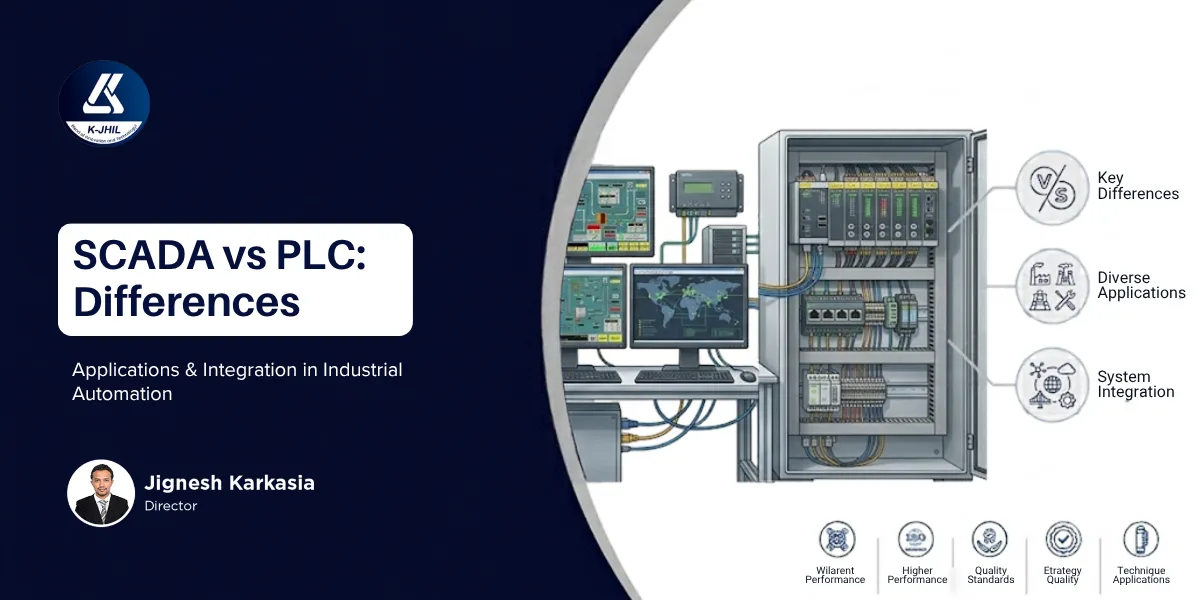

Search scada vs plc online and you will see them lined up like rival products. They are not rivals. One runs the machine, the other keeps watch over the whole plant.
The mix-up makes sense. Both sit in almost every automated plant, both handle the same signals, and job postings bundle the two names together.
So here is the clean split. A PLC is the hardware that reads sensors and drives valves, motors, and pumps on the spot.
SCADA is the software above it, pulling data from many controllers onto one set of screens so a person can supervise from a single room.
K-Jhil builds process and refining plants where both run together, reactor to control room. So the take here comes off the floor, not a spec sheet.
What Is a PLC Control System?
Open the panel on almost any automated machine and you will find one. A programmable logic controller, or PLC. A rugged little computer with a single job, done without complaint.
It reads its inputs, runs its logic, flips its outputs, then loops, thousands of times a second. Tank hits level, valve shuts, milliseconds later, no operator and no delay. That is what a PLC control system is built for.
And it is hardware first. A power supply, a processor, and banks of input and output modules, all wired straight out to the field.
How a PLC Works
Everything turns on the scan cycle. Read every input, run the program top to bottom, update every output, start over. A few milliseconds, every time.
That predictability is the whole trick. A PLC automation system holds a fast loop rock-steady where an ordinary computer would hiccup.
The programs follow IEC 61131-3, usually written as ladder logic. It looks a lot like a wiring diagram, which is exactly why electricians took to it decades back.
Where PLCs Are Used
Anywhere a machine has to think for itself. A bottling line stepping conveyors along, a jacketed glass reactor system holding its temperature, a press firing on a sensor.
One PLC, one machine or skid. Build out a full plant and you will count them in the dozens, each minding its own patch.
What Is a SCADA Control System?
Now step back from the single machine and take in the whole plant at once. That wider view is SCADA, short for supervisory control and data acquisition.
A SCADA control system reaches down to every PLC on the network, pulls their live data up, and paints it across screens. It flags whatever drifts and keeps a record of all of it.
It does not take the controller’s place. It rides on top, so one person can keep an eye on a hundred loops without leaving the chair.
Core SCADA Components
Underneath, it is only a few moving parts. PLCs and field devices feed the data in, a network carries it, and servers collect it.
Up front sit the HMI screens, the live picture of the plant, plus a historian logging every value for trends, reports, and audits. A SCADA automation system pulls all of that into one window.
What SCADA Does on the Plant Floor
Three jobs, mostly. It shows the live state, sounds the alarm when something strays, and keeps the record.
That last one carries more weight than it looks. In a regulated plant, the record is the batch history an auditor will ask to see, the proof the process stayed in bounds.
SCADA vs PLC: The Core Differences
Side by side, the line is easy to draw. The PLC is the hands; SCADA is the eyes and the control room. Hardware doing real-time control, software doing supervision.
Aspect | PLC | SCADA |
|---|---|---|
Type | Hardware controller | Software system |
Main job | Real-time machine control | Supervision, monitoring, data |
Speed | Milliseconds, deterministic | Seconds, human-paced |
Scope | One machine or skid | Whole plant or many sites |
Runs alone? | Yes, controls a machine by itself | No, needs PLCs to supervise |
Interface | Often a small local screen | Full operator screens and dashboards |
Data | Handles live inputs and outputs | Logs history, trends, reports |
If it fails | That machine stops | Visibility lost, machines keep running |
Difference Between SCADA and PLC, Point by Point
The table sketches it. A handful of points deserve a closer look, because this is where the difference between SCADA and PLC starts to bite on a live project.
Hardware vs Software
One you can touch. A PLC is a box in a panel wired to the field, while SCADA is software humming on servers and operator PCs. Almost every other difference grows out of that one.
Control vs Supervision
The PLC makes the calls that cannot wait, like shut this valve or trip that motor. SCADA decides nothing on the clock. It shows a person what is happening and lets them nudge a setpoint or start a sequence.
Scope and Speed
A PLC guards one corner on a millisecond clock. SCADA stretches across the plant, even across sites, but it runs at human speed, in seconds, because seconds are plenty for watching and choosing.
What Happens When Each Fails
Here is the part that matters most. Kill a PLC and its machine stops dead. Kill SCADA and you lose your view, yet every PLC keeps running, and that gap is the SCADA and PLC difference that decides uptime.
How PLC and SCADA Work Together
You almost never choose between them. PLC and SCADA work as a pair, each taking the half it was built for. Our look at chemical plant plc and scada systems shows that pairing on a real process site.
The Control Hierarchy, Field to PLC to SCADA
Think of three floors. On the ground, sensors and actuators touch the process; one floor up, PLCs read them and drive the field in real time. Top floor, SCADA gathers everything the PLCs see and hands it to people.
Data climbs up to be watched. Commands come back down to control. The fast loop stays with the PLC, while SCADA sets the targets and keeps the log.
Communication Protocols
They have to talk, so they share a language. Modbus is the old reliable, PROFIBUS and PROFINET run the plant floor, and OPC UA has become the go-between for modern controllers and software.
Nail the protocol and the network, and integration goes quiet. Miss it, and you will chase dropped packets and lag for years.
Security and Reliability
Wiring controllers to software opens a door, and doors need watching. The old protocols trusted everyone, which is why network segmentation and tight access control now sit at the heart of any serious build.
Reliability leans on the same failure split from earlier. Critical control lives in the PLC, so a machine keeps running even if a server or the network drops. The supervisory layer comes back up without ever halting the floor.
PLC, SCADA, and DCS, Where Each Fits
One more acronym muddies the water: DCS, the distributed control system. It smudges the line on purpose, folding control and supervision into one tight package.
Rule of thumb: PLCs plus SCADA fit discrete machines and spread-out sites, while a DCS fits one big continuous process like a refinery or a large chemical train. Plenty of plants run all three at once.
PLC and SCADA Applications in Industrial Automation Control Systems
Across industrial automation control systems, the pairing turns up wherever a plant has to move fast at the machine and still be watched as a whole.
Industry | What PLCs Do | What SCADA Adds |
|---|---|---|
Chemical processing | Control reactors, dosing, temperature | Batch records, alarms, plant-wide view |
Pharmaceutical | Run GMP sequences on each unit | Audit trail, trends, compliance data |
Water treatment | Drive pumps and valves at each station | Supervise a city-wide network from one room |
Power and utilities | Control substations and feeders | Monitor the grid across many sites |
Metal refining | Control furnaces, cells, and flows | Track yield, energy, and process history |
Chemical and Pharmaceutical Process Plants
This is K-Jhil’s home ground. A PLC keeps each reactor and dosing skid on target, and SCADA stitches them into one supervised line with full batch history.
The iron underneath counts as much as the code. A continuous stirred tank reactor runs a steady loop a PLC controls and SCADA logs, batch after batch.
Precious Metal Refining
Refining fits for the same reasons, with higher stakes. A precious metal refinery runs furnaces, electrolytic cells, and chemical steps, each one wanting local control and a close eye.
The feed is literally gold, so automation guards the margin too. The shift toward automated precious metal refining puts PLCs on the process and SCADA on the yield-and-energy record that accounts for every gram.
How to Choose, PLC, SCADA, or Both
Usually it is both, but start with the job, not the budget. A lone machine that has to act on its own needs a PLC, and maybe nothing more than a small screen beside it.
The day you have several machines, a site spread wide, or a record to keep for auditors, SCADA earns its spot on top.
Bolt it onto one standalone machine, though, and you are buying servers and licenses you will not use.
So match the control to the plant. One skid, one PLC. A plant, or a web of them, PLCs for control and SCADA to supervise.
Building PLC and SCADA Into Your Process
So the real call was never scada vs plc as an either-or. It is how much PLC control each machine needs and how much SCADA supervision the plant needs, sized to your process.
K-Jhil designs and builds process and refining plants with PLC and SCADA automation baked in, reactor to control room. We fit the control to the duty, not to a catalog.
Planning a plant or an upgrade? Contact us before the design is locked, and we will scope the automation around your process.
SCADA vs PLC FAQs
What is the difference between SCADA and PLC?
A PLC is hardware that controls a machine in real time. SCADA is software that supervises many controllers at once. Put plainly, the PLC does the work, and SCADA watches, warns, and records.
Is SCADA better than PLC?
Wrong question, that one. They do different jobs, so neither wins. Most plants run both.
Can SCADA work without a PLC?
Barely. SCADA needs controllers underneath, PLCs or RTUs, to pull data from and send commands to. On its own it has nothing to supervise.
Can a PLC work without SCADA?
Easily. A PLC runs its machine solo. SCADA only layers plant-wide visibility, logging, and supervision on top.
Is SCADA a PLC?
No. SCADA is a software system for plant-wide monitoring and control, and a PLC is the hardware doing the real-time work. They just tend to show up together.
What is a PLC control system?
A controller plus its input and output modules and program, built to run a machine or process in real time on a fast, repeating scan cycle.
What is a SCADA control system?
The software, servers, screens, and network that collect data from field controllers, put it in front of operators, raise alarms, and keep the history.
How do PLC and SCADA work together?
PLCs run the machines and push live data up to SCADA. SCADA displays it, logs it, and sends setpoints and commands back down. Together they are the backbone of most industrial automation control systems.
What is the difference between SCADA and DCS?
SCADA supervises controllers across wide or scattered sites. A DCS welds control and supervision together for one big continuous process, like a refinery.
Which is used in chemical plants, PLC or SCADA?
Both. PLCs control the reactors and dosing in real time, and SCADA ties them into one supervised line with alarms and batch records.
Do I need both PLC and SCADA?
For a single machine, a PLC might do. Add several machines, a spread-out site, or a compliance record, and SCADA earns its place on top.