
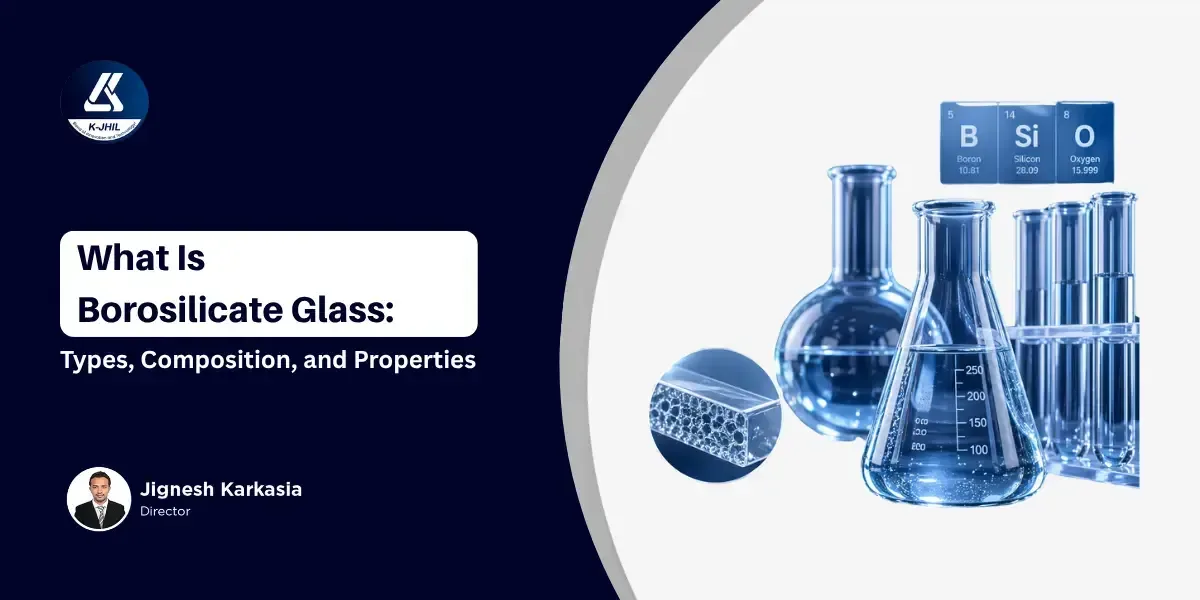
Have you ever thought about laboratory beakers? How could they withstand such extreme conditions?
The answer is actually borosilicate. It is a type of glassware that has unique properties that make it stronger and more resilient.
Such properties have made it popular not only in the laboratory but also in our homes.
But what makes it so special? And what is the actual way that it aids in causing chemical reactions on an industrial scale?
To answer these queries, I have created this informative guide. It will help you understand exactly what makes borosilicate different.
Let’s begin.
What Is Borosilicate Glass? What Makes it Different?
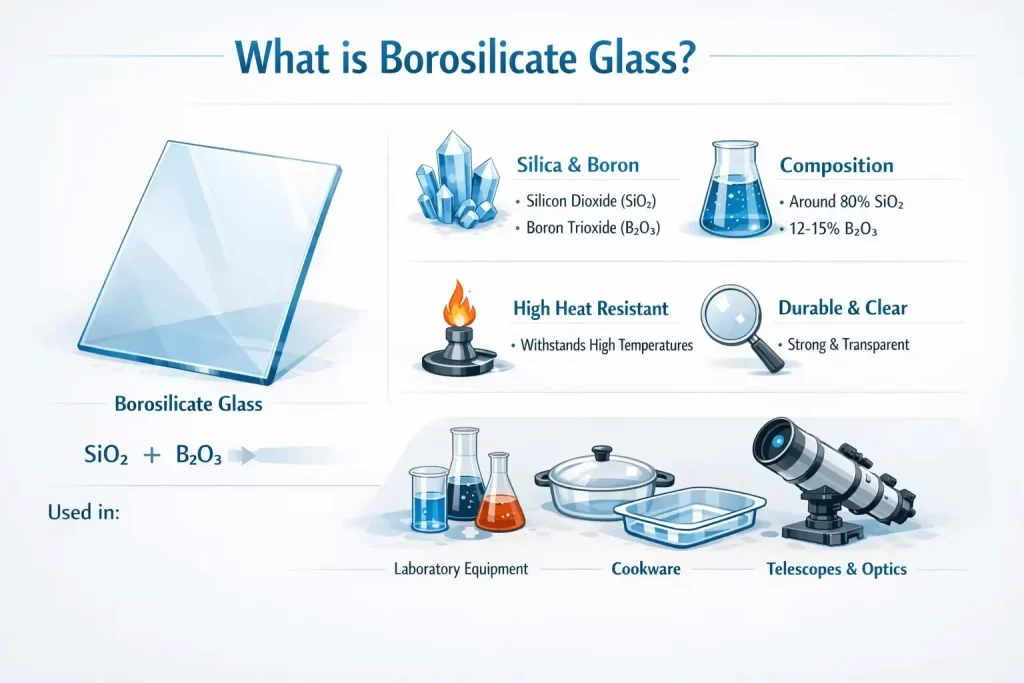
Borosilicate glass is a type of glass composed primarily of silica (SiO₂) with a significant amount of boron oxide (B₂O₃), which lowers thermal expansion and improves chemical resistance.
Unlike ordinary glass, borosilicate glass uses silica as its primary component, with boron oxide added to significantly improve thermal shock resistance. In addition, small amounts of alumina, sodium oxide, and other oxides are included to enhance durability and improve melting properties.
This helps in making it stronger for industrial uses like glass-lined reactors.
Borosilicate Glass Composition: What’s Inside?
Everything that is unique about borosilicate glass is found in its composition.
It typically includes the following materials.
| Component | Percentage | Role |
| Silica | 80-81% | Provides structure to the glass |
| Boric Oxide | 12-13% | Lowers thermal expansion |
| Sodium Oxide | 3-4% | Helps with melting |
| Alumina | 2-3% | Improves durability |

Types of Borosilicate Glass
Not every borosilicate glassware is made up of the same ingredients. There are actually three common types of borosilicate glass used today.
These types are based on numbers like 3.3, 4.9, and 5.4. These values refer to the coefficient of linear thermal expansion ×10⁻⁶/K, which measures how much the glass expands per degree Celsius.
What is this coefficient? It mainly explains how much the glass expands as the temperature increases.
Here are the three main types of borosilicate glass used today based on this coefficient:
| Component | 3.3 Expansion (Clear) | 4.9 Expansion (Clear) | 5.4 Expansion (Amber) |
| SiO₂ | 80.60% | 75.00% | 70.00% |
| B₂O₃ | 13.00% | 10.50% | 7.50% |
| Na₂O | 4.00% | 5.00% | 6.50% |
| Al₂O₃ | 2.30% | 7.00% | 6.00% |
Note: Type 3.3 has the lowest thermal expansion and best thermal shock resistance, ideal for laboratory and industrial applications. Types 4.9 and 5.4 offer higher expansion and moderate resistance, used for specific industrial needs.
Borosilicate Glass Properties
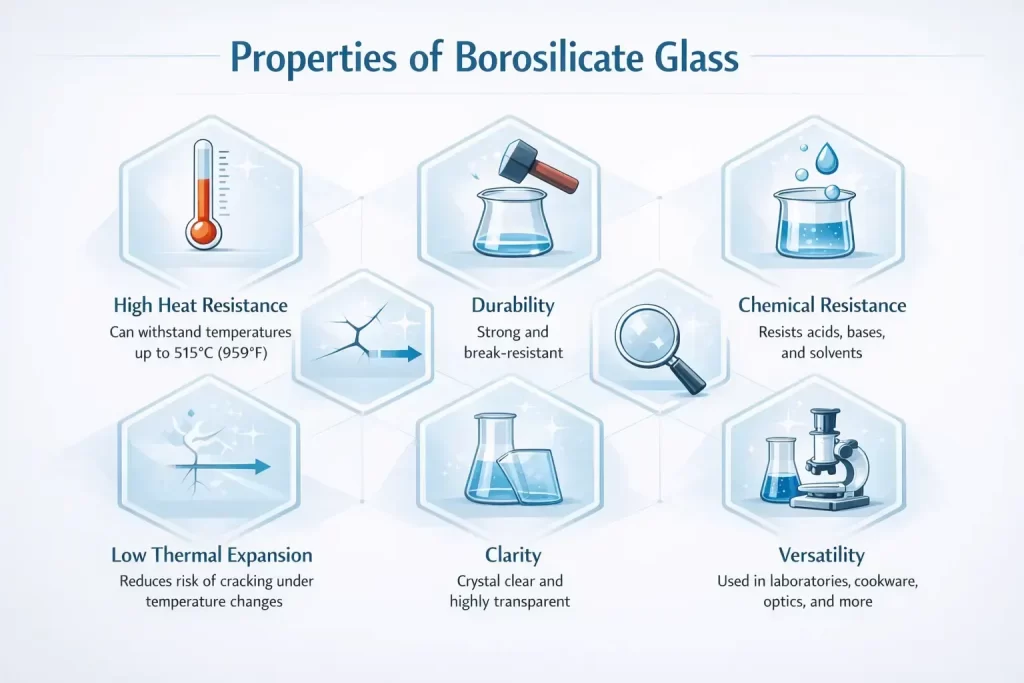
There is no debate that both professionals and common people love borosilicate glass.
Much of this appreciation stems from its borosilicate glass properties. These include:
Thermal Shock Resistance
Borosilicate glass is made to handle sudden temperature spikes.
Borosilicate glass can typically handle rapid temperature changes of up to ~150–160°C, depending on factors such as thickness, shape, and overall design.
How is it able to do it? The secret lies in its low thermal expansion.
Borosilicate glass has the unique ability to expand much less than other glassware as the temperature increases.
Chemical Resistance
Borosilicate glass is also significantly more chemically resistant. Borosilicate glass is highly resistant to most acids and salts at room temperature, making it suitable for a wide range of chemical applications.
However, strong alkalis (such as concentrated sodium hydroxide) and hydrofluoric acid can attack and damage the glass.
Temperature limits
There is a reason why modern kitchens now prefer borosilicate glassware. It is because:
- The softening point of borosilicate glass is approximately 820°C.
- Safe continuous operating temperatures are typically in the range of 200–230°C.
- Actual performance may vary depending on factors such as thickness, shape, and mechanical stress.
Borosilicate Glass Uses
Borosilicate glass is widely used across multiple industries due to its thermal and chemical resistance. Common applications include:
- Laboratory glassware (beakers, flasks, test tubes)
- Pharmaceutical packaging (vials, ampoules, syringes)
- Kitchenware (bakeware, cookware, storage containers)
- Industrial equipment (glass-lined reactors, piping systems)
- Lighting applications (bulbs, protective glass covers)
- Solar panels (protective glass layers)
- Medical devices (specialized components and implants)

Conclusion
Borosilicate glass is quickly becoming one of those discoveries that has made modern life possible.
Planning to use it for any industrial applications, such as jacketed glass reactor systems? Then, you need to find the right supplier.
For your supplier needs, consider partnering with K-Jhil Scientific. They are a leading global manufacturer of borosilicate glassware.
K-Jhil Scientific is a recognized manufacturer of borosilicate glassware, providing
precision-engineered products that meet international quality standards. Their team of experts ensures exceptional support, even after the sale.
With decades of experience in providing top-notch solutions, they are your best option. K-Jhil Scientific will help you realize the full potential of your industrial manufacturing.
Ready to consult the right experts for better production? Contact K-Jhil Scientific today to discuss your exact requirements!
FAQs
1. What is borosilicate glass made of?
Borosilicate glass composition typically includes 80-81% silica (SiO₂), 12-13% boric oxide (B₂O₃), 3-4% sodium oxide, and 2-3% alumina. The boron content is what gives it unique thermal and chemical properties.
2. What makes borosilicate glass special?
The key borosilicate glass properties are excellent thermal shock resistance (handles temperature swings up to 170°C), high chemical resistance to water and acids, and a low coefficient of thermal expansion—about one-third that of ordinary glass.
3. What are the different types of borosilicate glass?
The main types of borosilicate glass are classified by thermal expansion: 3.3 expansion (clear, best thermal resistance), 4.9 expansion (clear, moderate resistance), and 5.4 expansion (amber, lower resistance but UV protection). The 3.3 type is most common for labware and kitchenware.
4. What is borosilicate glass used for?
Common borosilicate glass uses include laboratory glassware (beakers, flasks), pharmaceutical packaging (vials, syringes), kitchen bakeware, industrial equipment, lighting glass, solar panels, and even medical implants.
5. Who are the leading borosilicate glass manufacturers?
When looking for a reliable borosilicate glass manufacturer, companies like K-JHIL Scientific in India have decades of experience producing high-quality glass for pharmaceutical, chemical, and industrial applications with precision engineering and international quality standards.