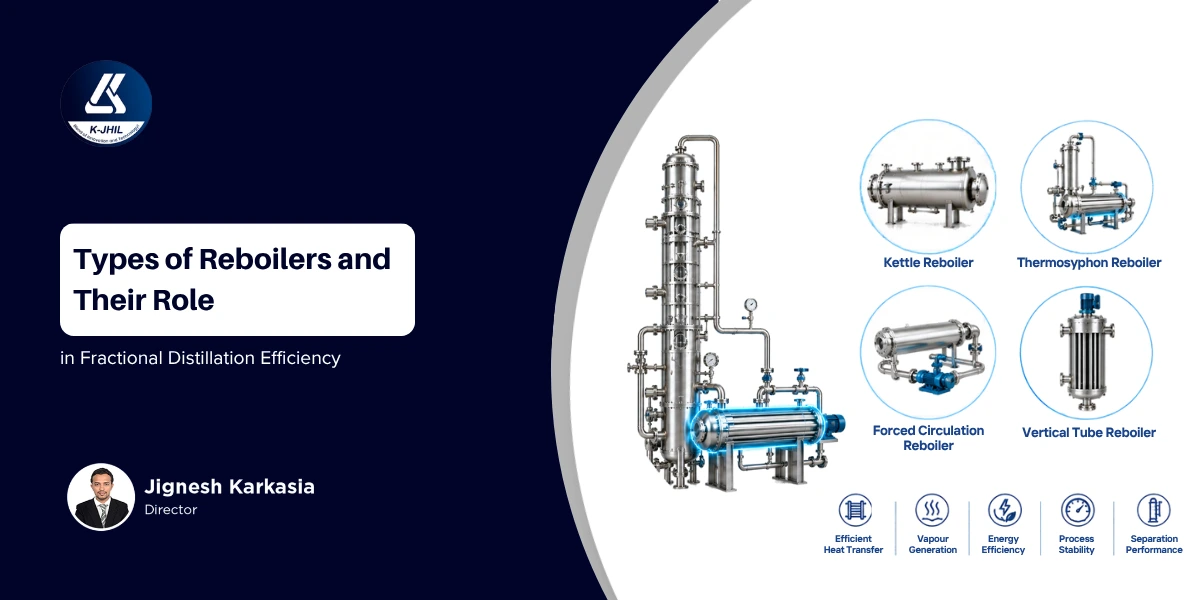

Common reboiler arrangements include kettle, thermosiphon, forced-circulation, and internal reboilers. Fired heaters may be used for specific high-temperature applications. A reboiler is the heat exchanger at the base of a distillation column: it boils part of the bottom liquid to send vapor back up the column, and that boil-up, set against the reflux, is what drives the separation. The type you reach for follows the fluid, the heat duty, the fouling risk, and how much you can spend to run it.
A distillation column requires heat input and appropriate vapor-liquid contact to achieve separation. The types of reboilers you can fit to its base all do one job, boil the bottom liquid back into vapor, but they go about it in very different ways.
Undersize the reboiler, or pick the wrong style, and the column floods, weeps, or just misses spec. It is not a bolt-on accessory. On most columns it is the biggest single lever you have over both separation and energy use.
Most of what we build at K-Jhil is borosilicate and glass-lined distillation gear, so the reboiler is a call we make on nearly every fractional distillation system we put together. What follows is the range of reboiler you actually meet on a column, how each one works, and how the choice feeds into fractional distillation efficiency.
The Main Types of Reboilers
Strip back the catalog and reboilers sort by how they move the boiling liquid past the heat. Some rely on natural circulation, some on a pump, and a kettle just holds a pool and lets it boil. Sort that out and the specific model usually picks itself.
Reboiler Type | How It Works | Best For |
|---|---|---|
Kettle | Liquid boils in an oversized shell, heating medium in the tubes | Wide turndown, high vaporization, fouling service |
Vertical thermosiphon | Natural circulation, process fluid boils in the tubes | Clean fluids, compact plants, low running cost |
Horizontal thermosiphon | Natural circulation, process fluid boils in the shell | Larger duties, lower headroom |
Forced circulation | A pump drives the liquid through the exchanger | Viscous, fouling, or vacuum service |
Internal (stab-in) | Tube bundle sits inside the column sump | Small duties, tight budgets, saving a shell |
Fired heater | A furnace heats the bottoms directly | Very high temperature, high-boiling bottoms |
The first four cover most distillation duty. The internal and the fired sit at the two ends, the cheapest small job and the hottest big one.
Reboiler Working Principle
Strip it down, and the reboiler working principle is not complicated. Liquid is drawn off the bottom of the column, heat is put into it, a fraction of it boils, and that vapor goes straight back up the column as boil-up.
Boil-up is one half of what makes a column separate anything. Reflux washes liquid down from the top, boil-up pushes vapor up from the bottom, and the two trade light and heavy components across every tray or through the packing. Our explainer on how fractional distillation works walks that loop end to end.
There is a subtlety worth knowing. A reboiler that boils its liquid all the way to equilibrium behaves as one theoretical stage on its own, so it gets counted as part of the column rather than a heater tacked on underneath.
BY THE NUMBERS: A partial reboiler that brings its liquid to equilibrium contributes roughly one theoretical separation stage. Reboiler duty sets the boil-up rate, and it is often a major contributor to the energy consumption of a distillation column, so the type and the design decide much of the running bill.
Kettle Reboiler
The kettle reboiler is what you reach for when the column needs a lot of vapor and a wide operating range. Liquid fills an oversized shell, the heating medium runs through a submerged tube bundle, and vapor separates out in the space above the pool before heading back into the column.
What earns the kettle its place is that big shell. It leaves plenty of room for vapor to disengage, shrugs off high vaporization rates, and copes with fouling and swinging loads far better than a natural-circulation unit can.
None of that is free. A kettle runs bulkier and costs more than a thermosiphon of the same duty, and its heat-transfer coefficient tends to be lower, so the flexibility shows up on both the price tag and the plot plan.
Thermosiphon Reboiler
A thermosiphon reboiler does away with the pump entirely. The two-phase mixture leaving the reboiler is lighter than the liquid feeding in, and that density difference alone is enough to keep a natural circulation loop turning.
You will see it built two ways. A vertical thermosiphon boils the process fluid inside the tubes and suits clean fluids and compact plants, whereas a horizontal thermosiphon boils it in the shell and handles larger duties where headroom is short.
Cheap to run and a strong heat-transfer performer, the thermosiphon still has a temperament. Thermosiphon performance depends on liquid level, pressure drop, heat input, and vaporization rate, so proper design and control are important.
Forced Circulation Reboiler
Once natural circulation gets unreliable, a pump has to step in. A forced circulation reboiler pushes the liquid through the exchanger under pressure, so the flow rate stops depending on a fragile density balance and becomes something you set.
Forced circulation can be advantageous for viscous, fouling, slurry, or certain vacuum services because the pump maintains controlled circulation.
The downside is the pump itself. It brings extra capital, extra power draw, and one more rotating machine to keep maintained, which is why a forced circulation unit shows up when the service genuinely calls for it rather than as a first choice.
Internal and Fired Reboilers
Two more designs sit at the edges of the range. An internal, or stab-in, reboiler slides a tube bundle straight into the column sump, which saves you a separate shell and its piping and works well for small duties on a tight budget, though the heat-transfer area is limited and maintenance is more awkward.
A fired heater goes the opposite way. Fired heaters may be used when conventional heating utilities cannot economically provide the required temperature. This setup is common on refinery towers but rare on the glass and specialty systems most Indian plants run.
Reboiler Design for a Distillation Column
This is the point where a reboiler stops being a stock heat exchanger and turns into a piece of the column. Sound reboiler design for distillation column duty starts from the process it has to serve, not from a heat-exchanger catalog.
The unit has to match the boil-up the separation demands, the fouling and viscosity of the bottoms, whatever heating medium you have on site, and the space and budget you are working within. Our breakdown of the key components of a fractional distillation unit shows where the reboiler fits alongside the column, condenser, and reflux divider.
In practice, reboiler design for distillation column service works through a short, ordered set of checks:
- Duty and boil-up: Size the heat input to the vapor rate the separation needs, with margin for startup and swings.
- Fluid and fouling: Clean and low-viscosity favors a thermosiphon, while fouling or viscous bottoms push toward a kettle or forced circulation.
- Heating medium and temperature: Steam is commonly used, while hot oil, other heat-transfer fluids, or fired heaters may be selected when higher temperatures are required.
- Layout and cost: Headroom, plot space, and running cost decide between vertical, horizontal, and kettle arrangements.
The Reboiler’s Role in Fractional Distillation Efficiency
A fractional column gets its sharp cuts from vapor and liquid meeting over and over, and it is the reboiler that keeps feeding vapor into that exchange. Starve it of boil-up and the column never reaches the purity you need. Excessive boil-up can increase energy consumption and may cause hydraulic limitations such as flooding.
So the reboiler is no background utility here. Together with the reflux ratio, it sets the balance the whole separation rides on, and matching the reboiler type and duty to that separation is most of what fractional distillation efficiency really depends on.
How a Fractional Distillation Machine Differs from a Simple Distillation Unit
This is also where a fractional distillation machine parts company with a simple distillation unit, which makes only a single rough cut in one pass and is fine when the components boil far apart.
A fractional distillation system uses repeated vapor-liquid contact within a column to achieve greater separation than simple distillation. It stacks many separation stages inside one column, all of them driven by the reboiler and reflux together, and that is what lets it pull close-boiling mixtures apart cleanly where a simple distillation unit cannot.
Getting the Reboiler Right for Your Column
Run through all the types of reboilers here and the same conclusion keeps surfacing. The right one is the one matched to your boil-up, your fluid, and the column it feeds, not the one that happens to fit a stock spec sheet.
At K-Jhil Scientific, we build borosilicate and glass-lined distillation systems and specify the reboiler around the separation, not the other way round. If you are scoping a column and want the reboiler sized to your duty and your bottoms, Contact Us before the system is finalized.
Frequently Asked Questions About Types of Reboilers
1: What are the main types of reboilers?
The kettle, the vertical and horizontal thermosiphon, the forced circulation, and the internal or stab-in reboiler, plus fired heaters for very high temperature bottoms. Most distillation columns use one of the first four.
2: What is the reboiler working principle?
A reboiler boils part of the liquid drawn from the column bottom and returns the vapor to the column as boil-up. That vapor, meeting the reflux liquid, drives the separation. A partial reboiler may be counted as one theoretical equilibrium stage when the exiting liquid and vapor are assumed to be in equilibrium.
3: What is a kettle reboiler?
A shell-and-tube reboiler where liquid boils in an oversized shell around a submerged tube bundle carrying the heating medium. The large disengagement space suits high vaporization, wide turndown, and fouling service.
4: What is a thermosiphon reboiler?
A reboiler that circulates by natural density difference rather than a pump, in vertical or horizontal form. It is compact and cheap to run but sensitive to the column base level and the vaporization fraction.
5: What is a forced circulation reboiler?
A reboiler where a pump drives the liquid through the exchanger, so circulation does not rely on a density balance. It suits viscous, fouling, slurry, or deep-vacuum service at the cost of pump capital and power.
6: What is the difference between a kettle and a thermosiphon?
A kettle boils liquid in an oversized shell and gives high vaporization and wide turndown at higher cost, while a thermosiphon uses natural circulation and is cheaper and more compact but more sensitive to operating conditions.
7: How does a reboiler affect fractional distillation efficiency?
It supplies the boil-up that drives vapor-liquid contact. Too little and the column cannot reach purity, too much and it floods and wastes energy, so reboiler type and duty set much of a column’s efficiency.
8: What drives reboiler design for a distillation column?
The boil-up the separation needs, the fouling and viscosity of the bottoms, the heating medium and temperature, and the layout and cost on site. Reboiler design for distillation column duty starts with the process, not a stock exchanger.
9: What is the difference between a simple distillation unit and a fractional distillation machine?
A simple distillation unit makes one rough separation in a single pass, while a fractional distillation machine uses many stages, driven by the reboiler and reflux, to split close-boiling mixtures sharply.
10: Which reboiler is used for viscous or fouling fluids?
A forced circulation unit, since its pump keeps velocity and wall shear up regardless of the boil-up. A kettle is also more fouling-tolerant than a natural-circulation thermosiphon.
11: Is the reboiler part of the distillation column?
Yes. It is the heat source at the base of the column, and because a partial reboiler brings its liquid to equilibrium, it is counted as one of the column’s theoretical stages.