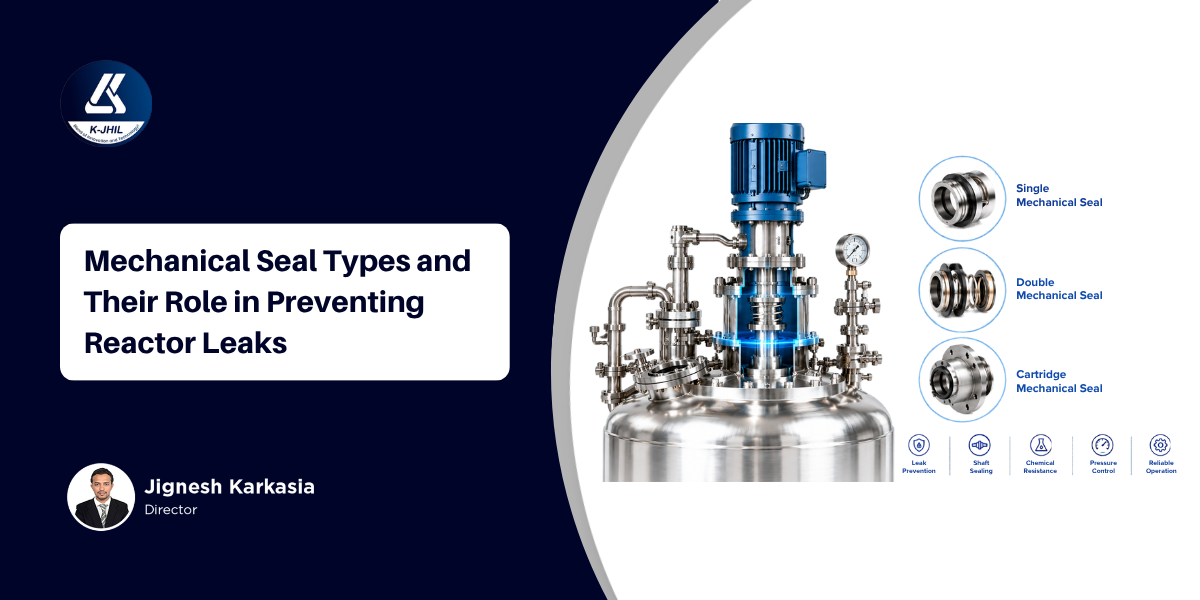

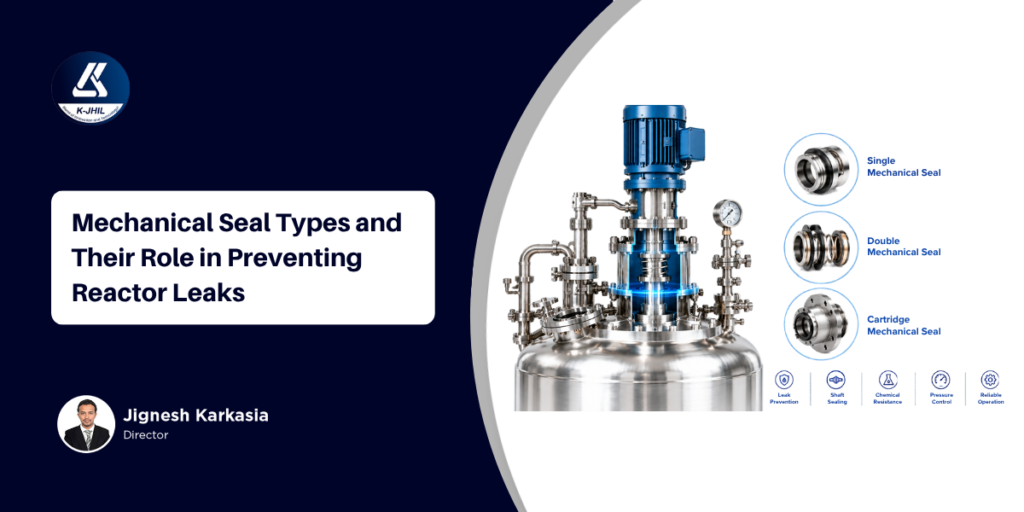
Mechanical seal types fall into a few groups by how they contain the process fluid: a single seal for clean, low-hazard duty, a double seal with a barrier fluid for toxic, volatile, or vacuum service, and a cartridge mechanical seal that arrives pre-set as a drop-in unit. They all work the same way, two lapped faces held together by a spring, one turning with the shaft and one fixed, riding on a thin film. On a reactor, the seal sits where the agitator shaft enters the vessel, so it is the part that decides whether a batch stays in or leaks out.
The agitator shaft seal is a critical potential leakage point because the shaft must rotate while the vessel remains sealed.
Seal that entry well, and the batch stays contained under heat, pressure, or vacuum. Seal it badly, and you lose product, or worse, vapor into the room.
This guide runs the seal types you meet on process equipment, how each contains a leak, and which one belongs on a reactor. We build the vessels and specify these seals ourselves, so the reactor part comes from the floor, not a bearing catalog. If you want the vessels first, our note on the continuous stirred tank reactor sets the stage.
The Main Mechanical Seal Types
Strip back the catalog and every seal sorts by how it contains the fluid and how it is packaged. Get that right, and the exact model mostly follows.
A single seal uses one pair of faces to hold the fluid in. A double mechanical seal uses two sealing face sets with a fluid between them. Depending on the design, this may be a pressurized barrier fluid or an unpressurized buffer fluid.
A cartridge is not a separate sealing principle, it is any of these built onto a sleeve as a pre-set unit.
Type | How It Contains the Leak | Best For |
|---|---|---|
Single seal | One face pair holds the fluid in | Clean, non-hazardous, low-vacuum duty |
Double seal | Two face pairs with barrier fluid between | Toxic, volatile, or vacuum service |
Cartridge seal | Any type, pre-assembled on a sleeve | Reliable fitting, retrofits, glass-lined shafts |
Gland packing | Braided rings compressed in a stuffing box | Older or low-duty service, tolerates a drip |
The first three are mechanical seals proper. The last, gland packing, is the older method they replaced, and it still turns up, so it earns a section of its own further down.
The Mechanical Seal Working Principle
The mechanical seal working principle is simpler than the hardware looks. Two flat faces are pushed together, one fixed to the housing and one turning with the shaft, and they run on a film of fluid microns thick.
A spring keeps the faces in contact as they wear and as the shaft moves. Secondary seals, usually O-rings, close the small gaps around the faces so fluid cannot slip past the back of them.
That thin film is the whole trick. Too much and the seal leaks, too little and the faces run dry and burn, so the film has to sit in a narrow band. Kept in that band, a mechanical seal leaks far less than any packed gland ever could.
BY THE NUMBERS: A well-run mechanical seal leaks in vapor-level amounts, often too little to see, while gland packing normally requires controlled leakage for lubrication and heat removal. That gap is why hazardous and regulated duty moved to seals, and why standards like API 682 exist to specify them for demanding service.
Single Mechanical Seal vs Double Mechanical Seal
The split between one seal and two is really a split by hazard. It is the first call on any reactor.
A single mechanical seal uses one face pair to hold the process fluid in. It suits clean, non-hazardous batches at modest pressure, it costs less, and it is simpler to maintain. For a lot of routine chemical duty, a single seal is all a reactor needs.
A double mechanical seal puts two face pairs in series with a barrier fluid held between them, usually at a pressure above the process. Any leak crosses into the barrier, not into the room, which is why a double seal is the standard for toxic, flammable, or vapor-sensitive batches. It also lubricates and cools the faces, which matters on a dry or abrasive service.
Vacuum service requires a sealing arrangement designed to prevent air ingress; depending on the application, this may include a pressurized double seal.
Cartridge Mechanical Seals
A cartridge seal solves a fitting problem, not a sealing one. It is a single or double seal built onto its own sleeve and gland, set at the factory and dropped on as one piece.
The payoff is that nobody has to measure and set spring compression on site. The cartridge seal is factory-assembled and preset, helping simplify installation and reduce installation errors. Faces are protected during fitting, and the guesswork that wrecks a hand-assembled seal is gone.
On a reactor that matters twice over. A glass or glass-lined shaft does not forgive rough handling, so a cartridge seal that fits right the first time protects both the seal and the vessel.
Mechanical Seal Materials
A seal is only as good as the faces and the elastomers, and this is where the process fights back. Mechanical seal materials get chosen against the chemistry, the temperature, and the abrasives in the batch.
- Seal faces: Carbon runs against a hard mate such as silicon carbide or ceramic. Silicon carbide seal faces provide excellent wear and corrosion resistance and may be selected for abrasive or chemically aggressive services.
- Secondary sealing elements: may use elastomers such as FKM or FFKM, while PTFE-based materials may be used in specific sealing designs.
- Metal parts: Springs and hardware in stainless or a higher alloy such as Hastelloy for corrosive duty.
The wrong face or O-ring is a leak waiting to happen. For a reactor running mixed or corrosive chemistry, seal materials are specified against the worst thing the vessel will ever see, not the average batch.
Mechanical Seal vs Gland Packing
The mechanical seal vs gland packing question comes up on every older vessel, and it is worth settling plainly.
Gland packing is braided rings compressed into a stuffing box around the shaft. It is cheap, tolerant of misalignment, and it seals by staying slightly loose, which means it is meant to weep a little to stay cool. That drip is fine for water and awkward for a solvent or a toxic batch.
Factor | Mechanical Seal | Gland Packing |
|---|---|---|
Leakage | Vapor-level, often none visible | Drips steadily by design |
Hazardous fluids | Suited, especially double seals | Not suited |
Upfront cost | Higher | Low |
Maintenance | Less frequent, more involved | Frequent gland adjustment, repacking |
Shaft wear | Low, runs on a fluid film | Higher, abrades the sleeve |
For hazardous or regulated fluids where low leakage and emissions control are important, mechanical seals are often preferred. Packing survives on water and low-duty service, and the seal takes everything else.
Choosing a Mechanical Seal for Reactor Service
Here the seal stops being a generic part and becomes part of the vessel. On a continuous stirred tank reactor the shaft turns without a rest, so the seal works every second the batch runs. This is where we spend the most time on a build, because the seal, the shaft, and the process all pull on the choice.
The right mechanical seal for reactor service depends first on the hazard. A clean, low-risk batch runs on a single seal, while a toxic, flammable, or vacuum batch wants a double seal with a barrier system behind it. The rule is simple: match the seal to the worst case the batch can present.
In a jacketed glass reactor system, the seal also has to respect the glass. A glass or glass-lined shaft runs true only within limits, so the seal has to tolerate a little runout without loading the faces unevenly, which is why cartridge designs suit these vessels.
Seal trouble also shows up as process trouble, a lost vacuum, a slow leak, a batch that will not hold temperature. Our guide on troubleshooting jacketed glass reactors covers how a failing seal reads on the floor, long before it drips.
Specifying a Seal for a Continuous Stirred Tank Reactor
Strip the brand names off, and specifying a mechanical seal for reactor duty is a short, ordered set of checks.
- Start with the fluid and the hazard: Toxic, flammable, or under vacuum points to a double seal. Clean and low-risk allows a single.
- Match the materials to the chemistry: Faces and O-rings are picked against the acids, solvents, and abrasives in the batch, not a generic spec.
- Respect the shaft: A glass or glass-lined shaft wants a cartridge seal that tolerates runout and fits without field guesswork.
- Plan the support system: A double seal needs a barrier fluid, and often a small reservoir or flush, so scope that with the vessel.
Getting the Seal Right for Your Reactor
Take the whole run of seal types together, and one thing holds: the seal has to match the hazard, the chemistry, and the shaft, not a stock part number. Get those right, and the shaft entry stops being the weak point on the vessel.
At K-Jhil Scientific, we build glass and glass-lined reactors and specify the shaft seal around the process, not the other way round. If you are scoping a reactor and want the seal matched to your batch and your safety case, Contact Us before the vessel is finalized.
Frequently Asked Questions About Mechanical Seal Types
1: What are the main mechanical seal types?
They sort by containment and packaging: one face pair for clean, low-hazard duty, two face pairs with a barrier fluid for toxic or vacuum service, and a pre-set cartridge unit for reliable fitting. Gland packing is the older method they largely replaced.
2: What is the mechanical seal working principle?
Two lapped faces are held together by a spring, one turning with the shaft and one fixed, running on a fluid film only microns thick. That film keeps leakage to vapor level while stopping the faces from running dry.
3: What is the difference between single and double seals?
A single mechanical seal uses one face pair to hold the fluid in, suited to clean, low-hazard duty. A double mechanical seal adds a second pair and a barrier fluid, containing toxic, flammable, or vacuum service.
4: What is a cartridge mechanical seal?
A single or double seal built onto its own sleeve and gland, pre-set at the factory and fitted as one unit. It removes the need to measure spring compression on site and protects the faces during fitting.
5: What mechanical seal materials are used?
Faces are usually carbon against silicon carbide or ceramic, or silicon carbide against silicon carbide for abrasives. Secondary O-rings are PTFE, FKM, or FFKM, and metal parts are stainless or a higher alloy, all chosen against the process chemistry.
6: Mechanical seal vs gland packing, which is better?
For hazardous or regulated fluids, a mechanical seal wins on leakage, shaft wear, and safety. Gland packing is cheaper and tolerant of misalignment, but it drips by design and suits only water or low-duty service.
7: What mechanical seal goes on a reactor?
It depends on the batch. A clean, non-hazardous reactor may use a single seal, while hazardous, emissions-sensitive, or vacuum applications may require a double seal or another suitable arrangement.
8: Why do reactors leak at the agitator shaft?
Because the shaft has to turn while the vessel stays sealed, the shaft entry is the one moving joint on the reactor. The mechanical seal there is what contains the fluid, and a worn or wrong seal is where leaks begin.
9: What seal is used for vacuum service?
A pressurized double seal, or a similar dual arrangement, since a single seal can draw air in under vacuum. This matters on distillation and drying batches run in a jacketed glass reactor.
10: What is a barrier fluid?
A barrier fluid is a clean fluid used between the sealing face sets of a pressurized double seal, typically maintained above process pressure. An unpressurized double seal uses a buffer fluid. Any leak crosses into the barrier rather than into the product or the room, and it also cools and lubricates the faces.
11: What standard covers mechanical seals?
API 682 provides requirements and guidance for mechanical seals and seal support systems within its stated scope and should be applied to reactor service where relevant.