
QUICK ANSWER
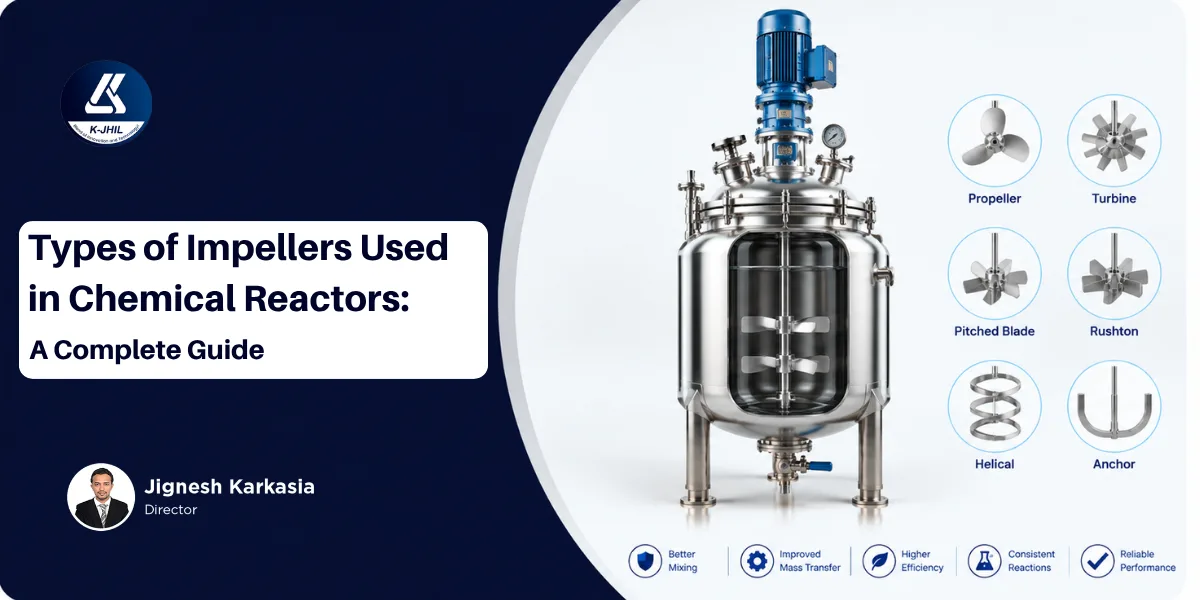
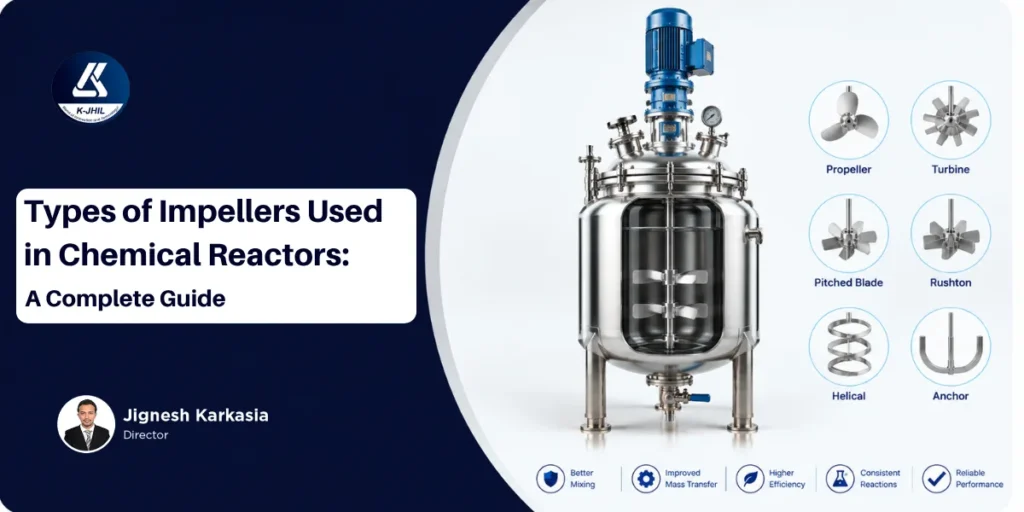
The main types of impellers in a chemical reactor sort by the flow they create: radial-flow turbines like the Rushton for shear and gas dispersion, axial-flow hydrofoils and propellers for gentle high-volume blending, mixed-flow pitched-blade turbines for solids suspension, and close-clearance anchor and helical impellers for thick, high-viscosity batches. What fits depends on the batch viscosity, the flow and shear the reaction needs, and the reactor around it. Match those and the batch mixes evenly; miss on one and you burn power or leave the corners unmixed.
The vessel gets the attention. The impeller does the work.
Spin the wrong blade in a good reactor and the chemistry still suffers. Dead zones in one corner. A jacket that cannot keep the heat moving.
We build glass and glass-lined reactors. The question we field most is not about the glass, it is which agitator goes inside, and why.
This guide walks the impeller types you meet in chemical service and how to pick one for the batch and the reactor. If you want the vessels themselves first, our guide to the different types of chemical reactors sets the stage. Process first, hardware second.
The Main Types of Impellers, by Flow Pattern
Strip back the catalog and impellers group into four flow classes: radial, axial, mixed-flow, and close-clearance. Get the class right and the blade mostly follows.
Radial-flow impellers throw liquid out to the wall. High shear, right at the blade.
Axial-flow impellers drive it down the shaft and back up in a loop. Big volumes, low shear.
Mixed-flow impellers do both at once, driving liquid out and down together.
Close-clearance impellers sweep the wall itself. They are for thick liquids that will not move on their own.
Impeller | Flow Pattern | Relative Power | Best For |
|---|---|---|---|
Rushton turbine | Radial | High | Gas dispersion, high shear |
Pitched-blade turbine | Mixed axial and radial | Moderate | Solids suspension, blending |
Hydrofoil | Axial | Low | High-flow blending, low shear |
Propeller | Axial | Low | Small-scale, low-viscosity mixing |
Anchor | Close-clearance | Moderate to high | High-viscosity, wall heat transfer |
Helical ribbon | Close-clearance | High | Very high-viscosity, laminar |
Power numbers depend on impeller geometry and the flow regime, set by the Reynolds number, and viscosity limits shift with the fluid and the vessel. Read the table as a starting point, not a spec sheet.
BY THE NUMBERS As a rough guide in the turbulent regime, a radial Rushton turbine draws several times the power of an axial hydrofoil at the same size and speed. The exact power numbers depend on impeller geometry and the flow regime, so treat them as ranges, not fixed values.
Close-clearance impellers come into their own as viscosity climbs into the tens of thousands of centipoise, where open impellers struggle to circulate the batch. The exact crossover depends on the fluid, the impeller, and the vessel.
Radial-Flow Turbine Impellers
The turbine impeller is the workhorse of reactor mixing, and the Rushton is its best-known face. A flat disc carries the blades, so liquid gets thrown hard at the wall. That radial throw is why the turbine rules gas dispersion and any job that needs shear.
It pays for that shear in power. A standard Rushton draws far more power than an axial blade of the same size and speed, several times as much in the turbulent regime.
Flat-blade and curved-blade turbines soften the shear a little. They still stay firmly in the radial camp.
Need to break up a gas or drive fast mass transfer? The turbine earns its keep. For gentle blending, it is overkill and a power bill.
Axial-Flow Hydrofoil and Propeller Impellers
When the job is moving a lot of liquid gently, the hydrofoil impeller is the answer. Narrow, airfoil-shaped blades push the fluid down the shaft in a tall loop. High flow, very little power, near a 0.3 power number.
That low shear is the point. A hydrofoil impeller blends miscible liquids and keeps light solids moving at low shear, which is gentler on shear-sensitive products. Pharma blending leans on it for exactly that reason.
The marine propeller does the same axial job at small scale, on portable and lab mixers.
Between the two sits the pitched-blade turbine, blades angled to throw flow both down and out. It is the all-rounder, decent at suspending solids and blending at a moderate power number.
Anchor and Close-Clearance Impellers for High Viscosity
Thick batches break the open-impeller rules. As viscosity climbs into the tens of thousands of centipoise, an open impeller struggles to circulate the liquid, and that is where close-clearance designs, the anchor impeller chief among them, take over, sweeping close to the wall and dragging the whole mass around.
The anchor earns its keep two ways. It moves viscous fluid a turbine would just drill a hole through. And fitted with wall scrapers, it clears the film off the wall, so heat keeps moving into or out of the jacket instead of baking onto the glass.
For even thicker material, the helical ribbon spirals the batch top to bottom in the slow laminar regime.
These run slow and close. The gap between blade and wall is small, so the fit to the reactor matters more than it does with any open impeller.
Choosing Impellers for CSTRs and Jacketed Glass Reactors
Here the impeller stops being a generic blade. It becomes part of the reactor, and the vessel and its jacket pull the choice as hard as the process does.
A CSTR lives or dies on uniformity. Fresh feed has to blend into the bulk before it leaves. A continuous stirred tank reactor that mixes unevenly runs its reactions at the wrong concentration, so it often uses an axial or mixed-flow impeller to turn the whole volume over, though the right choice still depends on the viscosity, the reaction, and the duty.
In a jacketed glass reactor system, the impeller and the jacket work as a pair. A viscous batch often uses an anchor, sometimes with wall scrapers, to keep liquid moving near the wall so the jacket can pull the heat; a strongly exothermic batch needs enough heat-transfer duty, which points to an anchor only when the viscosity calls for it. A thin reaction is happier with a hydrofoil turning the bulk.
Reactor Agitator Design and Selection
Strip the brand names off and reactor agitator design comes down to a handful of questions, taken in order.
- Start with viscosity: It sets the whole camp, open impellers for thin and medium fluids, close-clearance for thick.
- Match the flow to the job: Axial for blending and suspension, radial for shear and gas, mixed for a bit of both.
- Size the impeller to the vessel: The blade-to-tank diameter ratio depends on the impeller and the duty, smaller for high-shear turbines and much larger for close-clearance anchors, and it sets how the flow fills the reactor.
- Check power and tip speed: The power number helps size the motor, and tip speed is one guide to the shear a fragile product feels, alongside impeller geometry, power input, and the flow regime.
Good agitator design also respects the vessel. Our breakdown of glass-lined reactor agitator types covers how these choices land in an enamel vessel, where the geometry is not fully open to change.
Getting the Impeller Right for Your Reactor
Take the whole run of impeller types together and one truth holds: the blade has to match the batch and the vessel, not a catalog default. Get the viscosity and the flow right, then size the blade to the reactor. Do that and the mixing looks after itself.
At K-Jhil Scientific, we build glass and glass-lined reactors and specify the agitator around the process, not the other way round. If you are scoping a reactor and want the impeller sized to your batch and your jacket, Contact Us before the vessel is finalized.
Frequently Asked Questions About Types of Impellers
1: What are the main types of impellers used in chemical reactors?
A: They sort by flow pattern: radial-flow turbines like the Rushton, axial-flow hydrofoils and propellers, mixed-flow pitched-blade turbines, and close-clearance anchor and helical ribbon impellers for high viscosity.
2: What is the difference between axial and radial flow impellers?
A: Axial-flow impellers push liquid down the shaft and back up in a loop, good for blending and suspension. Radial-flow impellers throw liquid out to the wall, building the high shear needed for gas dispersion.
3: What is a turbine impeller used for?
A: High shear and gas dispersion. The Rushton turbine, with flat blades on a disc, produces strong radial flow at a high power number, which suits fast mass transfer and gas-liquid reactions.
4: What is a hydrofoil impeller?
A: An axial-flow impeller with narrow, airfoil-shaped blades that moves a large volume at low shear and low power. It suits blending and light solids, and its low shear is gentler on shear-sensitive products.
5: When do you use an anchor impeller?
A: For high-viscosity batches, typically in the tens of thousands of centipoise, where open impellers struggle to circulate the fluid; the exact point depends on the fluid and the vessel. The anchor impeller sweeps close to the wall, and with a wall-scraper design it also clears the film to help jacket heat transfer.
6: Which impeller suits a continuous stirred tank reactor?
A: Often an axial or mixed-flow impeller, since a continuous stirred tank reactor needs the whole volume turned over so fresh feed blends into the bulk. The final choice still depends on the viscosity and the process.
7: What impeller goes in a jacketed glass reactor?
A: It depends on viscosity. A viscous batch often uses an anchor, sometimes wall-scraping, to keep liquid moving for heat transfer, while a thin, low-viscosity reaction runs well on a hydrofoil; the choice follows the viscosity and heat duty, not the exotherm alone.
8: What is a pitched-blade turbine?
A: A turbine with blades angled around 45 degrees, giving mixed axial and radial flow. It draws moderate power and is a versatile choice for suspending solids and general blending.
9: What factors drive reactor agitator design?
A: Viscosity first, then the flow pattern the process needs, the shear a product can take, the power number and tip speed, and the impeller-to-vessel ratio. The reactor and its jacket constrain the final choice.
10: What is a power number?
A: A dimensionless measure of how much power an impeller draws, set by its geometry and the flow regime through the Reynolds number. It is higher for radial turbines than for axial hydrofoils, so flow pattern has a large effect on the energy bill.
11: What impellers are used in glass-lined reactors?
A: The enamel constrains the geometry, so glass-lined reactors use specific agitator designs, including retreat-curve and adapted turbine or anchor types, chosen to suit both the process and the lining.