
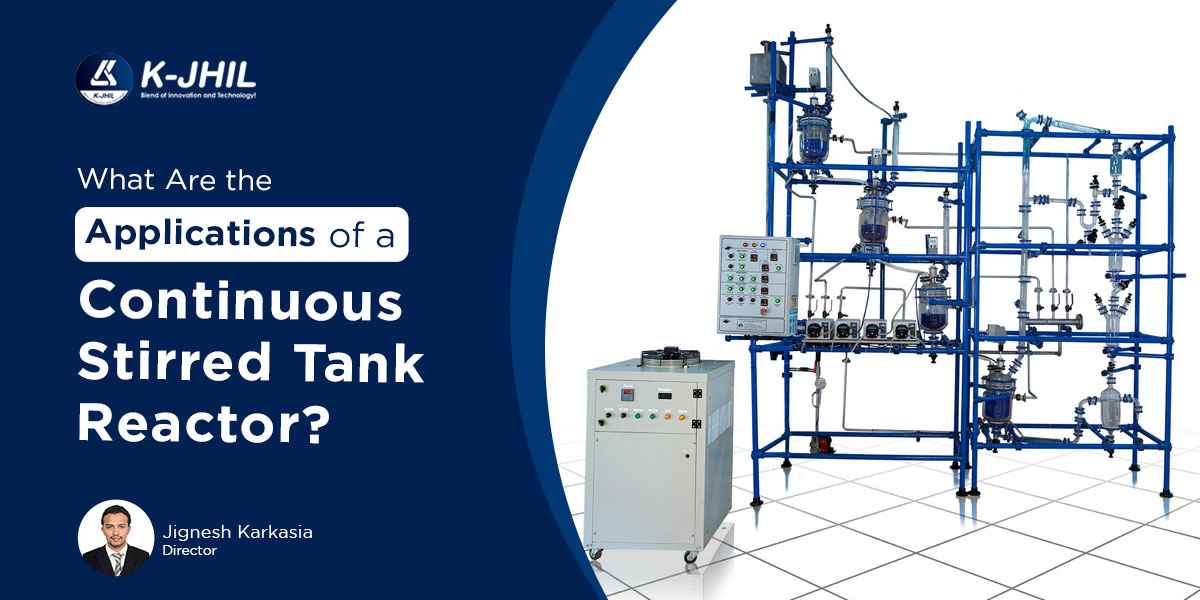
A continuous stirred tank reactor is one of the most important engineering marvels in the world of chemical processing.
It’s an array of mixers that operate under a steady state without ever stopping.
However, beyond this basic principle of continuous operation, CSTRs have extremely specific applications.
They can help you create life-saving pharmaceuticals, treat wastewater, and even produce clean energy.
In this blog, we will explore 9 applications of CSTRs that are revolutionizing efficiency, safety, and product quality across industries.
Let’s dive in!
Applications of a Continuous Stirred Tank Reactor: Table of Contents
- What is a Continuous Stirred Tank Reactor?
- The Applications of a Continuous Stirred Tank Reactor
- Get a Customized CSTR for Your Application from K-Jhil
- Applications of CSTRs: FAQs
What is a Continuous Stirred Tank Reactor?
A CSTR is a vessel where reactants are continuously fed in, and products are continuously drawn out, all while being perfectly mixed.
Think of it like this: a CSTR is a reactor that facilitates reactions in a smooth, uninterrupted flow. The working principle of a CSTR is thus that it operates in a constant flow at a “steady state” is the essence of a Continuous Stirred Tank Reactor (CSTR).
It’s like a perfectly managed kitchen where ingredients are always being added, and you can keep everything consistently blended through an impeller. As a result of this, the final product always comes out at the same rate.
This “steady-state” operation is the key differentiator. Unlike batch reactors (where conditions change from start to finish), a CSTR maintains uniform temperature, concentration, and composition throughout the entire vessel at all times.
This isn’t just a minor technical detail. It’s the foundation for achieving unmatched consistency, scalability, and efficiency in industrial processes.
The Applications of a Continuous Stirred Tank Reactor
1. Crystallization Processes
Crystallization is the process of forming solids with precise size, shape, and purity.
Inconsistency here leads to downstream filtration problems, variable product performance, and ultimately, lost revenue.
One option you can use is a batch crystallizer. But they are prone to “batch-to-batch” variation. Because conditions change over time, the crystals formed at the start of the process can be very different from those at the end.
A CSTR eliminates this. It provides a constant, controlled environment for consistent crystallization. This is critical for achieving a tight, consistent Crystal Size Distribution (CSD), which is often impossible to replicate reliably in a batch system.
Benefits of Using CSTRs for Crystallization
- Predictable Product Quality: Produce crystals with a uniform size and shape, batch after batch.
- Increased Throughput: Move from a stop-start batch process to a continuous, high-capacity operation.
- Reduced Operational Costs: Minimize product waste, improve filtration and drying efficiency, and lower manual oversight.
2. Polymerization Reactions
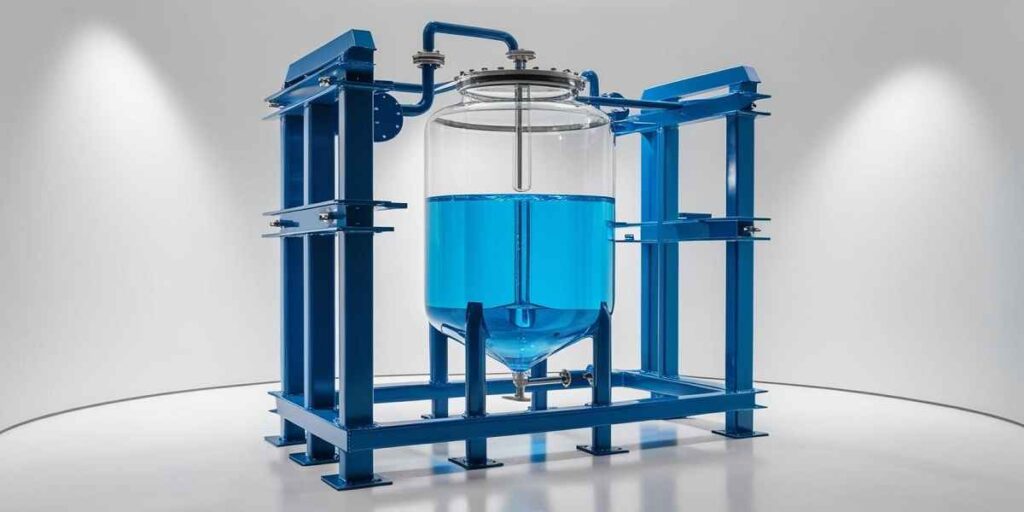
Polymerization transforms monomers into polymers, a process notorious for generating intense heat. Therefore, you will need a reactor system that offers precise molecular control.
In addition to thermal runaways, inconsistent conditions can lead to weak polymers and gel formation.
This is why tubular or batch reactors are not the best systems for polymerization reactions. They can develop hot spots, leading to a broad molecular weight distribution and unpredictable polymer properties.
A CSTR solves this through perfect mixing. It instantly dilutes the new reactant feed and distributes heat evenly throughout the vessel. This prevents temperature spikes and ensures every polymer chain grows in a uniform environment, which is essential for a narrow Molecular Weight Distribution (MWD).
Benefits of Using CSTRs for Polymerization:
- Superior Polymer Properties: Achieve consistent molecular weight and MWD for polymers with reliable strength, viscosity, and performance.
- Enhanced Process Safety: Mitigate the risks of thermal runaway reactions, protecting both personnel and equipment.
- Operational Efficiency: Maintain continuous, high-output production for better asset utilization than batch systems.
3. Bioreactor Operations
Bioreactor operations are used to cultivate microorganisms or cells that produce biofuels, enzymes, or other biochemicals.
These living systems are highly sensitive to even the smallest fluctuations in temperature, pH, and nutrient levels.
While you can use traditional bioreactors, they are not ideal for maintaining a perfectly stable environment that leads to optimal growth. Any deviation can stress the organisms and thus lead to suboptimal outcomes.
A CSTR (often called a chemostat in biology) excels by maintaining a constant, optimal environment. Fresh nutrient media is continuously added while product and cells are removed, keeping the culture in a steady state of exponential growth. This allows for precise control over growth rate and metabolic activity.
Benefits of Using CSTRs for Bioreactor Operations
- Maximized Product Yield: Maintain organisms in their most productive growth phase continuously, leading to higher output.
- Unmatched Process Control: Precisely regulate critical parameters like dilution rate to optimize for either cell mass or a specific metabolite.
- Consistent Product Quality: Produce biochemicals with uniform specifications, batch after batch.
4. Fermentation Processes
Fermentation is a process that uses microbial activity to produce everything from antibiotics to organic acids.
These processes require strict control over feeding strategies and waste product removal to prevent inhibition and sustain high productivity.
That’s where you might not want to use batch fermentations. They have a distinct lifecycle that includes four phases: lag, exponential, stationary, and death. As a result of this lifecycle, productivity is not constant, and batches must be stopped, cleaned, and restarted.
A CSTR transforms this into a continuous process. By continuously feeding fresh substrate and removing fermentation broth, it keeps the microbial population in the high-productivity exponential growth phase indefinitely. This eliminates downtime and dramatically boosts volumetric productivity.
Benefits of Using CSTRs for Fermentation
- Dramatically Increased Throughput: Achieve higher volumetric productivity by eliminating the downtime between batches.
- Reduced Operating Costs: Lower labor, cleaning, and sterilization costs per unit of product.
- Stable, Automated Operation: Once at steady state, the process requires less intervention and provides a more consistent product stream.
5. Cell Culture Applications
Cell culture commonly involves growing sensitive mammalian or insect cell lines for vaccines, antibodies, or therapeutic proteins.
These cells are vulnerable to shear stress from mixing and require an exceptionally stable, nutrient-rich environment.
And while Stirred-tank batch cultures are common, they lead to fluctuating nutrient levels and accumulation of waste products. These shifting conditions can affect cell viability as well as protein quality.
That’s where a Perfusion CSTR (a type of continuous system) can help you: it continuously adds fresh media and removes spent media while retaining the cells inside the vessel.
This provides a constant supply of nutrients and immediate removal of waste, creating the ideal home for sensitive cells.
Benefits of Using CSTRs for Cell Culture
- Higher Viable Cell Densities: Maintain cells at their peak health for longer, resulting in significantly higher product titers.
- Improved Product Quality: Especially for unstable proteins, the consistent environment helps maintain correct protein folding and modification.
- Efficient Nutrient Use: Continuous perfusion minimizes the lag phase and leads to more efficient use of often expensive culture media.
6. Wastewater Treatment
Industrial and municipal facilities typically treat large volumes of wastewater to remove organic pollutants.
To do this, they usually use microbes that consume contaminants. The goal is to maximize treatment efficiency while minimizing the physical footprint of the plant.
However, these batch treatment systems require multiple tanks and complex sequencing, leading to a large footprint and variable effluent quality – the opposite of what you need.
A CSTR, often referred to as a completely mixed activated sludge reactor, provides a single, continuously mixed tank. That’s why wastewater treatment is also a great application of CSTRs.
It ensures that incoming wastewater is instantly and uniformly mixed with a high concentration of acclimated microbes, leading to highly efficient and predictable biodegradation.
Benefits of Using CSTRs for Wastewater Treatment
- Stable and Predictable Effluent Quality: Produce treated water that consistently meets regulatory discharge standards.
- Robust Operation: The large microbial population can handle shock loads of contaminants more effectively than other system designs.
- Reduced Footprint: A continuous flow system can often treat the same volume of water in a smaller space than a batch system.
7. Hydrogen Production
The sustainable production of hydrogen via processes like electrolysis or dark fermentation requires efficient contact between the reactants, the catalysts, and the electrodes. It also requires precise control of operating conditions.
That’s where a CSTR comes in: it is ideal for hydrogen-producing biological or electrochemical processes.
Its intense mixing ensures maximum contact between substrates and catalysts/microbes, facilitates the efficient removal of hydrogen gas bubbles from the liquid phase, and maintains uniform temperature and pH critical for reaction kinetics.
Benefits of Using CSTRs for Hydrogen Production
- Higher Production Rates: Enhanced mass transfer and continuous operation lead to a greater volumetric yield of hydrogen.
- Improved Process Efficiency: Steady-state operation optimizes energy input per unit of hydrogen produced.
- Easier Product Recovery: The design allows for the continuous separation and collection of hydrogen gas as it is produced.
8. Liquid-Gas Separation
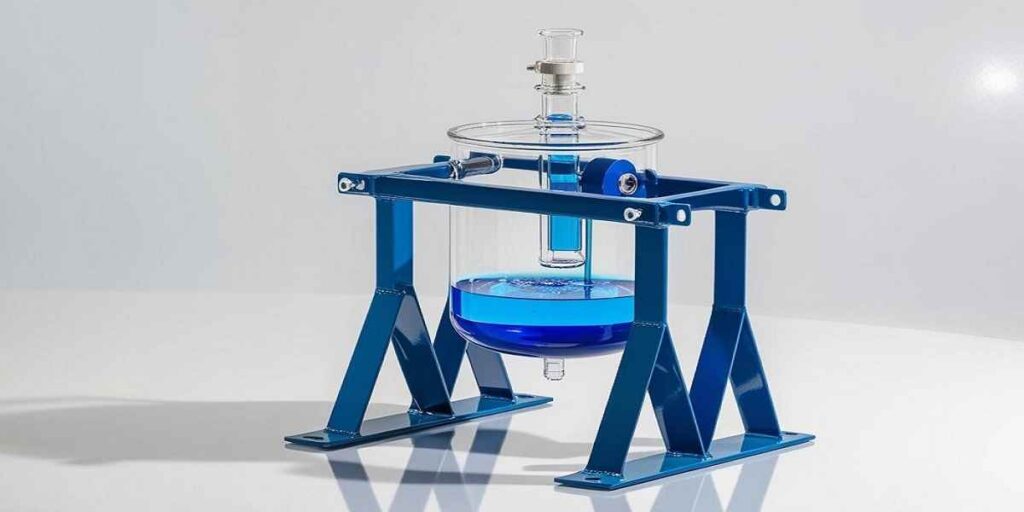
Processes like gas absorption (scrubbing) or stripping require intimate contact between a liquid and a gas to transfer components from one phase to the other.
In such processes, efficiency is of utmost importance.
While you can use static or packed columns can be used, they can suffer from channeling: the liquid and gas do not mix uniformly, which means you get inefficient outcomes.
In contrast to these columns, a CSTR (equipped with a sparger and impeller) acts as a highly efficient gas-liquid contactor.
The vigorous agitation creates a large interfacial area by breaking the gas into small bubbles, maximizing contact time, and ensuring highly efficient mass transfer.
Benefits of Using CSTRs for Liquid-Gas Separation:
- High Mass Transfer Efficiency: Achieve faster and more complete removal or absorption of gases compared to less aggressively mixed systems.
- Compact Design: Can achieve the same duty as a much larger static tower, saving space.
- Operational Flexibility: Easy to control and adapt to varying gas and liquid flow rates.
9. Solid-Liquid Separation
Processes like leaching (i.e., extracting a substance from a solid) or precipitation require continuous contact and reaction between solid particles and a liquid. The goal is to maximize the extraction yield or control the properties of the precipitated solid.
A CSTR is configured to keep solid particles uniformly suspended in the liquid. It ensures every particle is fully exposed to the liquid, leading to consistent and complete reactions.
It also provides the uniform environment needed to create a consistent, solid product.
Benefits of Using CSTRs for Solid-Liquid Separation (Reaction)
- Maximum Extraction Yield: Ensure complete contact between solids and liquid for near-total recovery of valuable materials.
- Controlled Precipitation: Produce uniform solid precipitates with consistent particle size, which are easier to filter and process downstream.
- Continuous Operation: Automate and streamline what is often a slow, batch-wise operation.
Get a Customized CSTR for Your Application from K-Jhil
In this blog, we have discussed the 9 major applications of continuous stirred tank reactors.
Whether you are optimizing crystallization, managing exothermic polymerizations, or scaling up a sensitive cell culture, the principles of steady-state operation are key to your success.
Now, the next step is for you to find the perfect CSTR manufacturer: one who has both the experience and the expertise to engineer customized systems for your operations.
That’s where we come in!
K-Jhil’s CSTRs are engineered to deliver unmatched consistency, safety, and efficiency for the exact processes that we have discussed in this blog.
So, if you’re struggling with batch inconsistencies and capacity limits, connect with us today!
We will show you how a customized Continuous Stirred Tank Reactor can transform your production process and boost your profitability.
Applications of CSTRs: FAQs
1. What is the main advantage of a continuous stirred tank reactor over a batch reactor?
A CSTR provides steady-state operation for unmatched product consistency, higher throughput, and better temperature control, eliminating batch-to-batch variations.
2. In which CSTR industrial application is temperature control most critical?
CSTR temperature control is vital in polymerization to prevent dangerous thermal runaways and ensure consistent polymer quality in the chemical process plant.
3. Why is a continuous flow stirred tank reactor ideal for biological processes?
It maintains a constant, optimal environment for microbes or cells, dramatically increasing product yield and ensuring consistent biological product quality.
4. Can a continuous stirred tank reactor handle solid particles?
Yes. A continuous stirred tank reactor can be designed for solid-liquid separation processes like leaching, ensuring maximum extraction yield and uniform precipitation.
5. How does a CSTR improve sustainability in a chemical process plant?
A continuous flow stirred tank reactor boosts efficiency, reduces waste in processes like wastewater treatment, and enables sustainable production like green hydrogen.