
Short path distillation separates heat-sensitive and high-boiling compounds under deep vacuum, where the vapor crosses only a few centimeters from a heated surface to a cold condenser sitting right beside it. That short trip, run at pressures near 0.001 to 0.1 mbar, lets a material distill far below its normal boiling point and spend only seconds in the heat.
The payoff is purity without thermal damage. Cannabis distillate, vitamin E, omega-3 concentrates, and fine pharmaceutical intermediates all lean on it for that single reason. Each of those would scorch, discolor, or lose potency in a still that ran hot and slow.
K-Jhil manufactures the borosilicate glass apparatus this process runs on, so the detail here comes from the build side. What follows is how it works, the parts involved, the vacuum behind it, and where it earns its place in industry.
What Short Path Distillation Is, and How It Differs
Short path distillation is a vacuum separation built for molecules that cannot take heat. A heated surface boils off the lighter fraction, and a condenser only a short distance away catches it before it has any chance to break down.
The name is literal. In a simple or a fractional still the vapor travels up a column and through piping, while here it crosses a gap measured in centimeters, which cuts both heat exposure and material loss.
It also sits apart from the everyday methods. Our explainer on the difference between simple and fractional distillation covers those two, and short path adds deep vacuum and a near-touching condenser to handle what neither can.
Push the vacuum deep enough and the method turns into molecular distillation. The pressure gets so low that vapor molecules fly straight to the condenser without colliding, so separation stops leaning on boiling point and starts tracking molecular weight and evaporation rate. Short path distillation and molecular distillation are related but distinct processes. Molecular distillation operates under conditions where the vapor path is shorter than the molecules’ mean free path.
How the Short Path Distillation Process Works
The short path distillation process runs in a sealed, evacuated system, one batch at a time. Feed goes into a heated flask, the pump pulls the pressure down to a fraction of a millibar, and the temperature is raised slowly until the target fraction begins to evaporate.
Good runs start before the heat goes on. The feed is usually degassed first to strip dissolved gases and light solvents that would spoil the vacuum, and the temperature is ramped rather than rushed so only the target fraction lifts off.
Vapor rises a few centimeters and meets an internal cold-finger condenser. It condenses there, runs down, and collects in a receiving flask, while the heavy residue stays behind in the boiling flask.
Fractions are split without breaking vacuum. A multi-position receiver, often called a cow or spider, lets the operator switch flasks as the distillate changes, so the heads, the main cut, and the tails stay separate. Unlike a fractional distillation machine that stacks many equilibrium stages, short path makes a single clean pass at low temperature.
BY THE NUMBERS
Short path distillation typically runs at 0.001 to 0.1 mbar, deep enough to pull boiling points down by 100 to 200 degrees C against atmospheric. Residence time depends on the equipment design and operating conditions; it is not always limited to a few seconds.
The Short Path Distillation Apparatus, Part by Part
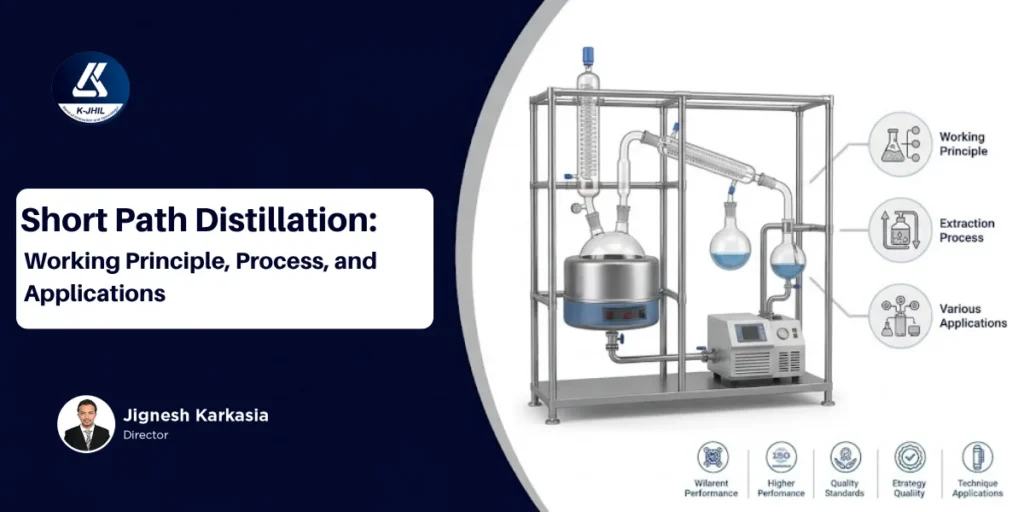
A short path distillation apparatus is simpler than it first looks, with every part doing one job. The heated boiling flask holds the feed, a mantle or an oil bath raises its temperature, and a short-path head carries the vapor the short distance across.
The condenser is the signature piece. It sits inside the head as a cold finger, chilled by a recirculating coolant, so vapor condenses almost as soon as it leaves the feed.
Seals and joints matter more here than in most glassware. Ground-glass joints with the right grease or O-rings hold the deep vacuum, and a single leak shows up at once as a pressure the pump simply cannot pull down.
Below that sit the receivers and the vacuum train. A cow receiver collects the fractions, a cold trap guards the pump, and a gauge reads the pressure, a layout that echoes the key components of a fractional distillation unit stripped down to its shortest path.
Short Path Distillation Equipment and Setup
Short path distillation equipment comes in two broad classes, bench glass and industrial. A laboratory kit is all borosilicate 3.3 glass, with flasks from two to twenty liters, and it runs in batches.
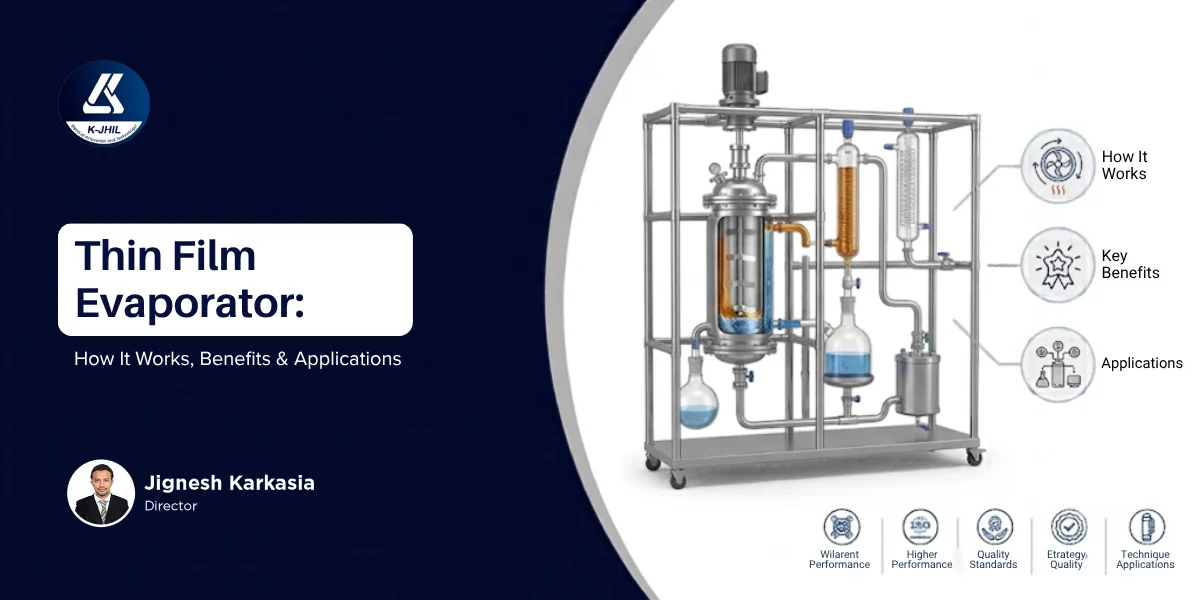
Scale changes the hardware. For continuous industrial output, a wiped-film or thin-film evaporator spreads the feed into a thin agitated layer, holding the same vacuum principle but moving far more material per hour.
Short path and wiped-film are close cousins. One runs a batch in a flask and the other a continuous film on a heated wall, but both chase the same low-temperature, high-vacuum separation, and plenty of plants run the two side by side.
Material is the quiet decision. Borosilicate glass offers good chemical resistance in many applications, but compatibility must be checked against the chemicals, temperature, pressure, and operating conditions. Glass also lets the operator watch the run,, which is why it outranks a steel simple distillation system for sensitive batches.
Why Vacuum Short Path Distillation Runs Cool
Vacuum is the whole trick, and vacuum short path distillation lives or dies on it. Dropping the pressure to a fraction of a millibar pulls boiling points down with it. Vacuum reduces boiling temperature, but the actual temperature depends on the compound and operating pressure. These values should not be presented as universal.
Lower temperature means less damage. Heat-sensitive molecules that would degrade, discolor, or polymerize in a hot still survive a cool, brief pass instead.
Reaching that vacuum takes the right pump train. A two-stage rotary vane pump handles rough duty, while deeper work leans on a diffusion pump or a vacuum ejector system that holds the pressure steady against the vapor load.
A cold trap between the still and the pump earns its place in that train. It freezes out solvent and light ends that would otherwise dissolve into the pump oil and spoil the vacuum over time.
Measuring the vacuum matters as much as pulling it. A Pirani or capacitance gauge reads the deep end where the process actually works, so the operator knows the still has reached pressure before the heat goes up.
Short Path Distillation Applications Across Industries
Short path distillation applications cluster wherever a product is valuable, heat-sensitive, and high-boiling. The table below runs the main ones and what the process does for each.
Industry | What Is Distilled | Why Short Path |
Cannabis and hemp | CBD and THC distillate | High potency without degrading cannabinoids |
Nutraceuticals | Omega-3 ethyl esters, vitamin E | Concentration at low temperature |
Essential oils | Aroma fractions and terpenes | Gentle recovery of delicate volatiles |
Pharmaceuticals | Heat-sensitive APIs and intermediates | Short path distillation equipment alone does not ensure GMP compliance. Compliance depends on the overall manufacturing process and quality systems. |
Specialty chemicals | Monoglycerides, silicone oils, esters | Separating high-boilers that char in open stills |
Cannabis gets the headlines, but the oldest uses sit in vitamins and fatty acids. The method has concentrated tocopherols and fish-oil esters for decades. The common thread is simple: a high-value product that breaks down under heat is the signal that an open still is the wrong tool.
Short Path Distillation Versus Other Methods
Picking a method starts with the feed, not the glassware. The table sets short path against the three it most often replaces or follows.
Method | Best For | Pressure |
Simple distillation | Wide boiling-point gaps, rough cuts | Atmospheric |
Fractional distillation | Close-boiling mixtures, many stages | Atmospheric to mild vacuum |
Short path distillation | Heat-sensitive, high-boiling, single pass | High vacuum, sub-millibar |
Wiped-film evaporation | Continuous industrial throughput | High vacuum |
The choice narrows fast. A wide boiling gap suits a simple still, close cuts want a column, and anything that degrades under heat points to short path or wiped film. Our rundown of the types of distillation column covers the column side of that decision.
Choosing a Short Path Distillation Unit
A short path distillation unit is sized around the feed and the output, not a catalog number. The first questions are how heat-sensitive the material is, how high it boils, and how much has to run per batch or per hour.
- Feed and heat sensitivity: Fragile, high-boiling material needs the deepest vacuum and the shortest path.
- Throughput: Small and batch favors glass, while continuous volume points to a wiped-film system.
- Vacuum level: Molecular work needs diffusion or ejector backing, not a rotary pump alone.
- Materials and fractions: Borosilicate glass for purity and visibility, with a multi-position receiver for clean cuts.
Budget and footprint settle the last call. A glass bench unit is quick to buy and easy to move, while a continuous wiped-film line is a larger commitment that only pays back at steady volume.
Match those and the unit configures itself. Get the vacuum or the material wrong and the product scorches or the yield drops, usually on the most expensive feed in the building.
Advantages and Limits, Weighed Honestly
The draw is low-temperature, low-damage separation of material that cannot survive a normal still. Short residence time, deep vacuum, and a short vapor path add up to high purity on heat-sensitive, high-value feeds, which is why the pharma and nutraceutical world leans on it.
It is not a universal tool, though. Throughput per batch is modest, close-boiling mixtures still separate poorly because there is really only one effective stage, and the deep vacuum and chilled condenser carry cost and upkeep a simple still never does.
So the smart plants pair it with the right partner. Short path for the fragile final cut, and a column or a simple still for the easier separations upstream.
Getting the Right Short Path Distillation System
Across every one of these short path distillation setups, the same rule holds. The system that works is the one matched to the feed’s heat sensitivity, its boiling range, and the purity the product demands, not a stock bench kit.
K-Jhil manufactures borosilicate glass distillation apparatus and systems, and sizes the evaporator, condenser, and vacuum train around the material they will carry. If you are scoping a short path or molecular still, Contact Us before the build is fixed, and we will match the glass to the batch.
Frequently Asked Questions About Short Path Distillation
1: What is short path distillation?
A: A vacuum distillation where vapor travels only a few centimeters from a heated surface to a nearby condenser. The short path and deep vacuum let heat-sensitive, high-boiling compounds distill at low temperature.
2: How does the short path distillation process work?
A: Feed is heated under vacuum in a flask, the light fraction vaporizes, crosses a short gap to an internal cold-finger condenser, and collects in a receiver. The heavy residue stays in the boiling flask.
3: What pressure does short path distillation run at?
A: Typically 0.001 to 0.1 mbar, a fraction of a millibar. That deep vacuum pulls boiling points down by 100 to 200 degrees C against atmospheric pressure.
4: What is the difference between short path and molecular distillation?
A: They overlap. When the vapor path is shorter than the mean free path of the molecules, short path distillation becomes molecular distillation, which runs at the deepest vacuum.
5: What is a short path distillation apparatus made of?
A: Laboratory and pilot units are borosilicate 3.3 glass for inertness and visibility, while large industrial stills use stainless or glass wiped-film evaporators.
6: What are the main short path distillation applications?
A: Cannabis and hemp distillate, omega-3 and vitamin concentration, essential-oil and aroma recovery, heat-sensitive pharmaceuticals, and specialty chemicals such as monoglycerides and silicone oils.
7: Why does short path distillation need vacuum?
A: Vacuum lowers the boiling point, so the material distills at a temperature low enough to avoid degradation. Lower pressure generally reduces boiling temperature, but product quality also depends on heating conditions, residence time, and feed properties.
8: Short path distillation versus fractional distillation, which fits?
A: It depends on the feed. Fractional distillation separates close-boiling mixtures with many stages, while short path handles heat-sensitive, high-boiling material in a single low-temperature pass.
9: How much can a short path distillation unit process?
A: Bench glass units run liters per batch. Throughput varies with equipment capacity, feed properties, and operating conditions. Specify these figures only when supported by manufacturer data. Throughput sets whether glass or wiped-film fits.
10: Is short path distillation used for CBD?
A: Yes. Short path and wiped-film distillation are used for cannabinoid processing. The appropriate method depends on the feed, required product quality, regulations, and production scale.
11: What vacuum equipment does short path distillation need?
A: A two-stage rotary vane pump for rough vacuum, backed by a diffusion pump or a vacuum ejector system for molecular-level work, plus a cold trap to protect the pump.