
Have you ever tried to separate a mixture in chemical processing? How about doing it during pharmaceutical or food production?
If you have tried to do it before, you already know how hard it can really be. Either the mixture fails to separate, or else the separation is not pure enough.
Thankfully, we have two common methods to solve this issue. These are:
- Distillation
- Extraction
Using these chemical separation techniques can make your job much easier. But you need to know how they work and their respective benefits.
In this guide, I will help you arrive at this understanding.
Let’s compare these two common separation techniques based on their pros and cons.
What is Distillation?
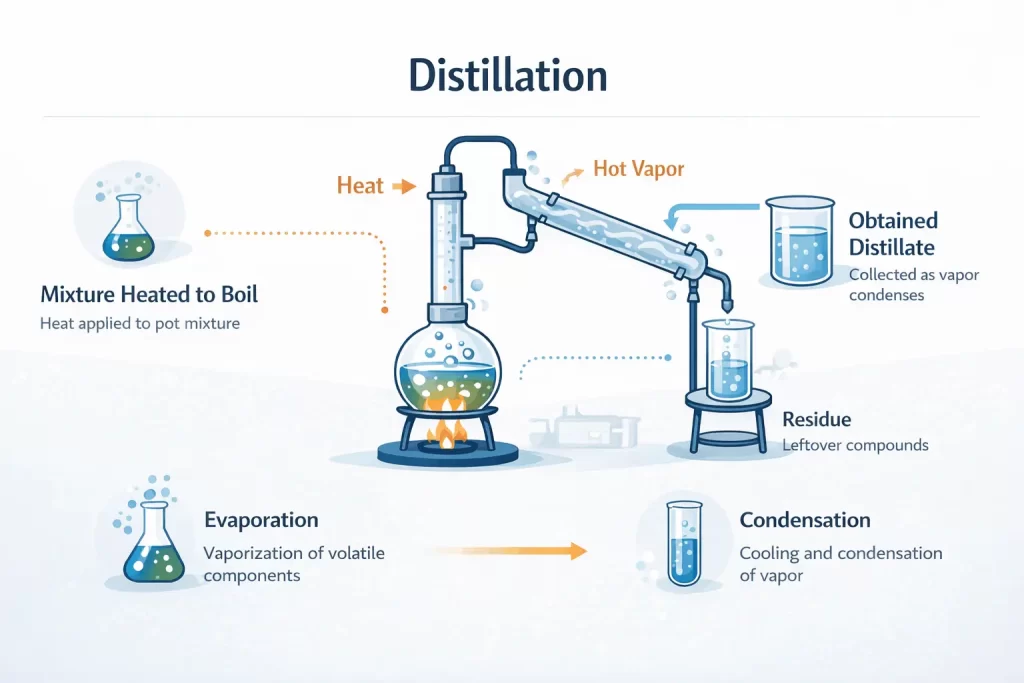
We shall start by first defining what distillation is.
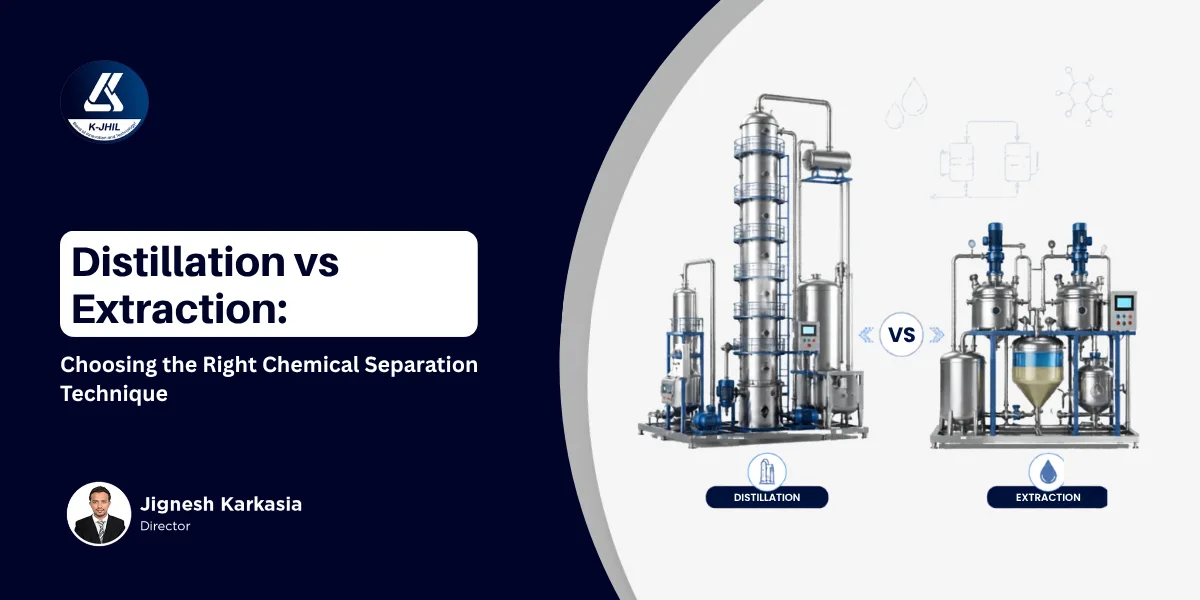
Distillation is a separation process that depends on the difference in boiling points of the components.
Fractional distillation is based on repeated vaporization and condensation (vapor-liquid equilibrium), allowing separation of components with close boiling points.
The vapor is cooled in a condenser, where it condenses back into liquid for collection.
This is also a popular method for water purification. On heating, the purified water vapors off, leaving the impurities.
Advantages of the Distillation Process
Here are the main advantages of the distillation process and why it is popular:
- High Purity: The process can achieve extreme purity levels if the boiling points are different enough
- Scalable: You can easily use this process in small labs as well as in industrial production
- Tested & Trusted: Distillation has evolved over the years from decades of research
- No added chemicals: Nothing needs to be added as a solvent for this process
What is Solvent Extraction?
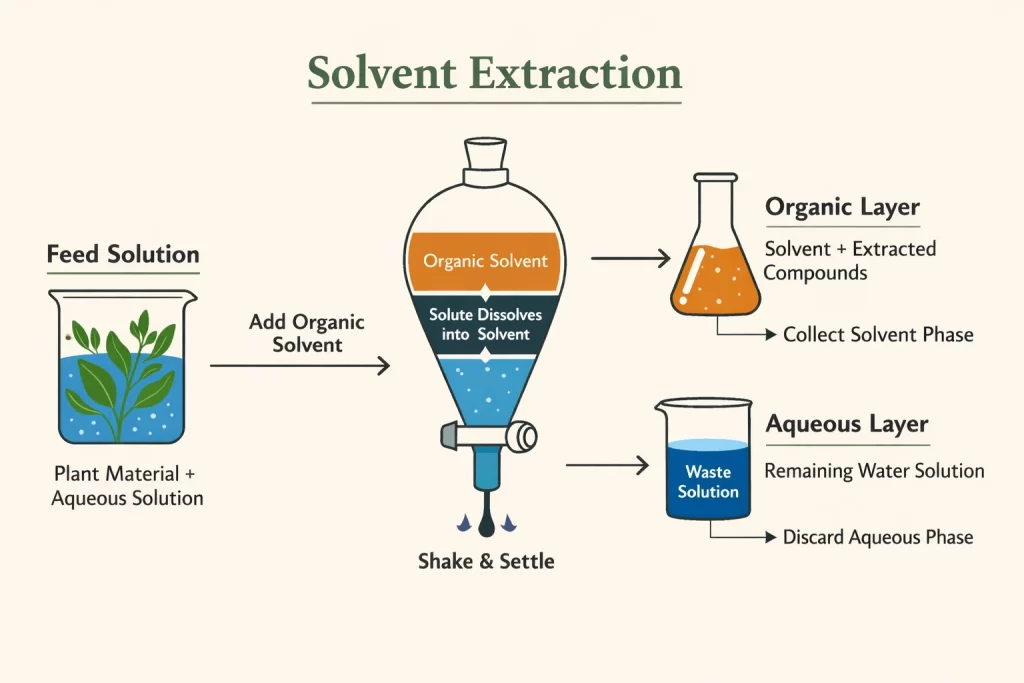
Now that we have understood distillation, it is time to look at another separation technique.
Solvent extraction is the process of using a solvent to dissolve one component from the mixture.
Also known as liquid-liquid extraction, this method relies on adding a compound to the mixture. The solvent selectively dissolves the target compound, separating it from the rest of the mixture.
The liquid-liquid extraction process relies entirely on solubility differences. It requires an immiscible extracting solvent to separate the mixture into two layers.
As the desired compound moves into the solvent layer, you can then easily remove it from the mixture.
Advantages of Solvent Extraction
Here are some of the best advantages of solvent extraction:
- Low temperature: This technique does not require boiling the mixture, separating even at room temperature
- Selective: You can use this technique to separate compounds with similar boiling points
- Energy efficient: Uses less energy due to the lack of vaporization
- Advanced mixtures: Effective for selective separation of heat-sensitive or closely-related components, but does not inherently break azeotropes.

Distillation vs Extraction: Key Differences
Here is a short comparison between these two chemical separation techniques:
Factor | Distillation | Solvent Extraction |
Separation Basis | Boiling point differences | Solubility differences |
Energy Use | High (requires vaporization) | Low to moderate |
Temperature | High heat needed | Ambient or low heat |
Best For | Volatile liquids, wide-boiling mixtures | Heat-sensitive compounds, close-boiling mixtures |
Equipment | Columns, reboilers, condensers | Mixer-settlers, extraction columns |
Solvent Needed? | No | Yes |
Purity Potential | Very high | High, but solvent residue possible |
When Should You Choose Distillation
I recommend choosing a simple distillation system when:
- Your components in the mixture have very different boiling points (Need to be at least 25-30°C apart)
- Heat cannot damage or destroy your product
- You require high purity levels without adding any solvents
- For processing large quantities of product, where solvents can drive up costs
When to Choose Solvent Extraction
You should choose solvent extraction when:
- Your compounds’ boiling points are very close together
- The mixture is heat-sensitive and can degrade due to it
- You need to deal with an azeotrope that cannot be separated through distillation
- Specific components need to be selectively extracted from the mixture
Choosing The Right Chemical Separation Technique
Here are tips on how you should choose the right chemical separation technique:
- Focus on the properties of your components
Both the boiling points and chemical structures of your components are crucial for your decision. Make sure that you understand what they require before choosing the technique.
- Consider Temperature Sensitivity
Not all components can withstand intense heat. For such volatile substances, use extraction instead of distillation.
- Factor In Energy Costs
Distillation could be an energy-consuming process. Make sure you only use it when necessary.
You can look into batch vs continuous distillation to lower your energy costs as well. This is because continuous distillation typically requires lower power.
- Think about scalability
As your business grows, so should your production. Make sure you choose scalable separation solutions that can grow with you. 
Conclusion
In distillation vs extraction, your choice depends largely on what you require in your production. It also depends on the chemical and physical properties of your components.
For successful separation, ensure you follow the guidelines I mentioned above. They can help you achieve pure results at minimal cost.
Obviously, they are just the beginning. For any large-scale implementation, you will require expert solutions and reliable guidance.
I recommend partnering up with K-Jhil Scientific Pvt. Ltd. to gain both. With their support, you will get both the solutions and guidance you will need for your separation challenges.
They are an expert manufacturer of exceptional distillation and extraction systems. With precision-engineered solutions, they have made a name for themselves in the global industry.
Require expert separation chambers for your next chemical separation? Consult K-Jhil today and receive the guidance you require!
FAQs
1. What’s the difference between distillation and extraction?
The main distillation vs extraction difference is how they separate mixtures. Distillation uses heat to boil and condense different components based on boiling points. Extraction uses a solvent to dissolve and remove one component without heating.
2. Which method is better for heat-sensitive materials?
Solvent extraction is better for heat-sensitive materials. It works at room temperature, so delicate compounds won’t get damaged. Distillation needs high heat, which can destroy sensitive products.
3. What are the advantages of distillation?
The advantages of the distillation process are simple: it achieves high purity, requires no additional chemicals, operates on a large scale, and is well-proven. It’s the go-to choice for separating liquids with different boiling points.
4. When should I choose solvent extraction?
Choose the liquid-liquid extraction process when boiling points are too close, your product can’t take heat, or you’re dealing with mixtures that won’t separate by boiling (azeotropes). It’s also more energy-efficient than distillation.
5. What does batch vs continuous distillation mean?
Batch vs continuous distillation is about the operation style. Batch processes work with one fill at a time, being good for small volumes and flexibility. Continuous distillation operates at steady state, maintaining consistent product quality and improved energy efficiency per unit volume.