
By the K-Jhil Scientific technical team, drawing on 30+ years in industrial borosilicate glass and chemical process equipment.
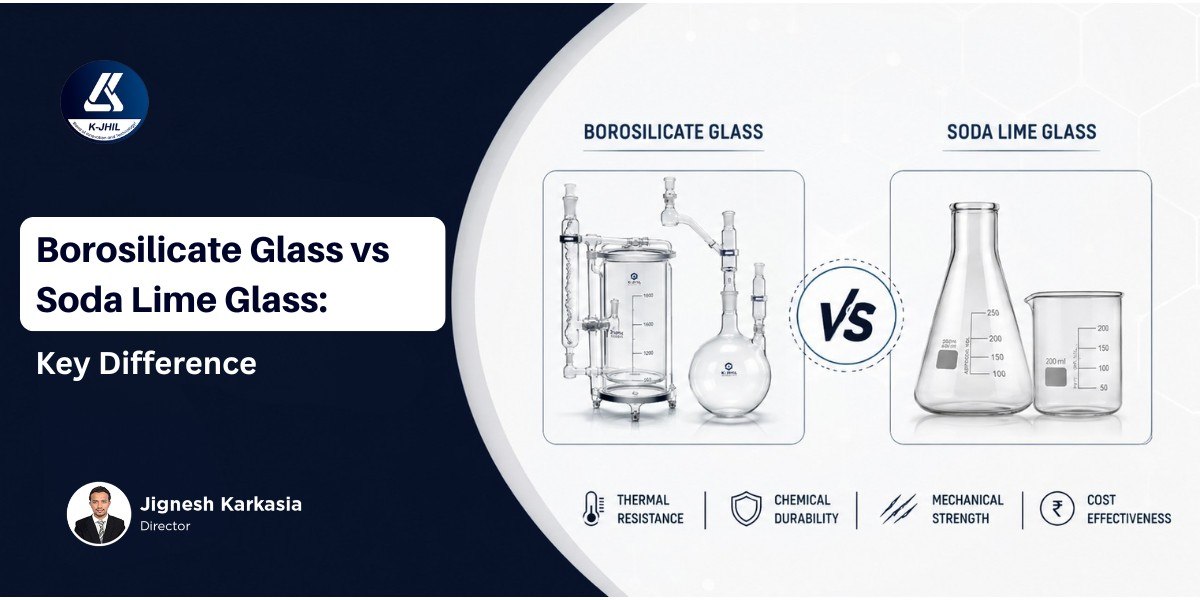
QUICK ANSWER: Borosilicate glass contains boron trioxide, which pulls its thermal expansion down to 3.3 x 10⁻⁶ /K and lets it survive sudden temperature swings near 160C. Soda lime glass skips the boron, expands roughly three times as fast, and tends to crack once the temperature shifts past about 40 to 50C. Reach for borosilicate when heat, chemicals, or purity are involved. Reach for soda lime when cost and volume matter more than heat.
Two glasses can sit side by side and look identical. Heat them, and they stop pretending to be the same material.
One handles a jump from a cold bath onto a hot plate without complaint. The other can split the moment hot water meets it after cold.
That gap in behavior is the heart of the borosilicate glass vs soda lime glass question. It also decides which glass belongs in a reactor and which belongs in a window frame.
After enough years around process glass, the choice stops feeling like a debate. You match the glass to the duty, and the arguing mostly ends there.
Five Differences that Actually Matter
Strip out the jargon and the whole comparison rests on five points.
- Boron. Borosilicate has boron trioxide. Soda lime does not. Everything else here flows from that one ingredient.
- Heat. Borosilicate takes thermal shock in stride. Soda lime gives up early.
- Chemistry. Acids and hot caustic that slowly eat soda lime barely touch borosilicate.
- Price. Soda lime melts cooler and shapes faster, so it is cheaper to make in bulk.
- Where it lands. Reactors and labware lean borosilicate. Windows and bottles lean soda lime.

So What is Borosilicate Glass?
Borosilicate is glass built for punishment. Its backbone is silica and boron trioxide, usually near 80 percent silica and 12 to 13 percent boron trioxide, rounded out with a little sodium oxide and alumina.
The chemistry has been settled for more than a century, so the formula barely shifts from one maker to the next. What matters on the plant floor is the grade: for reactors and lab work that means Borosilicate 3.3, held to the ISO 3585 standard, which is what we build our equipment from.
Boron does the heavy lifting. It locks the glass network tight and cuts thermal expansion, so the material rides out fast temperature changes that would crack cheaper glass. For the deeper cut on grades and makeup, I have covered borosilicate glass properties on its own.
In India it sells under several brand names, but the grade on the datasheet matters far more than the label. What you confirm before buying is Borosilicate 3.3, not a name.
And Soda Lime Glass?
Soda lime is the everyday glass. Somewhere near 90 percent of all glass made on the planet is soda lime, from the pane in your window to the bottle in your fridge.
Its recipe runs about 70 percent silica, plus soda ash and lime, with traces of magnesia and alumina. The soda drops the melting point so the silica flows without absurd heat. The lime keeps the finished glass from slowly dissolving in water.
Cheap, easy to shape, endlessly recyclable. Also soft, chemically plain, and jumpy about sudden heat.
For a jam jar, none of that is a problem. Inside a reactor, all of it is.
PRO TIP When a quote just says “glass,” read it as soda lime until a datasheet says otherwise. Real borosilicate is spelled out by grade, usually “Borosilicate 3.3,” and comes with an expansion figure. No grade on paper usually means no boron in the melt.
Types of Borosilicate Glass, and the USP Glass Classes
Borosilicate is not one single material. The number in the grade name tells you how much it expands with heat, and the right grade depends on the job.
- Borosilicate 3.3 (high borosilicate). The reactor and labware grade, and the glass in your heat-resistant cookware. You will see it as Duran, BORO-8330, Pyrex, and Borosil.
- Borosilicate 5.0. The number is its expansion coefficient, about 5.0 x 10⁻⁶ /K, not a purity or resistance class. It is drawn into tubing for ampoules, vials, and syringes, where Schott’s Fiolax is the name that shows up most.
- Borosilicate 7.0 (low borosilicate). Cheaper and less resistant than 5.0, so it sits at the budget end of drug packaging.
Grade numbers and pharmacopoeia classes measure different things, so they should not be swapped for one another. The 3.3, 5.0, and 7.0 grades describe thermal expansion, while USP Type I, II, and III describe hydrolytic resistance, meaning how much the surface gives up to water.
Type I covers borosilicate, including both 3.3 and 5.0 glasses, and is the standard for injectables, while Type II is treated soda lime and Type III is plain soda lime.
How Borosilicate Glass is Made?
It starts at the batch house. Silica sand, boron trioxide, soda ash, and alumina get weighed to a tight recipe, and purity is not optional, since a stray speck of iron turns into a visible flaw later.
The mix goes into a furnace running past 1,500C, often closer to 1,650C, until it melts into a clear pool. Borosilicate needs more heat than soda lime because boron and high silica push the melting point up.
From there the glass gets drawn into tube, blown, or pressed. Then it is annealed, cooled slowly and on purpose to pull the internal stress back out.
Rush the annealing and you get glass that looks perfect and fails on its first real thermal load. A fair share of what people call “bad borosilicate” is decent glass that was cooled badly.
Recipe alone does not make good glass. Process does.
Borosilicate Glass vs Soda Lime Glass: Full Comparison Table
Specs settle arguments faster than adjectives. Here is the side by side I point people to when they want the borosilicate glass vs soda lime glass call in black and white.
Property | Borosilicate Glass 3.3 | Soda Lime Glass |
|---|---|---|
Main formers | Silica + boron trioxide | Silica + soda + lime |
Boron trioxide | About 12 to 13% | None |
Thermal expansion (CTE) | 3.3 x 10⁻⁶ /K | About 9 x 10⁻⁶ /K |
Thermal shock tolerance | About 160C swing | About 40 to 50C swing |
Softening point | About 820C | About 700 to 730C |
Density | About 2.23 g/cm3 | About 2.5 g/cm3 |
Chemical resistance | Very high | Moderate |
Hydrolytic class | ISO 719 HGB 1 (top) | Lower |
Relative cost | Higher | Lower |
Typical home | Reactors, labware, pharma | Windows, bottles, tableware |
Which Glass Should You Choose?
The honest answer is not one winner. It is a match between the glass and the job, so use this quick split.
Choose borosilicate if your work involves heat, thermal cycling, acids or solvents, reactors or condensers, lab glassware, sight glasses, or anything a person will eat, drink, or inject.
Choose soda lime if you need windows, bottles, jars, bulbs, storage, or display at low cost, with no real heat or chemical stress in the picture.
When a job sits on the fence, price the risk, not just the glass. One failed batch usually settles it in borosilicate’s favor.
The Real Difference Between Borosilicate and Soda Lime Glass
If one idea sticks, let it be this. The difference between borosilicate and soda lime glass is how much each one moves when it heats up.
Soda lime swells about three times more than borosilicate for the same rise in temperature. Heat one patch of a soda lime vessel faster than the rest, and the hot part strains against the cold part until the glass tears. Borosilicate barely moves, so that inner struggle stays small.
The freezer-to-oven trick, the reactor that survives a steam jacket, the beaker you can hold over a flame, all of it traces back to that one number.
WATCH OUT “Heat resistant” on a listing is marketing, not a spec. Tempered soda lime takes more thermal stress than plain soda lime, but it is still soda lime, and it will not keep pace with real borosilicate through repeated heat and chemical cycles. Get the expansion coefficient in writing before you trust a vessel with anything hot.
Thermal Shock and Heat Resistance
Borosilicate 3.3 typically withstands thermal shocks of around 160C under standard test conditions, though real performance depends on wall thickness, geometry, and manufacturing quality. Soda lime taps out somewhere near 40 to 50C. That is not a narrow edge, it is the line between a vessel you can trust and one you cannot.
Move a borosilicate flask from a chilled bath onto a hot plate and it keeps working. Pour hot water into a plain soda lime jar right after cold and it can crack. Same job, opposite outcomes.
Steady heat is a separate property from thermal shock. Borosilicate 3.3 is generally suitable for continuous service up to about 450 to 500C, while its softening point sits near 820C, and the two numbers are not interchangeable. Soda lime softens far sooner and turns fragile long before it ever melts.
None of this makes borosilicate bulletproof. Heat it fast enough, or unevenly enough, and it can still crack, so technique still matters.
Chemical Resistance Where It Counts
This is where borosilicate quietly pays for itself. It sits in the top hydrolytic class, ISO 719 HGB 1, which is a formal way of saying it gives up almost nothing to water, acids, or most solvents. Side by side degradation tests back that up, with borosilicate breaking down far slower than soda lime in both mildly acidic and alkaline conditions.
Soda lime is ordinary here. Hot caustic and strong acids pull sodium out of its surface over time, which clouds the glass and can taint whatever sits inside.
A cloudy pickle jar is nobody’s crisis. A tainted API intermediate is a failed batch.
Borosilicate does have a soft spot. Hot concentrated alkali and hydrofluoric acid will attack it, so even the good stuff has limits worth knowing.
Is Soda Lime Glass Breakable?
People ask this all the time, so here is the straight answer: yes, more than borosilicate, and in two separate ways.
Drop either one and it can chip or shatter. On raw hardness the two sit close enough that it is not a deciding factor, so scratch resistance is not the reason to choose borosilicate. Where soda lime really falls behind is heat, since a sudden temperature swing can break it with no impact at all.
Tempering and chemical strengthening claw some of that back, which is why phone screens and car windows are treated soda lime. Left raw and pushed with heat, borosilicate is simply the tougher glass.
WATCH OUT Broken soda lime and broken borosilicate are not the same hazard. Tempered soda lime crumbles into dull pebbles, which is why it belongs in windows. Lab and reactor borosilicate breaks into sharp shards, so a cracked borosilicate vessel is a retire-it-now item, not a watch-and-wait one.
What Each Glass is Bad At?
No glass is perfect, and pretending otherwise is how buyers get burned. Here is the honest downside of each, the part the product page leaves out.
Borosilicate costs more, it is heavier to ship than plastic, and it still gives way to hot concentrated alkali and hydrofluoric acid. Quench it fast enough and even this glass can crack.
Soda lime is the fragile one under heat, and the one that clouds and leaches when chemicals turn aggressive. It is happy holding cold, stable contents, and out of its depth anywhere hot or reactive.
Is Borosilicate Glass Safe for Food and Health?
Yes, and it rests on the same inertness that makes it a process material. Borosilicate is inert, lead free, and BPA free, and it does not leach into food or drink even when it gets hot.
That same inertness is why pharma leans on Type I borosilicate for injectables and reagents. If a grade is trusted to hold an injectable drug, food and beverage contact is never the concern.
Soda lime is food safe too, for its normal jobs like bottles and drinking glasses. The catch is heat and chemistry, not toxicity, since soda lime was never built for hot or aggressive contents.
Where Each Glass Belongs?
Match the glass to the work and the debate mostly disappears. Soda lime covers windows, bottles, jars, bulbs, and tableware, the high volume, low stress end of the market.
Borosilicate takes over the second heat, chemicals, or purity enter the picture. Reactors, condensers, distillation lines, lab glassware, sight glasses, pharma containers, that is its territory. There is a reason plants specify it by default, and I have laid the full case out under borosilicate glass benefits.
A K-Jhil’s Jacketed Glass Reactor System is borosilicate for exactly this reason, since it faces hot jackets, cold feeds, and reactive chemistry in a single run. Drop soda lime into that duty and failure is a matter of when, not if.
PRO TIP Buying in India? Ask for Borosilicate 3.3 to ISO 3585, and for lab glassware look for IS 2619 or ISO 3819 on the box. A vendor who can name the standard is usually running the annealing and testing to hit it. One who cannot is asking you to gamble.
Borosilicate vs Quartz and Tempered Glass, in Short
Two other names come up whenever glass and heat share a sentence, so here is where borosilicate sits against them.
Fused quartz beats borosilicate on heat by a wide margin, since it expands close to a fifteenth as much as soda lime. It is also harder to work and far more expensive, which is why borosilicate stays the practical choice for most labs and plants.
Tempered glass is usually soda lime that has been heat treated for strength and safer breakage. It shrugs off more thermal stress than plain soda lime, yet it still trails real borosilicate once heat and chemicals keep repeating.
How to Tell the Two Apart Without a Lab?
You will not always have a datasheet in hand, so here are the checks that work on the floor. None is proof on its own. Together they usually tell you enough.
Start with weight. For the same size, borosilicate feels a touch lighter, since it is less dense, around 2.23 against 2.5 for soda lime.
Then look at the edges. Borosilicate holds clean, crisp rims and stays clear for years, while thick soda lime often shows a faint green cast along an edge from its iron content.
The surest tell is still paper. A grade stamp, an expansion number, or a standard on the box beats any guess your eye can make.
WATCH OUT The scam I hear about most is soda lime sold as “borosilicate” at a borosilicate price. The tell is almost always the datasheet, or the lack of one. No expansion figure, no grade, no standard, walk away, whatever the label says.
How to Care for Borosilicate Glass?
Treated with a little sense, good borosilicate lasts for years. The whole point of care is to guard against the two things that still kill it: extreme thermal shock and hidden cracks.
Warm it and cool it with some patience instead of slamming it between extremes at full speed. Check for star cracks and chips before any serious run, because a flaw draws stress straight to it. Wash it with mild lab detergent, and keep it clear of hydrofluoric acid and long hot caustic soaks.
Store pieces so their rims are not knocking together. Small habits here save real money down the line.
Why Borosilicate Costs More, and When It Pays Back?
Borosilicate costs more, and the reasons are honest. Purer inputs, hotter furnaces, and slower annealing all land in the price, so a borosilicate beaker runs a few times the cost of a plain soda lime one, and a full reactor assembly climbs into lakhs.
Here is the part that gets missed on a spreadsheet. The cheaper glass stays cheaper right up until the first thermal failure, and a single lost pharma or agro batch can swallow years of the so-called savings.
So the rule is short. Buy borosilicate for anything that meets heat, chemistry, or a regulated product. Buy soda lime for everything else.
QUICK STAT Thermal shock: borosilicate about 160C versus soda lime about 40 to 50C. Thermal expansion: 3.3 against about 9 x 10⁻⁶ /K. One cracked reactor batch in pharma or agro can run into lakhs, many times over the price gap between the two glasses.
Five Things Worth Remembering
- Boron trioxide is the whole difference. Borosilicate has it, soda lime does not.
- Borosilicate rides out roughly 160C swings. Soda lime cracks near 40 to 50C.
- Borosilicate shrugs off acids and solvents that slowly wreck soda lime.
- Soda lime wins on one front only: cost and easy mass production.
- Reactors, labware, and pharma call for borosilicate. Windows and bottles are fine in soda lime.
Choosing the Right Glass for Your Setup
Take away the chemistry and the decision is short. If the job involves heat, chemicals, or a product someone will eat, drink, or inject, the borosilicate glass vs soda lime glass answer is borosilicate. If it does not, soda lime will do the work and save you money.
The error that keeps repeating is buying on price alone, then meeting the difference in the middle of a live batch. Match the glass to the duty and you skip that lesson entirely.
At K-Jhil Scientific, we build borosilicate reactors and process systems for the exact conditions that break lesser glass. If you are speccing equipment for a chemical, pharma, or agro line, talk to our team before you lock in the glass.
Frequently Asked Questions About Borosilicate Glass vs Soda Lime Glass
1: What is the main difference between borosilicate and soda lime glass?
A: Borosilicate contains boron trioxide, which gives it very low thermal expansion and high chemical resistance. Soda lime has no boron, expands about three times as much, and is cheaper but far less heat and chemical resistant.
2: Is soda lime glass breakable?
A: Yes. Soda lime breaks more easily than borosilicate, both from impact and especially from sudden temperature change, which can crack it with no physical contact at all.
3: How can I tell borosilicate from soda lime glass?
A: Check the datasheet for a grade like Borosilicate 3.3 and an expansion figure. In the field, borosilicate is slightly lighter, keeps crisp clear edges, and lacks the faint green tint that thick soda lime often shows.
4: Is borosilicate glass safe for food and drink?
A: Yes. It is inert, lead free, and BPA free, and it does not leach into food even when heated, which is why it is also used for pharma packaging.
5: How is borosilicate glass made?
A: Silica sand, boron trioxide, soda ash, and alumina are melted past 1,500C, shaped by drawing, blowing, or pressing, then slowly annealed to remove internal stress.
6: What temperature can borosilicate glass handle?
A: Borosilicate 3.3 is generally suitable for continuous service up to about 450 to 500C, and it tolerates sudden temperature swings near 160C under standard test conditions. Its softening point sits around 820C, which is a different property again, and well above soda lime’s roughly 700 to 730C.
7: Why is borosilicate more expensive than soda lime?
A: It uses purer raw materials, higher melting temperatures, and slower annealing. Those production demands raise the cost compared to easy, low-temperature soda lime.
8: Can soda lime glass be used in a laboratory?
A: For non-heated, non-reactive tasks like some petri dishes or storage, yes. For heating, open flame, or aggressive chemicals, borosilicate is the correct choice.
9: Does borosilicate glass ever break from heat?
A: It can. Very rapid or uneven heating can still crack it, and any existing chip or star crack concentrates stress and raises the risk.
10: Which glass is used in glass reactors and chemical plants?
A: Borosilicate 3.3, almost without exception. It handles the heat cycling, cold feeds, and reactive chemistry that soda lime cannot survive.
11: What are Type I, Type II, and Type III pharmaceutical glass?
A: Type I is borosilicate, the most chemically resistant and the standard for injectables. Type II is treated soda lime and Type III is plain soda lime, both used for less demanding contents.