
By the K-JHIL Scientific technical team, drawing on 30+ years of building refining plants in Vapi, Gujarat. Reviewed by Jignesh Karakasia, Director.
In three decades of commissioning refining plants, one question decides more outcomes than any other. It is rarely the one buyers open with.
Most ask how pure the output can get.
The question that matters more is where their metal goes.
Purity is a specification you can buy. Yield is an operating discipline you have to build, and it is where in-house refining either pays for itself or quietly bleeds money every batch.
The precious metals refining process covers everything that happens after recovery. It takes doré bars, jewelry scrap, polishing sweeps, and electronic waste, and it strips out the base metals until what remains meets a market specification.
This guide walks through the actual industrial routes. Gold, silver, and the platinum group metals each behave differently, and choosing the wrong route for your feed is the most expensive mistake in this business.
Quick Answer
The precious metals refining process purifies recovered gold, silver, and platinum group metals in six stages:
- Assay the feed by fire assay or XRF, and homogenize the lot before sampling.
- Inquartation and nitric parting if the feed carries more than roughly 8% silver.
- Dissolution in aqua regia, three parts hydrochloric acid to one part nitric.
- Precipitation using sodium metabisulfite or oxalic acid.
- Wash, filter, and dry the gold powder.
- Melt and cast with borax flux at 1,100°C to 1,300°C.
Aqua regia reaches 99.95% purity in four to eight hours. Reaching 99.99% needs a Wohlwill electrolytic stage. Silver refines separately through Moebius or Balbach-Thum cells to 99.9% and higher. Indian plant costs run from ₹3 lakh to ₹5 crore.
Five Numbers that Decide Whether In-House Refining Pays
Before any discussion of method, get these five figures on paper. They decide whether the precious metals refining process makes commercial sense for you more than the technology ever does.
Recovery yield. A properly operated plant returns better than 99% of the gold you put in. Losses between 0.5% and 1% are normal, and anything above 2% needs investigation rather than acceptance.
Output purity. Decide whether you need 995, 999, or 9999 before you buy anything. The jump from 999 to 9999 changes your entire process route and your capital cost.
Acid consumption per kilogram. This is the operating cost line that separates a good plant from a cheap one. Poor dissolution control can double your nitric acid bill without improving purity at all.
Batch cycle time. A standard aqua regia batch runs four to eight hours from charge to cast. That number sets your daily throughput ceiling.
Feed variability. Refining 22K jewelry scrap is a different problem from refining floor sweeps at 3% gold. Feed that swings widely needs assay discipline and a plant sized for the worst case.
Quick Stat
A plant losing 1.5% instead of 0.5% on 5 kg of gold per day is giving away roughly 50 grams a month. At current Indian bullion rates that is a recurring loss large enough to fund a better plant within a year.
What the Precious Metals Refining Process Actually Involves
Here is the distinction that trips up most first-time buyers, and it matters commercially.
Mining and mineral processing is the work of getting metal out of rock. Crushing, grinding, flotation, and cyanide leaching all belong to that stage, and they happen at the mine site.
Refining begins where that ends. Your feed is already metal-rich, and the job is removing what is left: copper, silver, lead, zinc, iron, and traces of palladium or platinum.
That difference decides your equipment. A refinery buys reactors, scrubbers, filtration, and electrolytic cells. It does not buy ball mills and flotation tanks.
Three feed streams dominate Indian refining today. Doré bars from mining and recovery operations, jewelry scrap and old ornaments moving through the trade, and secondary material such as gold recovered from electronic waste, polishing rouge, filings, and wash slurry.
How the Gold Refining Process Works, Stage by Stage
Aqua regia is the workhorse route across India. It is versatile, it handles mixed feed, and it recovers silver and copper as saleable by-products.
Six stages, start to finish. The diagram below maps the main chain and the by-product streams that branch off it.
Step 1: Assay and Feed Characterization
Nothing starts until you know what you have. Fire assay remains the reference method for gold content, and handheld XRF gives a fast working number on the shop floor.
Skip it and disputes follow.
If you cannot state the input assay, you cannot prove your yield. Every argument with a supplier then becomes a matter of opinion rather than a matter of record.
Step 2: Inquartation and Nitric Parting
Aqua regia has one hard limitation, and it is silver.
Silver in the feed forms insoluble silver chloride. That coating seals the metal surface and stops the reaction dead.
The fix is inquartation. You alloy the feed down to roughly 25% gold by adding silver or copper, granulate it, then dissolve the base metals and silver in nitric acid. The name comes from that one-quarter ratio.
What remains is a porous gold sponge ready for aqua regia. Any feed above roughly 8% silver needs this step, which covers most jewelry scrap in the Indian trade.
Step 3: Aqua Regia Dissolution
Aqua regia is three parts hydrochloric acid to one part nitric acid by volume. The nitric acid oxidizes the gold, and the chloride holds it in solution as chloroauric acid.
Temperature and addition rate matter more than most operators expect. Running too hot wastes nitric acid as nitrogen oxide fumes and loads your scrubber for no benefit.
Once dissolution is complete, excess nitric acid has to go before precipitation. Urea addition or controlled evaporation handles this, and getting it wrong is the most common cause of poor precipitation yield.
Pro Tip
Track acid consumption per kilogram of gold as a standing KPI, not as an occasional check. A creeping acid bill is usually the first visible sign of dissolution control drifting, and it shows up in the ledger months before it shows up in purity.
Steps 4 to 6: Precipitation, Washing, and Melting
Gold comes out of solution as a brown powder. Sodium metabisulfite is the common precipitant in Indian plants, while oxalic acid gives higher purity and ferrous sulfate remains in use at older operations.
The powder is washed, filtered, and dried. Washing discipline here has a direct effect on final purity, and rushed washing is a frequent cause of batches landing at 99.5% instead of 99.95%.
Melting follows, usually with borax as flux, and the metal is cast into bars or granules. Gold melts at 1,064°C, so induction furnaces for this duty typically operate in the 1,100°C to 1,300°C band.
Watch Out
Never add nitric acid to a charge that has not been fully wetted with hydrochloric acid first. Rapid uncontrolled reaction throws material out of the vessel, and that loss is unrecoverable as well as dangerous.
The Miller Process and the Wohlwill Process Compared
Two named processes dominate large-scale gold refining worldwide, and both are worth understanding even if aqua regia suits your operation better.
The Miller process, developed by Francis Bowyer Miller in 1867, bubbles chlorine gas through molten gold. Base metals and silver form chlorides that either volatilize or float off as a slag layer.
It is fast, finishing in one to two hours, and it handles large doré volumes. Its ceiling is roughly 99.5%, which falls short of bullion-grade specification.
The Wohlwill process, developed by Emil Wohlwill in 1874, is electrolytic. Impure gold serves as the anode in a chloroauric acid electrolyte, and pure gold deposits on the cathode at 99.99% and above.
Wohlwill has one commercial drawback that decides most purchasing conversations. It locks a large quantity of gold inside the electrolyte and the anodes, and that working capital sits idle.
There is a throughput rule that settles this cleanly. Miller and Wohlwill together only compete economically with aqua regia at large throughput, which is why the pairing belongs to mine-site refineries rather than to the jewelry trade.
Most mine-site refineries run Miller first, then Wohlwill on the output. Indian jewelry and scrap refiners generally find aqua regia the better fit, since their feed is mixed and their batch sizes are smaller. Our guide to traditional versus modern gold refining techniques covers the trade-offs in more depth.
How the Silver Refining Process Works
Silver refining follows different chemistry, and one common error is worth correcting up front.
Carbon in pulp is a gold recovery route. Silver adsorbs poorly onto activated carbon, so silver-rich solutions use Merrill-Crowe zinc dust cementation instead.
For metallic feed, nitric acid parting comes first. The silver dissolves as silver nitrate while gold stays behind as an insoluble residue, which is then routed into the gold circuit.
Electrolytic refining does the final work. The Moebius cell uses vertical electrodes, and silver crystals are scraped from the cathode continuously.
The Balbach-Thum cell uses a horizontal arrangement, with the anode held in a basket above and the cell base acting as cathode. It handles anodes carrying higher gold content, and the gold reports to the anode slime for recovery.
Both routes deliver 99.9% silver as standard. Well-run cells reach 99.95% and above, which is the grade the industrial and bullion trade expects.
Electrolytic refining is the only silver route that reliably clears 99.95%. Chemical precipitation alone will not hold that grade batch after batch.
Watch Out
Silver chloride is light-sensitive and it is easy to lose. Sealed, opaque handling of silver chloride residues is not optional, and open-tray storage in a lit workshop is a slow leak that never appears in a single batch reconciliation.
Platinum Group Metals and Why They are Harder to Refine
Six metals make up the platinum group: platinum, palladium, rhodium, iridium, osmium, and ruthenium. Their chemistry is close enough that separating them cleanly is genuinely difficult work.
Platinum and palladium dissolve in aqua regia. Platinum precipitates as ammonium hexachloroplatinate when ammonium chloride is added, and calcining that salt yields platinum sponge.
Palladium follows a different salt route, precipitating as a diammine complex before reduction to metal. Both are established, well-documented industrial procedures.
Rhodium, iridium, ruthenium, and osmium are another matter. Modern refineries handle these through solvent extraction and ion exchange rather than simple precipitation, and the capital and technical demands rise steeply.
The commercial driver in this segment is autocatalyst recycling. Spent catalytic converters carry meaningful platinum, palladium, and rhodium, and that feed stream is growing across Indian recycling operations. Our list of the top precious metals covers the relative market values of each.
Refining Method Comparison
| Method | Primary Metal | Typical Purity | Cycle Time | Best Suited Feed | Main Limitation |
|---|---|---|---|---|---|
| Aqua regia | Gold | 99.95% | 4 to 8 hours | Jewelry scrap, doré, mixed feed | Needs inquartation above 8% silver |
| Inquartation and parting | Gold | Pre-treatment stage | 3 to 6 hours | High-silver jewelry scrap | Adds a step and a silver circuit |
| Miller process | Gold | 99.5% | 1 to 2 hours | Large doré volumes | Purity ceiling below bullion grade |
| Wohlwill process | Gold | 99.99%+ | 24 to 48 hours | Pre-refined gold anodes | Large gold inventory locked in cells |
| Nitric parting | Silver | Pre-treatment stage | 2 to 5 hours | Silver-bearing alloys | Generates nitrogen oxide fumes |
| Moebius cell | Silver | 99.9 to 99.95% | Continuous | Cast silver anodes | Needs steady anode quality |
| Balbach-Thum cell | Silver | 99.9 to 99.99% | Continuous | Anodes with higher gold content | Larger floor area per unit output |
| Merrill-Crowe | Silver | Recovery stage | Continuous | Silver-bearing solutions | Solution feed only, not metal |
| Ammonium chloride precipitation | Platinum | 99.9%+ | 8 to 24 hours | Aqua regia solution from PGM feed | Requires careful salt handling |
| Solvent extraction | Rh, Ir, Ru, Os | Varies by metal | Multi-stage | Autocatalyst and refinery residues | High capital and technical demand |
Which Refining Route Should You Choose?
Buyers often want a method recommended before a single assay exists. That is the wrong order, and the table below shows how the decision actually resolves.
| If Your Situation Is | Recommended Route | Why |
|---|---|---|
| Mixed jewelry scrap, silver above 8% | Inquartation, then aqua regia | Silver chloride will stall a direct aqua regia charge |
| Clean gold scrap or dust, silver under 8% | Aqua regia direct | No parting stage needed, shorter cycle |
| Doré bars in large daily volume | Miller, then Wohlwill on the output | Speed first, then bullion-grade finishing |
| Output must be certified 9999 | Wohlwill or an electrolytic finishing stage | Aqua regia alone stops at 99.95% |
| Silver-bearing alloys as main feed | Nitric parting, then Moebius or Thum cell | Recovers gold from anode slime as a by-product |
| Silver already in solution | Merrill-Crowe cementation | Carbon adsorption suits gold, not silver |
| Spent autocatalyst | Aqua regia, then salt precipitation | Platinum and palladium separate on different salt routes |
| Floor sweeps, rouge, wash slurry | Aqua regia with feed preparation | Low grade, so preparation matters more than the route |
Two questions settle most cases. What is the silver content of your feed, and what fineness does your buyer contractually require?
Answer those honestly and the route selects itself. Answer them optimistically and you will buy a plant that cannot make your specification.
Quick Stat
Feed above roughly 8% silver requires inquartation. That single threshold decides whether your plant needs a parting circuit, and it is the specification most often left out of enquiry emails.
Purity Grades Explained: 995, 999, and 9999
Purity in this trade is quoted in parts per thousand, and the shorthand causes confusion in contracts.
995 means 99.5% pure, and it is the minimum fineness accepted for good delivery gold bars. 999 means 99.9%, commonly sold as 24 karat. 9999 means 99.99%, the four-nines grade that requires an electrolytic refining stage to finish.
Karat maps to fineness directly. 22K corresponds to 916 fineness, 18K to 750, and 14K to 585.
Indian jewelry carries mandatory BIS hallmarking, with IS 1417 setting the permitted gold grades and the HUID system providing traceability. If your refined output feeds the domestic jewelry trade, your assay records need to stand up to that framework.
Pro Tip
Write your target fineness into the purchase specification before you buy a plant, not after commissioning. Retrofitting an electrolytic finishing stage onto a plant built for 999 output costs far more than specifying 9999 capability at the outset.
What a Refining Plant Costs in India
Indicative capital bands for the Indian market, based on current equipment pricing:
| Plant Type | Daily Throughput | Indicative Cost | Suited To |
|---|---|---|---|
| Small or lab-scale unit | Under 2 kg | ₹3 lakh to ₹8 lakh | Testing, assay support, very small workshops |
| Semi-automatic system | 2 to 5 kg | ₹8 lakh to ₹15 lakh | Jewelry workshops bringing refining in-house |
| Fully automatic system | 6 to 15 kg | ₹15 lakh to ₹35 lakh | Manufacturing jewelers, established scrap refiners |
| Turnkey refinery plant | 25 kg and above | ₹1.5 crore to ₹5 crore | Bullion refiners, large recycling operations |
Prices are indicative and move with specification, automation level, and material costs. Our detailed breakdown of gold refining machine price in India covers the cost drivers in full.
Capital cost is the visible number. The one that decides your return is acid consumption per kilogram over five years, and a cheap plant with poor dissolution control is routinely the more expensive purchase.
Yield Loss: Where Your Metal Actually Goes
Read this section twice.
The precious metals refining process hides its losses in six places, and most plants audit none of them.
Filter cake and residue. Incomplete washing leaves gold in the cake. This is the single largest recoverable loss in most plants.
Spent acid solution. Precipitation is never absolutely complete. Spent liquor should be checked and re-treated rather than discharged on assumption.
Fume and splatter. Aggressive boiling carries fine material into the scrubber. A scrubber that has never been cleaned out for recovery is holding metal.
Slag and crucible. Flux traps gold. Crucibles and slag need periodic recovery, and older crucibles hold more than operators expect.
Floor sweeps and wash water. In a working refinery this is a genuine revenue stream, not housekeeping. Sweeps, rouge, and wash slurry all carry recoverable metal.
Assay error. If your input assay is wrong, your calculated loss is fiction. Sampling discipline is what makes every other number on this list meaningful.
Watch Out
A plant reporting suspiciously low losses is usually mis-assaying its input, not outperforming physics. Reconcile against fire assay periodically rather than trusting XRF readings alone, particularly on heterogeneous scrap.
Choosing Equipment for Your Throughput
Size the plant against your realistic daily volume with headroom, not against your best month. Equipment for the precious metals refining process should be specified for the feed you actually run.
Under 5 kg per day, a semi-automatic system is usually the right economics. Operator skill matters more at this scale, and batch-to-batch variation is normal.
Between 6 and 15 kg per day, automation starts paying for itself. Automated chemical dosing and controlled dissolution cut acid consumption and reduce the variation that comes with manual operation.
Pro Tip
Size the scrubber for your worst dissolution day, not your average one. An undersized nitrogen oxide scrubber is one of the most common reasons a commissioned plant stalls at the consent stage.
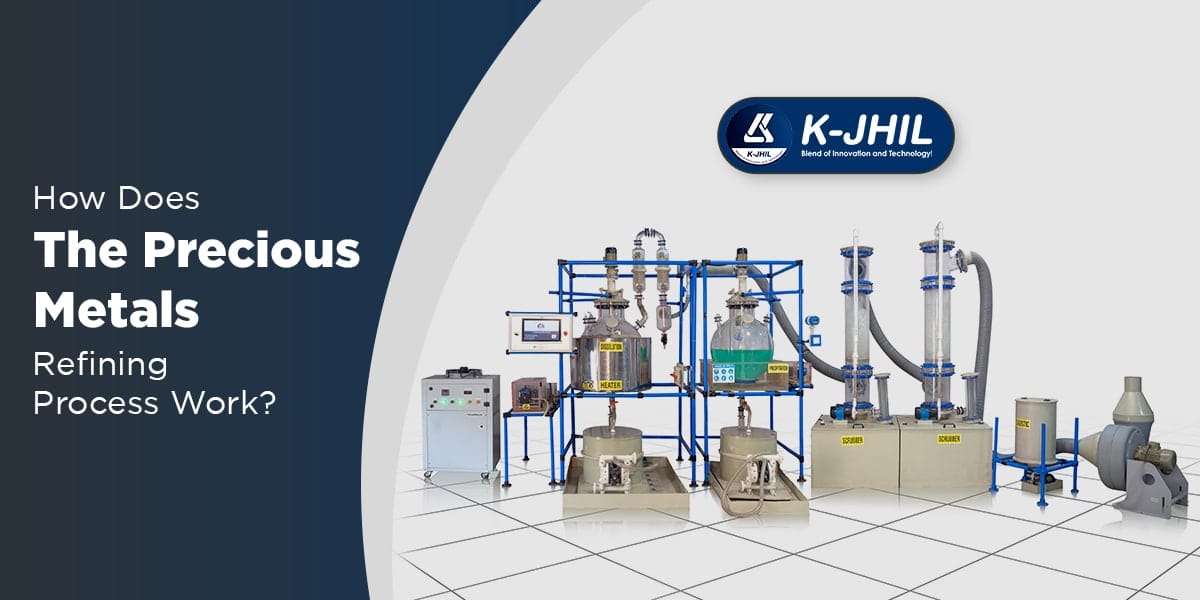
Above 25 kg per day, you are into turnkey territory with integrated scrubbing, effluent treatment, and process control. At this scale the precious metals refinery system specification needs to be built around your specific feed, since mixed scrap and doré make different demands on the same equipment.
Our systems handle 1 kg to 100 kg capacities and deliver 99.95% purity with silver and copper recovered as by-products. For the gold-specific route in detail, see our gold refining process guide, and for the distinction that confuses many buyers, gold refining versus gold smelting.
Environmental and Regulatory Requirements in India
Refining is a regulated activity, and the approvals are not a formality.
You need Consent to Establish and Consent to Operate from your State Pollution Control Board, issued under the Water Act 1974 and the Air Act 1981. Spent acid and process residues fall under the Hazardous and Other Wastes Rules 2016.
Operations processing electronic scrap come under the E-Waste Management Rules 2022, which carry their own registration and record-keeping obligations.
Nitrogen oxide scrubbing is the technical requirement that gets underspecified most often. Alkali scrubbing on the reactor vent is standard practice, and an undersized scrubber becomes a compliance problem and a metal loss at the same time.
Quality systems matter to buyers as much as regulators. ISO 9001 certification and documented assay procedures are what large customers audit, and our notes on quality control in precious metals refining and refinery safety practices cover what that looks like day to day.
Quick Stat
Consent to Establish and Consent to Operate typically take several weeks to a few months depending on the state board and category. Start the application before equipment delivery, not after, since a commissioned plant sitting idle awaiting consent is pure carrying cost.
Getting the Right Refining System for Your Operation
The precious metals refining process rewards operators who measure carefully and punishes those who buy on price alone. Feed characteristics, target fineness, and honest throughput numbers should decide your specification, in that order.
K-JHIL Scientific has built refining and chemical process systems from Vapi, Gujarat since 1990. Our aqua regia systems cover 1 kg to 100 kg capacities at 99.95% purity, with silver and copper recovered and acid consumption held low.
Send us your feed assay and your realistic daily volume, and we will size a system against those numbers rather than a catalog page. Request a quote or talk to our engineering team about your requirement.
Precious Metals Refining Process FAQs
How does the precious metals refining process work?
Refining removes base metals from recovered gold, silver, and platinum group metals through assay, chemical dissolution or electrolysis, precipitation, and melting. Aqua regia refining reaches 99.95% gold purity, while the Wohlwill electrolytic process reaches 99.99% and above.
What is the difference between refining and extraction?
Extraction gets metal out of ore through crushing, flotation, and leaching at the mine site. Refining purifies metal that has already been recovered, working from doré bars, jewelry scrap, or electronic waste.
What purity can an aqua regia gold refining plant achieve?
A well-operated aqua regia plant delivers 99.95% purity consistently. Reaching 99.99% requires an additional electrolytic finishing stage.
Why is inquartation needed before aqua regia?
Silver in the feed forms insoluble silver chloride that coats the metal and halts dissolution. Inquartation dilutes the alloy to roughly 25% gold and removes silver through nitric parting first.
What is the difference between the Miller and Wohlwill processes?
Miller uses chlorine gas through molten gold, finishing in one to two hours at around 99.5% purity. Wohlwill is electrolytic, reaching 99.99% and above, but it takes far longer and ties up substantial gold in the cells.
How is silver refined to 99.9% purity?
Silver-bearing alloys are parted in nitric acid, cast into anodes, and refined electrolytically in a Moebius or Balbach-Thum cell. Silver crystals deposit on the cathode while gold reports to the anode slime for recovery.
Can the same plant refine gold, silver, and platinum?
A single aqua regia plant handles gold and recovers silver and copper as by-products. Platinum group metals need dedicated precipitation and separation stages that should be specified separately.
What does a gold refining plant cost in India?
Small units start around ₹3 lakh, semi-automatic systems run ₹8 lakh to ₹15 lakh, and fully automatic systems fall in the ₹15 lakh to ₹35 lakh range. Turnkey refineries run from ₹1.5 crore upward depending on capacity.
What is an acceptable refining loss?
Losses of 0.5% to 1% are normal for a well-run plant. Anything consistently above 2% points to washing discipline, precipitation control, or assay error rather than unavoidable physics.
What licenses are needed to run a refinery in India?
Consent to Establish and Consent to Operate from the State Pollution Control Board are the core requirements, under the Water Act 1974 and the Air Act 1981. Hazardous waste authorization applies to spent acid, and e-waste processing carries additional registration.
Does the precious metals refining process handle electronic waste?
Yes. Circuit boards and connectors are processed to concentrate metals, then dissolved and refined through the same chemical route, though feed preparation differs considerably from jewelry scrap.
How long does one refining batch take?
A standard aqua regia batch runs four to eight hours from charge to cast. Inquartation adds three to six hours when the feed carries high silver.