
By the K-Jhil Scientific technical team, drawing on 30+ years building distillation and extraction systems for aroma, pharma, and specialty chemical plants.
QUICK ANSWER
Five essential oil extraction methods cover almost all commercial production: steam distillation, hydrodistillation, solvent extraction, cold press, and CO2 supercritical extraction. The split is not complicated. Steam and hydrodistillation take heat-tolerant botanicals, solvent and CO2 handle delicate florals and resins, and cold press expression is used predominantly for citrus peel, where the oil glands can be mechanically ruptured. What you reach for comes down to three things: the part of the plant, how much heat the oil survives, and the purity your buyer demands.
A heap of plant goes in. A small bottle of concentrated oil comes out. What happens in between is not a preference you get to pick, it is set by the botanical, the part of the plant, and where the oil hides inside it.
Get it right and yield, aroma, and purity look after themselves. Get it wrong and you either cook the oil off or leave most of it sitting in the spent biomass.
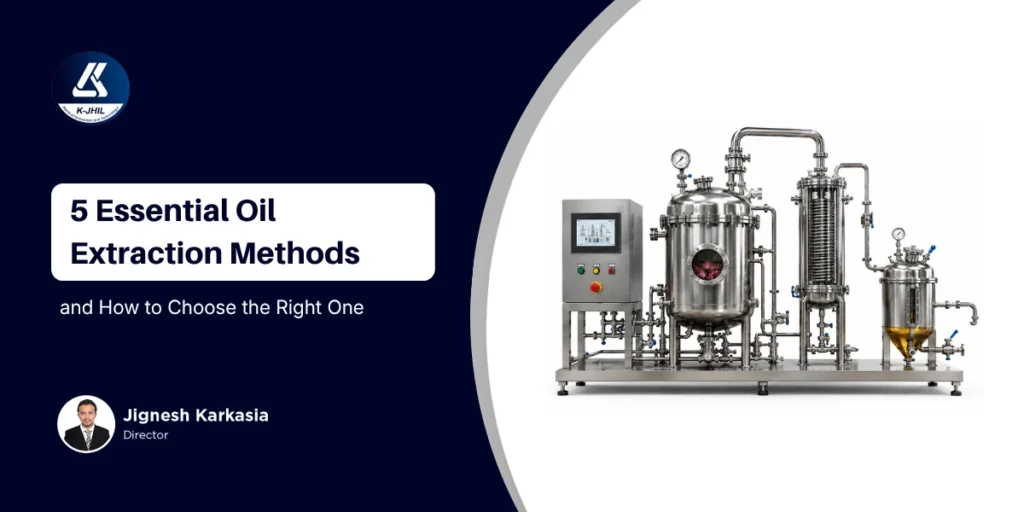
What follows is the five essential oil extraction methods that account for nearly all commercial production, how each behaves on a real plant floor, and how to pick the one your material actually wants. Process first. Marketing never.
What Actually Decides the Extraction Method
Before you weigh the essential oil extraction methods against each other, five questions settle it. Answer these and the method mostly picks itself.
- Plant part. A flower gives up its oil differently than a seed, a bark, or a strip of peel. That alone shifts the method.
- Heat sensitivity. Some aromatics take heat fine. Others shift or break down the moment steam reaches them, which quietly rules out plain distillation.
- Where the oil sits. Citrus keeps its oil in sacs just under the peel. Most other botanicals bury it deeper, where only steam will reach.
- Yield. Distillation always leaves a little behind. Solvent and CO2 dig more out of stingy, low-yield material.
- Purity and rules. Once pharma or food-grade enters the picture, residual-solvent limits and GMP start steering the choice, often toward CO2.
Across the types of essential oil extraction in commercial use, those five decide the fit far more than habit or price ever will.
How Essential Oils are Extracted
Strip the equipment away and how essential oils are extracted comes down to a single job: getting the volatile aromatic oil out and leaving the rest of the plant behind. Three families of method do it.
Distillation carries the oil out as vapor on steam or boiling water, then condenses it back. Solvent methods dissolve it out, with a liquid or with pressurized CO2. Expression just squeezes, no heat, no solvent, nothing chemical about it.
Those three families cover nearly all the types of essential oil extraction you will meet. Which one suits your botanical is the whole question. The rest is equipment and control.
Method 1: Steam Distillation Method
Steam distillation is the workhorse of the trade. By published estimates it accounts for around 93 percent of all essential oil produced, a fair measure of how well it fits the everyday botanicals. Leaves, herbs, wood, spice, anything that shrugs off heat, from mint and eucalyptus through to lemongrass and clove.
The steam distillation method keeps the steam source and the plant apart. A boiler pushes steam up through the charged still, the steam bursts the oil cells and carries the vapor over, and a condenser drops it back to liquid. Oil and water then part in the separator, sorted by density.
The oil is separated from the condensate according to density. Many essential oils form an upper layer, while denser oils such as clove and cinnamon oil form a lower layer. For the core vessel and condenser train, our simple distillation unit covers the standard build.
At atmospheric pressure, steam distillation commonly operates near 100 degrees C, while the actual temperature depends on pressure, steam conditions and equipment design. Hot enough to move the oil, gentle enough for most hardy botanicals. If you need to split close-boiling fractions afterward, the difference between distillation and fractional distillation is worth reading before you buy.
PRO TIP: Steam quality settles oil quality more than the brochure will ever admit. Wet or patchy steam finds the easy path, channels through the charge, and leaves oil behind. A steady, slightly superheated supply and an evenly packed bed matter every bit as much as the still.
Method 2: Hydrodistillation (Water Distillation)
Hydrodistillation drops the botanical straight into boiling water instead of running steam past it. That one change is the whole difference from steam distillation, and it shows up in the oil.
In hydrodistillation, the botanical is immersed in boiling water. This can be useful for materials that compact or channel under direct steam flow, although prolonged heating and water contact can affect heat-sensitive compounds.
Powders, roots, and some flowers that would clump under steam do better here, and a few botanicals simply give up more oil. Clove is the textbook case, where published work has hydrodistillation pulling close to double the oil of steam, because steam locks clove oil into a stubborn emulsion.
The price is time and heat. The charge stews longer, which can flatten delicate top notes and drag the batch out, so you match the method to the material rather than default to it.
Method 3: Solvent Extraction Method
Some flowers are too delicate for heat, or hold too little oil to make distillation pay. That is when solvent extraction earns its place. Jasmine, tuberose, rose, the ones steam either ruins or barely touches.
The solvent extraction method washes the botanical in a suitable volatile solvent, which lifts the aromatics along with wax and pigment. Conventional concrete production has historically used solvents such as hexane, while other solvent systems may be selected depending on the application.
Boil the solvent off and you are left with a waxy concrete. A second wash in alcohol pulls the pure absolute away from that wax.
Strictly, an absolute is not an essential oil, though the trade tends to lump them together. The principle is the same one behind what is liquid liquid extraction, one phase pulling a target compound out of another. Contact, dissolve, separate, recover the solvent.
WATCH OUT: Solvent choice is a regulatory decision, not just a yield one. Any residual solvent left in the finished absolute has to clear limits such as ICH Q3C for pharma and food use, so residual-solvent testing and proper solvent recovery are not optional on a commercial line.
Method 4: Cold Press Expression
Cold press, or expression, is the odd one out, and it is citrus almost to the exclusion of everything else. Lemon, orange, bergamot, lime, grapefruit, each keeps its oil in sacs right under the skin, so you rupture and squeeze the peel and the oil comes away with no heat at all.
Nothing gets hot, so the oil keeps the sharp, fresh top note that makes citrus citrus, the very thing distillation dulls. Try it on anything else and it fails, since the oil sits too deep to press.
Shelf life is the catch. Cold-pressed citrus carries more of the peel’s heavier, non-volatile compounds, so it turns faster and wants cooler, tighter storage than a distilled oil.
WATCH OUT: Cold-pressed citrus oil is the fastest thing in the store to go off. Those extra peel compounds oxidize, so a drum that sat warm and half-empty can spoil before you sell it. Keep it cold, keep it full, keep it dark.
Method 5: CO2 Supercritical Extraction
CO2 supercritical extraction is the newest of the five and the one that empties a budget fastest. Squeeze carbon dioxide past its critical point and it becomes something between a gas and a liquid, a clean solvent that pulls oil out cool, usually somewhere near 35 to 60 degrees C.
Two things make it worth the trouble: the low heat and the clean finish. Gentle temperature spares compounds steam would wreck, and the second you release the pressure the CO2 turns back to gas and walks off, leaving no residue behind. That is why pharma and nutraceutical work under GMP leans on it, and why it suits resins like frankincense and myrrh.
The cost is not small. These rigs run at brutal pressure, carry heavy capital and running costs, and fight you on continuous scale-up, so you save the method for material that earns it back. One camphor-leaf study put supercritical CO2 at about 4.63 percent oil against under 0.5 percent for steam, a gap that only pays when the material is precious to start with.
The Five Essential Oil Extraction Techniques, Compared
Here is how the five essential oil extraction techniques stack up on the things that actually move a purchase. Treat the numbers as typical ranges, since they wander with botanical, pressure, and equipment.
Method | How It Works | Temperature | Best For | Output | Cost |
|---|---|---|---|---|---|
Steam Distillation | Steam carries oil out as vapor | ~60 to 100 C | Heat-tolerant leaves, herbs, spice | Essential oil | Low to moderate |
Hydrodistillation | Botanicals boiled in water | ~100 C | Powders, roots, some flowers | Essential oil | Low |
Solvent Extraction | Solvent dissolves the oil out | Relatively low, varies with solvent and recovery | Delicate florals, low-yield material | Absolute | Moderate |
Cold Press | Peel ruptured and pressed | No heat | Citrus peel only | Essential oil | Low |
CO2 Supercritical | Pressurized CO2 as solvent | ~35 to 60 C | Resins, delicate material, pharma | CO2 extract | High |
Which Extraction Method Should You Choose?
Of the five essential oil extraction methods, the truth is the material picks more than you do. Still, here is the split I give producers when they ask.
Choose steam or hydrodistillation if you run heat-tolerant leaves, herbs, wood, or spice at volume and want the lowest cost per kg of oil.
Choose the solvent extraction method if your material is a delicate floral that heat ruins, or one that yields too little to distill, and you can run residual-solvent control.
Choose cold press if you are working citrus peel and want that fresh, unheated top note.
Choose CO2 supercritical if you need zero solvent residue, pharma or nutraceutical grade, or you are working high-value resins that justify the capital.
When a material sits on the fence, run a small batch each way and compare the yield and the GC profile before you commit to a plant. The best method is the one your buyer pays for, not the one that squeezes out the most raw oil.
PRO TIP: For an Indian producer, size the plant to your botanical calendar, not a single crop. Steam distillation units here commonly run batch sizes from about 50 to 500 kg of charge, and a right-sized unit that stays busy across mint, lemongrass, and spice seasons pays back faster than an oversized one idling half the year.
Where Fractional Distillation Fits?
Extraction hands you a crude oil. Turning that into something standardized and saleable usually takes a second pass, and that pass is fractional distillation.
Mint is the everyday example. The crude oil off the still gets fractionated to pull menthol and split the grades a buyer will actually name, work plain distillation cannot do cleanly. A fractional distillation machine does it by boiling point, across a lot of stages.
So extraction and refining are two jobs, not one. Scope both when you plan a line, because that fractionation step is often what turns a raw oil into a grade someone will buy.
The Essential Oil Manufacturing Process, Start to Finish
Pull back far enough and the essential oil manufacturing process holds the same shape no matter which method sits in the middle. Field at one end, sealed drum at the other.
It opens with harvest and prep, since oil content peaks at a certain maturity and starts falling the moment you cut. Then the charge runs through one of the five methods, and the oil gets parted from water or solvent. Last comes drying, filtering, sometimes fractionating, and storage kept cool, dark, and airtight.
Every stage of the essential oil manufacturing process feeds the next. A late harvest or a sloppy drum will undo a perfect distillation, so you judge the thing end to end, never at the still alone.
QUICK STAT: Distillation yields for most botanicals sit in the low single digits by weight, often well under 2 percent, and some florals far less. That is why matching method to material matters, since a point of extra yield on a low-yield oil can outweigh the equipment difference many times over.
Choosing the Right Extraction System for Your Setup
Take away the detail and every one of the essential oil extraction methods comes back to one call: match the process to your material, your target grade, and your volume. Nail those three and the equipment stops being guesswork.
At K-Jhil Scientific, we build distillation and extraction systems in borosilicate glass and glass-lined steel for aroma, pharma, and specialty chemical producers. If you are scoping an essential oil line and want the process specified around your material rather than a stock catalog, Contact Us before you finalize the plant.
Frequently Asked Questions About Essential Oil Extraction Methods
1: What are the main essential oil extraction methods?
The five main methods are steam distillation, hydrodistillation, solvent extraction, cold press expression, and CO2 supercritical extraction. Steam and hydrodistillation suit most botanicals, while solvent, cold press, and CO2 handle specific materials. These are the main types of essential oil extraction used in industry.
2: How are essential oils extracted?
This is how essential oils are extracted: by separating the volatile aromatic oil from the plant, using steam or boiling water, a liquid solvent, pressurized CO2, or mechanical pressing. The route depends on the botanical and how much heat the oil can take.
3: What is the difference between steam distillation and hydrodistillation?
In steam distillation, steam is generated separately and passed through the plant material. In hydrodistillation, the material sits directly in boiling water, which protects fragile charges but adds heat exposure and time.
4: Which extraction method is best?
There is no single best method. Steam distillation is best for heat-tolerant botanicals at scale, cold press for citrus, solvent extraction for delicate florals, and CO2 for zero-residue pharma-grade work.
5: What is the solvent extraction method used for?
For delicate flowers like jasmine, tuberose, and rose that heat would damage or that yield too little oil for distillation. It produces an absolute and requires residual-solvent control for pharma and food use.
6: Does CO2 extraction leave solvent residue?
No. Once the pressure is released, the CO2 returns to gas and leaves the extract, so no solvent residue remains, which is why it suits pharma and food-grade applications.
7: Why is cold press only used for citrus?
Citrus holds its oil in sacs close to the peel surface, so pressing ruptures those sacs and releases the oil without heat. Other botanicals hold their oil too deep to press out.
8: What is an absolute versus an essential oil?
An absolute is the aromatic extract produced by solvent extraction, while an essential oil is produced by distillation or expression. Absolutes are common for delicate florals that cannot be distilled well.
9: What temperature does steam distillation use?
At atmospheric pressure, the steam distillation method commonly operates near the boiling point of water (about 100 degrees C), with actual conditions varying according to pressure and equipment design.
10: How much oil does a plant yield?
Most botanicals yield only low single-digit percentages of oil by weight, and many florals far less, which is why yield differences between methods carry real commercial weight.
11: What equipment is needed to extract essential oils?
A distillation system needs a still or charge vessel, a steam source, a condenser, and a separator, plus fractionation equipment if the oil needs refining. Solvent and CO2 routes use extraction vessels and solvent recovery instead.