
Heat is the enemy for a lot of valuable liquids. Leave a delicate pharma intermediate on a hot wall too long and it breaks down. Push a thick resin and it chars.
That is the problem a thin film evaporator is built to solve. It never lets the liquid sit still, and never lets it sit long.
Instead of a deep pot of boiling liquid, it wipes the feed into a film thinner than a sheet of paper and runs it down a heated wall.
The useful vapor lifts off in seconds, under vacuum. The product is clear before heat can even touch it.
A few numbers carry the idea. The film is a tenth of a millimeter to a millimeter thick, the liquid stays on the wall for seconds, and the percentage of volatiles removed depends on the feed composition, operating conditions, and equipment design.
Wiped-film evaporators can handle highly viscous feeds, but the maximum viscosity depends on the equipment design, temperature, and operating conditions. All of it happens under a vacuum that lowers the boiling point, so nothing ever has to get as hot.
What Is a Thin Film Evaporator?
So what is it, really? Strip away the jargon and you have a still that works on a moving film instead of a boiling pool. Same goal, very different method.
The feed drops in near the top and gets flung against a heated cylinder. Blades smear it into a thin, churning film that slides down the wall, and the lighter fraction boils off along the way.
The vapor gets pulled off and condensed. The heavy leftover collects at the bottom and is pumped out. Because the film is thin and the trip quick, the product barely feels the heat.
Key Components of a Thin Film Evaporator
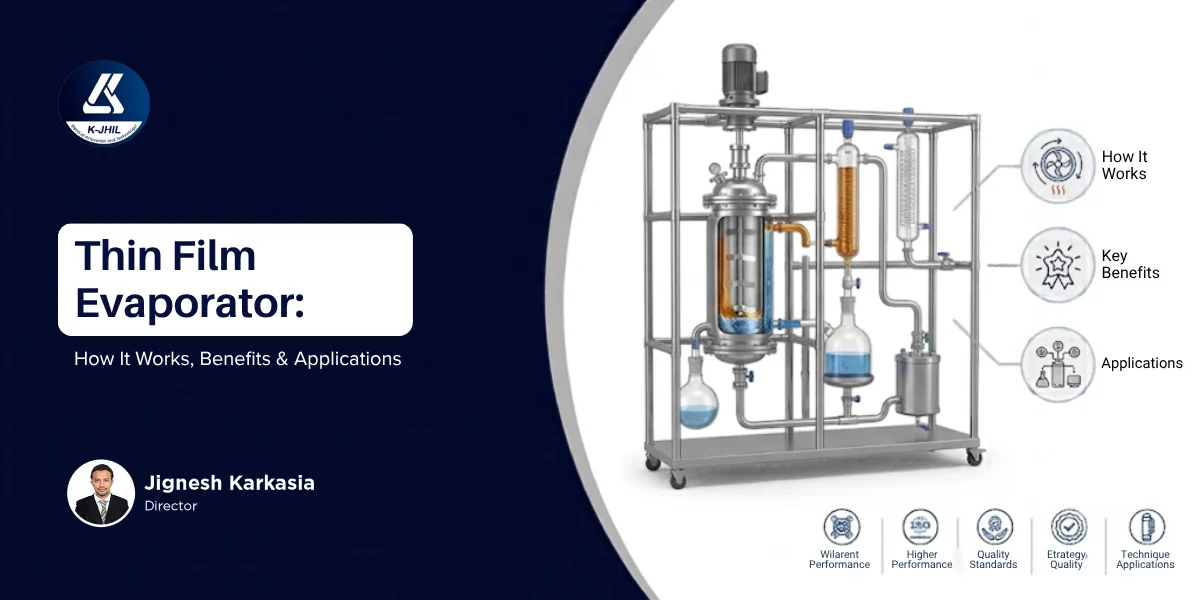
Five parts do the real work. The outer body is a jacketed cylinder, heated from the outside by steam, hot oil, or hot water.
Inside sits the rotor, a driven shaft carrying the blades that form and sweep the film. A distributor ring at the top lays the feed down evenly.
A port pulls the chamber down to vacuum, and a condenser catches the vapor while the residue drains from the base.
Thin Film Evaporator vs Wiped Film Evaporator
The two names get muddled all the time, so here is the clean line. Thin-film and wiped-film evaporators are closely related terms, but their definitions can vary by manufacturer.
A handful of designs hold the film with fixed rigid vanes instead of wiping it. On a plant floor, though, nobody splits hairs. Thin film, wiped film, and agitated thin film usually mean the same machine.
Thin Film Evaporator Working Principle
The thin film evaporator working principle is almost embarrassingly simple: keep the film thin and moving. Evaporation then turns fast and gentle at once, and the split finishes before the product can cook.
How the Thin Film Evaporation Process Works, Step by Step
Follow the thin film evaporation process once and it sticks. The feed enters at the top, just above the heated zone, and the wipers spread it across the hot wall as a film.
Volatiles boil off within seconds and get drawn to a condenser, where they are caught as distillate. Whatever refuses to evaporate, the residue or concentrate, runs out the bottom. The whole thing runs continuously, not in batches.
Why Vacuum and Short Residence Time Matter
Pull a vacuum and the boiling point falls. Vacuum lowers the boiling temperature, but the actual temperature depends on the compound’s vapor pressure and operating pressure. Either way, that lower heat is everything for a fragile molecule.
The short stay on the wall counts just as much. Nothing lingers long enough to char or polymerize. Keeping that low pressure steady falls to a vacuum ejector system, and the whole result stands or falls on it.
Types of Thin Film Evaporators
Not every film forms the same way, and picking the right type comes down to three questions. How thick is the feed, how fragile is it, and how deep a vacuum does it need?
Wiped Film, Falling Film, and Short-Path
A wiped film unit builds and stirs the film with blades, which is why it shrugs off thick, fouling feeds.
Falling-film evaporators are generally best suited to low-viscosity feeds, but their suitability depends on the liquid properties, fouling tendency, and equipment design.
A short-path evaporator pushes further still, tucking the condenser right inside the body, inches from the film. The vapor barely travels, and the vacuum can run very deep.
That is also where you hear the term molecular distillation. Molecular distillation operates when the vapor path is shorter than the molecules’ mean free path. This is a specialized process and should not be used as a blanket description of every short-path evaporator.
Vertical vs Horizontal
Most units stand upright, feed at the top, gravity lending a hand. Horizontal ones show up for the awkward jobs, very high solids or crystallizing feeds, where a sideways rotor manages the residue better.
Type | Film Formed By | Best For | Limit |
|---|---|---|---|
Wiped / thin film | Rotating wiper blades | Viscous, fouling, heat-sensitive feeds | More moving parts to maintain |
Falling film | Gravity | Low-viscosity, clean liquids | Fouls and dries out easily |
Short-path | Wipers plus internal condenser | High-boiling, very heat-sensitive products | Higher cost and complexity |
Benefits of a Thin Film Evaporator
Every benefit comes back to the same two things, a thin film and a short pass. Between them, you can run material that would scorch, foul, or set solid in an ordinary evaporator.
Heat-Sensitive and High-Boiling Materials
The product meets heat for only seconds, and it boils under vacuum, so delicate molecules make it through whole. That is why pharma, food, and flavor houses turn to it the moment quality cannot slip.
Heavy, high-boiling residues behave the same way. You can lift a clean distillate off a thick, sluggish feed without ever driving it to the point where it falls apart.
High Viscosity, Fouling, and Solids
The wipers earn their keep twice over. Every rotation scrapes the wall, so scale and fouling barely get a grip, and the unit keeps running where others would clog solid.
That same scraping moves feeds most evaporators cannot touch, thick stuff running into the hundreds of thousands of centipoise. A falling-film or tube unit simply stalls there.
The rest of the wins are quieter but real. A small footprint for the output, turndown near 10 to 1, low pressure drop, and steady round-the-clock running rather than batch stop-start.
Limitations to Keep in Mind
No evaporator suits every job, and pretending otherwise helps nobody. A thin film unit costs more than a plain falling-film or batch design, both to buy and to run.
The rotor, bearings, and blades are moving parts, so they need regular attention. And one unit can only grow so large before shaft length and heated area cap it.
For a clean, heat-stable, thin feed, a cheaper evaporator does the same work for less. This design earns its price only when the feed is genuinely difficult.
Thin Film Evaporator Uses and Applications
Thin film evaporator uses all circle one idea, separating or concentrating something that heat or thickness makes hard. The feed changes from one plant to the next, but the reason never does.
Solvent Recovery and Distillation
Pulling clean solvent back out of a spent stream is about the most common job of all. The unit lifts the good solvent off the dirty mix so you can use it again.
On a lot of Indian chemical plants, it is the beating heart of the solvent recovery unit itself.
It handles gentle distillation too, the heat-sensitive and high-boiling liquids a packed column would ruin. Monomers, plasticizers, fatty acids, glycols, silicone oils, all of them come apart this way.
Pharmaceutical, Food, and Specialty Chemicals
In pharma it concentrates APIs and intermediates and strips leftover solvent under GMP conditions, where the low heat guards potency. Food and flavor makers put it to work on fruit concentrates, gelatin, and essential oils.
Specialty chemical plants lean on it for polymers, pre-polymers, resins, and VOC reduction, the thick, reactive feeds that love a wiped, self-cleaning wall.
Bromine and Halogen Recovery
Halogen chemistry is corrosive and unforgiving. Material compatibility and safe vapor handling are essential for corrosive and hazardous streams, and the specific application should be confirmed before a thin film evaporator is chosen for bromine or halogen recovery. Related equipment appears in the bromine manufacturing process.
Industry | Typical Application | Why a Thin Film Evaporator |
|---|---|---|
Pharmaceutical | API and intermediate concentration, solvent stripping | Low-temperature processing can help protect product quality. GMP compliance depends on the overall manufacturing process, equipment qualification, documentation, and quality-control procedures. |
Chemical | Solvent recovery, monomer and resin distillation | Handles viscous, fouling, reactive feeds |
Food and flavor | Fruit concentrates, gelatin, essential oils | Gentle heat keeps aroma and quality |
Halogen and bromine | Recovery and concentration of halogen streams | Sealed vacuum plus corrosion-grade build |
Environmental | Effluent concentration, zero liquid discharge | Concentrates to a pumpable residue |
How to Choose a Thin Film Evaporator
The right choice follows the feed, not the sales sheet. Before you weigh quotes, pin down four things: how viscous the feed is, how heat-sensitive, how corrosive, and how deep a vacuum it needs.
Thick and fouling feeds point you to a wiped design. The very high boilers and the most fragile products point to short-path. Corrosive duty settles the material, whether that is borosilicate glass, SS316, or Hastelloy.
Weigh it against the alternative as well. For a heat-sensitive or thick feed, a thin film unit usually beats column distillation, and our note on solvent distillation technologies shows where each one pulls ahead.
Do not forget running cost and upkeep. The rotor, seals, and blades all want periodic care, and the same discipline that keeps a solvent recovery system maintenance schedule on track keeps this unit at full output.
On price, a pilot-scale borosilicate unit starts from a few lakh. Large production units in stainless or exotic alloys climb into crores as the heated area and corrosion resistance go up.
Choosing the Right Thin Film Evaporator for Your Process
Match the unit to your feed, your heat limits, and the vacuum your product needs, and the equipment takes care of the rest.
Get those three right and a thin film evaporator guards quality while pulling value from streams you might otherwise discard.
K-Jhil Scientific designs and builds borosilicate glass and glass-lined process equipment for pharma, chemical, and solvent recovery plants across India. We size each system to the duty, not to a catalog page.
Send us your feed, its viscosity, and your separation target, and we will point you to the right thin film evaporator setup, or to the simpler unit, when that is the honest answer for your process.
Thin Film Evaporator FAQs
What is a thin film evaporator?
It spreads a liquid into a thin film, a tenth of a millimeter to a millimeter thick, on a heated wall and boils off the volatile part in seconds under vacuum. Rotating wipers keep heat-sensitive products from degrading.
What is the difference between a thin film evaporator and a wiped film evaporator?
A wiped film evaporator is the common kind of thin film evaporator, the one that uses rotating wiper blades to form the film. Along with agitated thin film evaporator, the terms usually point at the same machine.
How does the thin film evaporation process work?
The feed enters at the top, the wipers spread it across a heated wall as a thin film, and the volatiles boil off within seconds. That vapor is condensed into distillate, while the heavier residue drains out the bottom.
What are the main thin film evaporator uses?
Solvent recovery, gentle distillation of heat-sensitive and high-boiling liquids, and concentration of viscous or fouling products. You see it across pharmaceutical, chemical, food, and halogen recovery plants.
Why does a thin film evaporator run under vacuum?
The vacuum lowers the boiling point, so products separate at far lower temperatures. That protects delicate molecules and keeps heat-sensitive feeds from breaking down.
What viscosity can a thin film evaporator handle?
Far more than a falling-film or tube evaporator, often into the hundreds of thousands of centipoise. The wiper blades keep even very thick feeds moving as a film.
What is the difference between a thin film and a short-path evaporator?
A short-path evaporator puts the condenser inside the body, right next to the film, so the vacuum can go deeper. It suits the most heat-sensitive, highest-boiling products, while a standard thin film unit covers most duties.
Is a thin film evaporator better than a distillation column?
For heat-sensitive, high-boiling, or viscous feeds, usually yes, since the short contact and low heat avoid degradation. For simple, heat-stable mixtures, a column can be cheaper and just as good.
What materials are thin film evaporators made from?
Borosilicate glass where you want to watch the process at smaller scale, and stainless steel or alloys like Hastelloy for larger or aggressive duties. How corrosive the feed is decides the choice.
How much does a thin film evaporator cost in India?
A pilot-scale borosilicate unit can start from a few lakh, while large production units in stainless or exotic alloys run into crores. Heated area, materials, and vacuum needs drive the price.
What industries use thin film evaporators?
Pharmaceutical, chemical, specialty chemical, food and flavor, biotechnology, and environmental or effluent treatment. Any plant separating or concentrating a difficult, heat-sensitive, or viscous stream is a candidate.
Can a thin film evaporator handle fouling or solids?
Yes. Wipers help reduce deposits and fouling on the heated surface, but they do not eliminate fouling or guarantee uninterrupted operation.