
QUICK ANSWER
Everyday heat exchanger examples include the car radiator, the air conditioner, and the coil behind a refrigerator. A heat exchanger moves heat from one fluid to another through a wall, without letting the two mix. Scaled up, the same device becomes the shell-and-tube condenser, plate pasteurizer, reactor jacket, and reboiler that keep an industrial plant running.
Walk through any chemical plant, and you pass dozens of these without a second look. A reboiler under a distillation column, a cooler on a pump’s lube oil, the jacket wrapped around a reactor: all of them heat exchangers, all doing one job in different clothes.
The clearest heat exchanger examples sit much closer to home, though. A car radiator sheds engine heat into the air rushing past it. A refrigerator lifts heat out of the cabinet and dumps it through the coils at the back.
K-Jhil manufactures borosilicate and glass-lined heat-transfer equipment for process plants, and that is the vantage point behind this guide. It covers how they work, the handful of types worth knowing, ten heat exchanger applications you meet on real sites, and the standards that let them drop into a plant anywhere.
The Heat Exchanger Working Principle
Two fluids, one warm and one cool, flow on opposite sides of a metal or glass wall. Heat crosses from the warm side to the cool side while the wall keeps the streams apart, so a cooling medium never gets into the product. That barrier is the entire point of the thing.
Send the two fluids in opposite directions, what engineers call counter-flow, and a temperature gap holds along the whole length. That pulls across far more heat than running them the same way, which is why almost every heat-recovery duty is piped counter-flow.
Sizing rests on one balance. Heat lost by the hot stream equals heat gained by the cold one, weighed against the average temperature difference and the area between them. That average goes by a specific name in the heat exchanger working principle, the log-mean temperature difference, or LMTD, Heat exchanger surface area is calculated using the heat duty, LMTD, overall heat transfer coefficient, correction factor (where applicable), and design allowances.
BY THE NUMBERS
A large shell-and-tube unit can pack hundreds of square meters of tube surface into a single shell. Counter-flow generally provides better heat-transfer performance than parallel flow under comparable conditions, but actual performance depends on operating conditions and exchanger design.
Common Heat Exchanger Types
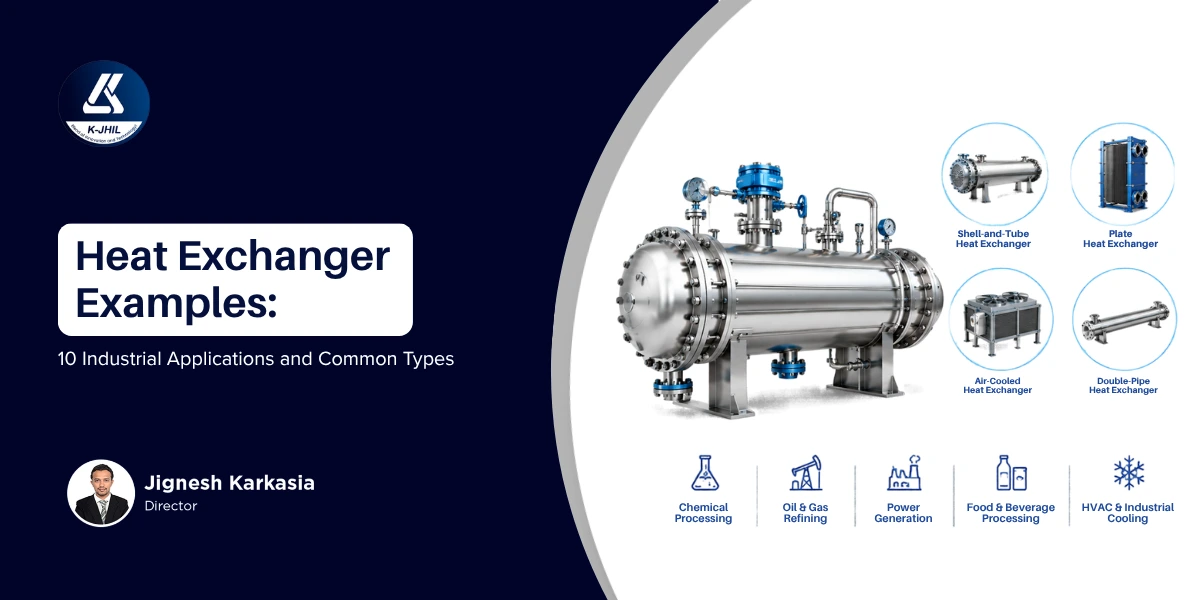
Most of the catalog boils down to five or six heat exchanger types, grouped by how the surfaces are laid out and how the two fluids stay apart. Shell-and-tube and plate units do the heavy lifting across industry. Finned, double-pipe, spiral, and brazed plate-fin designs handle the rest.
Type | How It Works | Where It Shows Up |
|---|---|---|
Shell and tube | One fluid in a tube bundle, the other in the shell around it | High pressure and temperature, most process duty |
Plate | Thin corrugated plates with fluids in alternating gaps | Food and dairy, HVAC, tight temperature approach |
Finned (air-cooled) | Fins add area for a gas-to-liquid swap | Radiators, air coolers, air-cooled condensers |
Double-pipe | One pipe running inside a larger one | Small, high-pressure, simple duty |
Spiral | Two channels coiled around a center | Slurries, sludge, heavily fouling fluids |
Brazed plate-fin | Stacked, brazed fin passages | Cryogenics, refrigeration, very close approaches |
Those are the broad families. Pressure, fouling, and the floor space on hand swing the pick as much as the fluids do, so the next table lines the same units up against the three questions that usually settle it.
Type | Pressure and Temperature | Fouling | Footprint |
|---|---|---|---|
Shell and tube | High on both | Tube side cleans easily | Large |
Plate | Low to medium | Struggles with dirt | Compact |
Finned (air-cooled) | Low to medium | Exterior wipes down | Large |
Double-pipe | Very high pressure | Simple to open | Small per unit |
Spiral | Medium | Built for it | Compact |
Brazed plate-fin | Cryogenic, tight approach | Sealed, hard to clean | Very compact |
Why the Shell and Tube Heat Exchanger Dominates
The shell and tube heat exchanger turns up on nearly every process unit built. Picture a bundle of tubes slid inside a cylinder: one fluid runs through the tubes, the other fills the shell around them, and heat crosses the tube walls.
It takes conditions that flatten thinner designs, well past 100 bar and several hundred degrees in refinery and power work. You can pull the bundle to clean it, re-tube one that has corroded, or switch to a tougher tube metal without throwing away the shell.
Two rulebooks keep them interchangeable. TEMA sorts the front heads, shells, and rear heads into letter classes, an AES or a BEM for example, and ASME Section VIII governs the pressure design. TEMA, ASME Section VIII, and API 660 address different design and construction requirements. Their applicability depends on the equipment type and project specifications.
What They Are Made Of
Shape decides what a unit can do, and the metal or glass it is built from decides what it can survive. Stainless steel covers most ordinary duty. For seawater, strong acids, or chlorides the spec climbs to titanium, a nickel alloy such as Hastelloy, or a duplex steel.
Lighter service costs less. Air coolers and refrigeration coils often run copper or aluminum, since little attacks them and price counts for more than exotic metal.
Pharma and fine-chemical work is where glass belongs. Borosilicate 3.3, the grade set by ISO 3585 with a thermal expansion near 3.3 by ten to the minus six per kelvin, shrugs off acids and holds purity, Borosilicate glass and glass-lined equipment can provide excellent corrosion resistance in suitable applications. Material selection must be based on the chemical composition, concentration, temperature, pressure, and operating conditions.
10 Heat Exchanger Applications and Examples in Industry
The list below runs ten heat exchanger applications you would actually find on a working site, roughly in order from the reactor hall out to the fence line.
- Reactor heating and cooling: A jacketed glass reactor system circulates hot oil or chilled brine through the jacket wrapped around the vessel. The jacket is a heat exchanger in its own right. A reactor jacket helps control reaction temperature, but preventing thermal runaway requires adequate cooling capacity, temperature monitoring, suitable controls, and independent safety measures where necessary.
- Stirred-tank temperature control: An exothermic batch can make more heat than the jacket alone can pull, so an internal coil or an external recirculation cooler takes the overflow. Lose that cooling and the batch cooks.
- Column condensers: The condenser at the top of a distillation column turns overhead vapor back to liquid and sets the reflux. Our note on the fractional distillation machine shows how it pairs with the reboiler below.
- Reboilers: At the base of that same column, a reboiler boils part of the bottoms to drive vapor back up, one of the key components of a fractional distillation unit.
- Feed-effluent heat recovery: Plenty of reactors preheat their cold feed with their own hot product through a single interchanger, trimming the furnace or steam bill. On a large unit that one exchanger can save a serious slice of the energy.
- Power-station condensers: A steam turbine exhausts into a surface condenser the size of a bus, tens of thousands of tubes cooled by river or sea water. Feedwater heaters then claw heat back from bled steam before it reaches the boiler.
- Refrigeration and HVAC: A window air conditioner holds two of them, an evaporator inside and a condenser outside. Big chillers stack brazed-plate and shell-and-tube units through the refrigerant loop.
- Milk and juice pasteurizing: A plate pasteurizer holds milk at 72 degrees C for about 15 seconds, then chills it, all in one gasketed stack. A regeneration section warms the incoming milk with the outgoing hot milk and recovers most of the heat.
- Oil and gas trains: Crude preheat exchangers, overhead condensers, and lube-oil coolers all run shell-and-tube built for pressure and dirty service. Where cooling water is short, banks of air-cooled fin-fans take over.
- Effluent and flue-gas recovery: Spiral units pull heat from sludge and effluent that would clog anything flatter, while economizers scavenge warmth from boiler flue gas. The reclaimed heat usually goes straight back into feedwater or process water.
Everyday Heat Exchanger Uses
Step away from the plant and the examples turn familiar fast. A car radiator pushes engine coolant through finned tubes while the fan drags air across them. The cabin heater is that same trick in reverse, warming you off the engine’s waste heat.
Your fridge and your air conditioner each move heat with a pair of coils and a compressor between them. One coil soaks up heat, the other sheds it, and swapping their roles is the only difference between cooling and heating in a reversible heat pump.
A gas geyser belongs on the list too, running water past the hot flue of a burner. These everyday heat exchanger uses outnumber the industrial ones by a wide margin, and they just never go by the name.
Industrial Heat Exchangers in Chemical and Pharma Plants
On a process site the industrial heat exchangers are not accessories bolted on at the end. The different types of chemical reactors on the floor each need heat added or pulled off, and so do the columns, dryers, crystallizers, and the chilled-water loop that feeds them.
That duty is what K-Jhil manufactures for. We build the glass-lined jackets, borosilicate condensers, and reboilers that ride on a continuous stirred tank reactor or a distillation column. Each one is sized so the cooling keeps pace with the reaction and the surface takes whatever the chemistry throws at the wall.
Corrosion is usually what settles the build. Carbon steel may corrode rapidly in certain acidic services. Material selection should be based on corrosion data and the actual process conditions rather than a fixed service-life assumption.
How to Choose the Right Heat Exchanger
Selection starts with the fluids, not the brochure. Name both streams, their temperatures and pressures, how corrosive and how dirty they are, and how much heat has to shift. The rest follows from those answers.
- Corrosion and purity: Aggressive or high-purity media push the choice toward glass, glass-lined, or a high alloy.
- Pressure and temperature: Hard duty favors shell-and-tube, while gentle duty opens up plate and finned designs.
- Fouling: Dirty, viscous, or solid-laden fluids want spiral or widely spaced units you can open and scrape.
- Space and budget: Plate packs the most area into the least floor, and shell-and-tube wins on cost per square meter once the units get big.
Get those four right and the type nearly names itself. Miss on corrosion, though, and no amount of surface area saves the unit, because it will leak, usually at the worst possible moment.
Key Takeaways
- Everyday heat exchanger examples like the car radiator, AC, and fridge are the same device as the condensers, reboilers, and reactor jackets in a plant, just at a different scale.
- Two fluids trade heat through a wall without mixing, and counter-flow moves the most heat for a given area.
- Shell-and-tube and plate handle most industrial duty, with finned, double-pipe, spiral, and brazed plate-fin filling the edges.
- Material tracks the chemistry, which is why corrosive pharma and specialty work runs on glass and glass-lined units.
- Choose by fluids first, then pressure and temperature, then fouling, then space and cost.
Getting the Right Heat Exchanger for Your Process
Across all these heat exchanger examples, one thread holds. The right unit is the one matched to the fluids it carries and the duty it has to hold, built in a material those fluids will not eat, rather than the one that fits a standard drawing.
At K-Jhil Scientific, we manufacture borosilicate and glass-lined reactors, condensers, and distillation systems, and size the heat-transfer surface around your actual process. If you are scoping a reactor or a column and want the exchanger matched to the batch it will carry, Contact Us before the design is frozen.
Frequently Asked Questions About Heat Exchanger Examples
1: What are some common heat exchanger examples?
At home, the car radiator, air conditioner, refrigerator, and gas geyser. In industry, shell-and-tube condensers, plate pasteurizers, reactor jackets, and distillation reboilers.
2: How does the heat exchanger work?
Two fluids at different temperatures flow on either side of a wall and trade heat without mixing. Running them counter-flow, in opposite directions, moves the most heat for a given surface area.
3: What are the main heat exchanger types?
Shell-and-tube, plate, finned or air-cooled, double-pipe, spiral, and brazed plate-fin. Shell-and-tube and plate heat exchangers are widely used in industry, while other types are selected according to pressure, temperature, fouling, heat-transfer requirements, and available space.
4: What is a shell-and-tube heat exchanger?
A tube bundle carrying one fluid inside a shell carrying another, with heat passing through the tube walls. It can handle high pressure and temperature, which makes it the most common industrial type.
5: What are the main heat exchanger applications in industry?
Reactor heating and cooling, distillation condensing and reboiling, power-station condensers, HVAC and refrigeration, food pasteurizing, oil and gas cooling, and effluent or flue-gas heat recovery.
6: What are everyday heat exchanger uses at home?
The refrigerator, the air conditioner, the car radiator, and gas water heaters. Each shifts heat between two fluids without letting them touch.
7: Which heat exchanger is used in chemical plants?
Mostly shell-and-tube, with glass and glass-lined units for corrosive service. Reactor jackets, condensers, and reboilers all count as heat exchangers too.
8: Why is counter-flow better than parallel flow?
Counter-flow keeps a temperature difference along the whole length, so it transfers more heat for the same area. Parallel flow closes that gap early and recovers less.
9: What are industrial heat exchangers made of?
Stainless steel and higher alloys for most duty, and borosilicate glass or glass-lined steel for corrosive pharma and specialty service. The material follows the chemistry.
10: How do I choose a heat exchanger?
Start with the fluids, their temperature and pressure, the fouling risk, and the space and budget. Those four narrow the type before any brand name comes up.
11: Is a reactor jacket a heat exchanger?
Yes. It circulates a heating or cooling fluid around the vessel wall to hold the batch on temperature, which is exactly what a heat exchanger does.