
Funny story. My first day on a bromine site was somewhere outside Bhavnagar, back in July 1996. The senior engineer there told me half the salt farmers in Gujarat still thought recovery was Western nonsense.
Three decades later, those same farmers can’t build these plants fast enough. And every client I sit with eventually asks me the same thing.
So how does the actual plant work?
Let me show you the bromine production process the way I’d walk a new engineer through it on day one.
Bromine Recovery Plant: Numbers People Always Ask Me First
Before getting to the mechanics, here are the figures that come up in pretty much every meeting:
- Purity at the gate sits between 99.5 and 99.9 percent, well inside IS 2142
- A decent plant pulls 90 to 95 percent of the bromine out of the bittern
- Effluent leaves at under 10 ppm. Pollution Boards have no issue with it
- Most projects pay back in 2 to 4 years. My fastest was 22 months in Ankleshwar
- Run it right, and you’ll get 20 to 25 years before any major rebuild
Those numbers are why anyone bothers building one. Now the actual plant.
So What Even is a Bromine Recovery Plant?
In plain words, an industrial unit. You feed it dilute bromide brine. Out comes liquid bromine that meets IS 2142.
The magic happens through chlorine oxidation, steam stripping, and a final distillation. Chemistry-wise, it’s tired old stuff from the 1930s. Engineering-wise though, that’s where 30 years of experience start to count.
Where Does the Feed for a Bromine Recovery Plant Come From?
Two main sources. Pick whichever one you have access to.
Sea bittern (the grass-root route)
- Mother liquor left over after sea salt crystallizes out
- Carries roughly 2.5 to 4 GPL of bromine
- Almost every coastal Indian producer starts here
Industrial effluent (the waste route)
- Aqueous NaBr, KBr, or HBr from chemical plants
- Concentration is all over the map, anywhere from 2 GPL to a wild 300 GPL
- Common in pharma, dyes, agrochem, and flame retardant production
The table below shows roughly what you’ll see across different industries. I’ve worked with each of these feeds.
Industry | Common Bromide Form | Typical Concentration |
|---|---|---|
Agrochemicals | HBr, NaBr, KBr | 5 to 40 GPL |
Dyes and Intermediates | NaBr, HBr | 10 to 60 GPL |
Flame Retardants | HBr, NaBr | 15 to 80 GPL |
Pharmaceuticals | NaBr, KBr | 2 to 20 GPL |
Sea Bittern | MgBr2, NaBr | 2.5 to 4 GPL |
The Chemistry Behind the Bromine Production Process
Here’s the funny part. The reaction running the whole bromine production process is something you probably learned in 10th grade.
That’s basically how bromine is made at industrial scale. Chlorine sits one step above bromine on the periodic table, so chlorine kicks bromine out of its bromide salt.
The reaction itself looks like this:
Cl₂ + 2 Br⁻ → Br₂ + 2 Cl⁻
That single line is what every column, condenser, and scrubber in the plant exists to make happen. Cleanly. At scale, without eating itself alive.
Hot vs Cold Bromine Manufacturing Process: How I Pick
This is your first big design call. Pick wrong and you’ll spend the next year fixing the back end.
Hot process (steam stripping)
- Best for any feed above 3 GPL
- Live steam carries the bromine vapor straight out
- Cleaner product, easier downstream, my usual go-to
Cold process (air blowing-out)
- For feeds below 3 GPL
- Air does the lifting, then alkali traps the bromine
- Useful for very dilute streams or huge throughput
Sea-bittern operators almost always go hot. NaBr and KBr effluent too. Cold makes sense in maybe one out of ten projects I see.
Inside a Bromine Recovery Plant: The 7 Working Steps
Here’s the actual sequence, in the order it runs on a real plant floor.
Step 1: Brine Pre-Treatment
Raw brine doesn’t go straight into the reaction tower. Ever. We screen it, settle it, and check for hardness, iron, and dissolved organics.
Calcium and iron will scale your columns within weeks if left alone. Organics react with bromine and silently steal your yield. Activated carbon or chemical oxidation handles them.
Pre-treatment is the cheapest insurance you’ll ever buy on a bromine plant. Skip it and you’ll learn the hard way. Too many owners have already learned that lesson.
Step 2: Acidification
Cleaned brine goes into an acidification tank. Sulfuric acid lowers the pH to approximately 1.5–2.0. Maintaining this acidic range suppresses bromine hydrolysis and improves bromine recovery efficiency. Bromine only stays useful in that acidic window.
Some operators use HCl instead, depending on their downstream chemistry. Either way, a reliable online pH meter on this loop is one of the smartest investments anywhere on the plant. Trying to save on acid here is the worst kind of false economy.
Step 3: Chlorine Oxidation
Acidified brine then enters the reaction-cum-stripping tower, and chlorine gas gets injected. The chemistry from earlier? This is exactly where the bromine manufacturing process really happens.
Dosing matters more than anything else in this step. Too little and bromide slips through to your effluent. Too much and you waste reagent while contaminating the product.
Step 4: Chlorine Dosing
In industrial plants, chlorine dosing is controlled using ORP (Oxidation Reduction Potential) monitoring and flow control systems. Excess chlorine can react with bromine to form bromine chloride (BrCl), which negatively affects product purity and increases downstream separation requirements.
Step 5: Steam or Air Stripping
Free bromine has to leave the water somehow. In the hot process, live steam at the column bottom carries it upward. In the cold process, dry air does the same job at room temperature.
The trade calls this reactive stripping. One column doing two jobs at once. Clean design, smaller footprint, less steam usage.
Step 6: Condensation and Phase Split
Vapor leaves the top of the tower and runs through borosilicate glass condensers. Although bromine boils at 58.8°C, process vapors are typically cooled to 15-20°C within the condenser system to maximize bromine recovery and minimize vapor losses. Both end up in a gravity phase separator.
Bromine is roughly three times denser than water. Barely soluble in it either. So the two layers settle apart on their own.
The water phase gets refluxed back to the column. Anything trapped in there gets a second pass.
Step 7: Distillation and Final Cleanup
Crude bromine moves into a purification column. Gentle heat lifts off dissolved chlorine and moisture from the top. Pure bromine collects at the bottom, between 99.5 and 99.9 percent.
A final wash through concentrated sulfuric acid pulls out any remaining moisture. Vent gases pass through a vent condenser, then through an alkali scrubber. The finished bromine sits in lead-lined or glass-lined tanks until it ships.
Key Equipment in a Bromine Recovery Plant
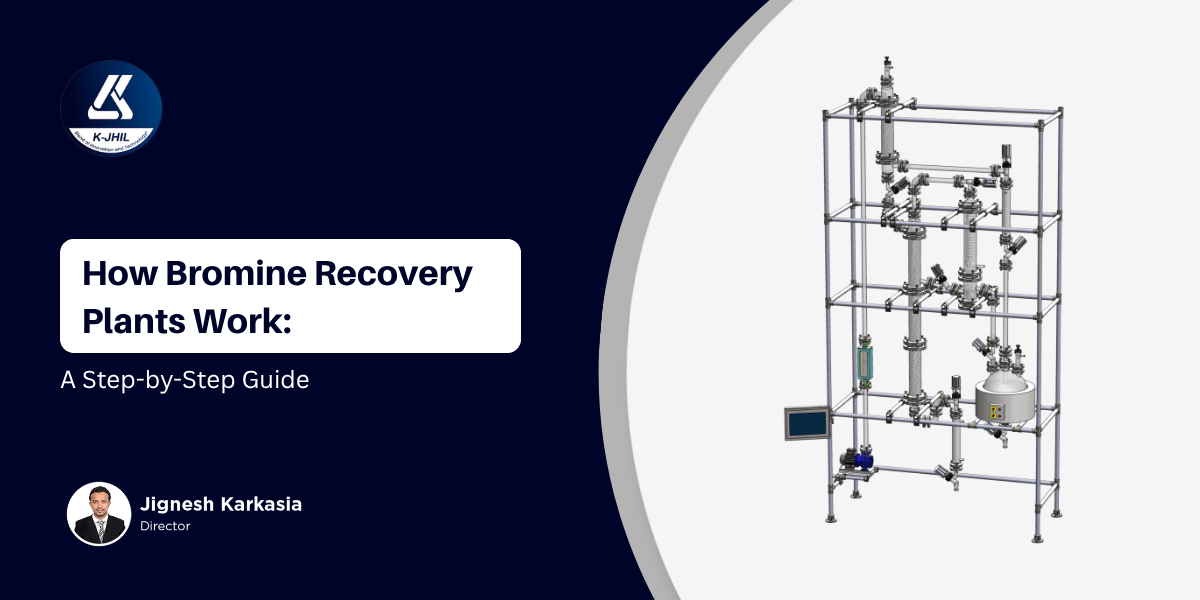
Procurement teams always want a clear equipment list. Here’s the one I’d hand them:
- Feed storage tank with pre-treatment column
- Acidification tank with acid dosing system
- The reaction-cum-stripping tower (this is the heart of the whole thing)
- Series of borosilicate glass condensers
- Gravity phase separator
- Purification column with reboiler
- Vent condenser and alkali vent scrubber
- Product receivers and storage tanks
- DCS-based controls and online analyzers
Standard columns top out around 600 mm diameter. Bigger plants run modular trains side by side.
Materials that Actually Survive Bromine
Bromine doesn’t play nice. It corrodes pretty much every common metal you’d reach for. So material selection isn’t a place to save money.
What I always insist on:
- Borosilicate glass for columns, condensers, and piping
- PTFE and PVDF for gaskets, linings, and small-bore pipes
- Tantalum for high-stress trim and thermowells
- Hastelloy C-276 for select valves and pumps
- Glass-lined steel for big vessels
- Glass-Lined Steel (GLS), PTFE-lined, PVDF-lined, or tantalum-compatible vessels are commonly used for finished bromine storage in modern plants.
A properly built Bromine Recovery Plant gets designed around these materials from day one. Teams like K-Jhil Scientific that make their own borosilicate glass in-house have a real edge here. They control quality end to end, from the glass melt right through to plant commissioning.
Bromine Recovery Plant Cost and ROI in India
Indian project economics are pretty consistent these days. A 30 to 100 KLD plant runs ₹80 lakh to ₹2.5 crore. Depends on capacity, materials, and feed type.
Recovered bromine sells in the ₹80,000 to ₹1,50,000 per metric ton range. Payback usually lands between 2 and 4 years. My Ankleshwar client closed in 22 months because their feed was unusually rich.
Where Recovered Bromine Goes: Water Treatment and Beyond
Bromine in water treatment has exploded over the last decade. It stays active in warm, alkaline cooling water where chlorine starts giving up. Cooling towers at power plants, refineries, and pharma campuses all lean on bromine biocides now.
Beyond water, the recovered bromine ends up in:
- Flame retardants for electronics, furniture, and building materials
- Drilling and completion fluids for oil and gas wells
- Pharma intermediates that show up in everyday medicines
- Soil fumigants, pesticides, and other agrochemicals
- Dye intermediates and photography chemicals
That long application list is exactly why recovery plants stay profitable decade after decade.
Mistakes I Keep Watching Owners Make
The same handful of mistakes keep showing up. Year after year. Each one is cheap to catch early and brutally expensive to ignore.
- Skipping pre-treatment clogs columns within months
- Loose dosing control silently bleeds yield until someone notices
- Undersized vent scrubbers corrode the steel frame around the plant
- Material shortcuts save lakhs today and cost crores three years later
- Operator complacency once everything seems to be running fine
Honestly, I’ve watched all five destroy otherwise solid projects. The fix is always cheaper than the damage. Owners just keep walking into the same traps anyway.
Planning Your Bromine Recovery Plant Project
One genuine takeaway from this guide. Bromine recovery is half chemistry and half craftsmanship. Both halves deserve equal attention.
The science is old and settled. The build quality and daily operator discipline are what separate a great plant from an average one. Pick partners who’ve already made the painful mistakes and learned from them.
If you’re planning a new line or upgrading an existing one, talk to people who live this work every day. You can Contact Us anytime, and we’ll help you map out the right setup for your brine, your purity targets, and your end product. I’d much rather help you avoid the traps than fix them later.
Bromine Recovery Plant FAQs from Site Visits
1. How Much Bromine Actually Comes Out of One Cubic Meter of Bittern?
A decent plant pulls 90 to 95 percent of the available bromide. From 3 GPL bittern that’s roughly 2.7 to 2.85 kg per cubic meter processed.
2. What Purity Should I Expect at the Gate?
Indian plants typically deliver 99.5 to 99.9 percent purity, meeting IS 2142. Pharma-grade can go tighter if you specify it upfront.
3. How Low Can the Effluent Bromide Go?
Modern plants debrominate effluent down to about 10 ppm before discharge. Pollution Board norms are no problem at that level.
4. Hot or Cold Process for My Project?
Above 3 GPL, hot. Below 3 GPL, cold. Sea-bittern producers almost always go hot.
5. What’s the Typical Cost in India?
A 30 to 100 KLD plant runs ₹80 lakh to ₹2.5 crore. Bigger or pharma-grade plants cost more.
6. How Long Does the Plant Actually Last?
With proper materials and operator discipline, 20 to 25 years before major rebuild. Column repacking every 5 to 7 years is normal.
7. Can I Recover Bromine from NaBr or KBr Industrial Waste?
Yes, and those feeds are often richer than sea bittern. They almost always run on hot process because of high bromide content.