

We’ve all heard that precious metals are scarce.
What's on this page:
There are limited sources, and we need to pay a premium to get our hands on high-grade, pure gold, silver, or platinum.
But what if this wasn’t the case?
What if you could extract precious metals from discarded objects and convert waste into a literal gold mine?
All you need to do is take the extracted metals and run them through a precious metals refinery, and everything you touch will become gold (or silver, or platinum)!
This will help you purify those metals and give them:
- Visual Appeal
- Structural Integrity
- Internationally Required Quality
In this blog, we’ll discuss everything about the role of precious metal refining in the jewellery industry and how it transforms raw metals into wearable art.
The Role of Precious Metal Refining in the Jewellery Industry: Table of Contents
- What Is Precious Metal Refining?
- Global Jewellery Demand and the Push for Refined Precious Metals
- What Are the Benefits of Refining Precious Metals in the Jewellery Industry?
- How does a precious metal refinery work?
- K-JHIL Scientific’s Contribution To Precious Metal Refining Solutions
- The Role of Precious Metal Refining In The Jewellery Industry: FAQs
What is Precious Metal Refining?
Precious Metal Refining is the method by which the precious metals are collected from the scrap, purified and turned into the most usable form and of the highest quality.
Since we spoke about scrap, it can be of any type, like:
- Old jewelry
- Dental alloys
- Electronics
- Mining output
And, talking about the precious metals, they can be:
- Gold
- Silver
- Platinum
- Palladium
At the stage at which the metals are extracted, they contain impurities like copper, zinc, lead, and other elements that may have damaged their strength and appearance. Precious metal refining is the process that restores the desirable characteristics in precious metals!
These are the techniques through which the precious metals refining can be done:
- Chemical refining
- Electrolytic refining
- Fire assay
- Thermal reduction and smelting
Once you refine these metals, your jewellery product may look visually appealing, have a consistent finish across the curves and become durable.
Global Jewellery Demand and the Push for Refined Precious Metals
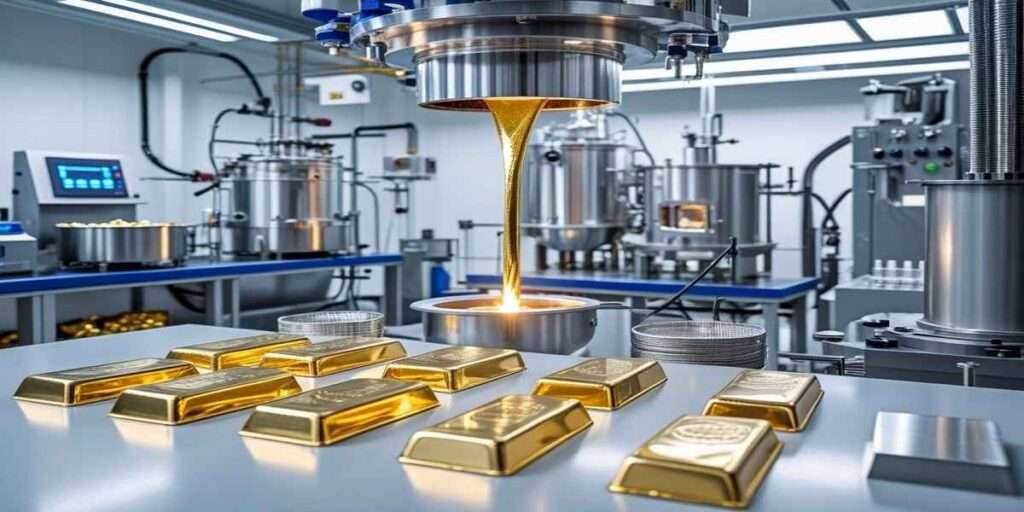
Despite certain fluctuations in global gold jewellery volume last year, we saw a significant 9% year-over-year increase in consumer spending on gold jewellery. Thus, it has now reached US$144 billion.
Along with that, there’s an 11% rise in the demand and supply of recycled gold.
Plus, there has been a healthy 3% growth in demand for silver jewellery, reaching 208.7 million ounces in India.
It is estimated that the overall jewellery market will generate USD 117.56 billion in revenue this year, with Asia Pacific countries accounting for more than half of this amount.
This indirectly indicates the need for precious metals refineries to meet the growing demand for high-purity and high-value jewellery in both our local and global markets.
What Are the Benefits of Refining Precious Metals in the Jewellery Industry?
According to our observations, precious metal processing offers a comprehensive suite of benefits. You can enjoy these benefits by installing a precious metals refinery.
Let me walk you through these benefits:
- Recovering Precious Metals from Scrap: This process helps you recover the valuable metals we discussed above from scrap. In fact, it’s a big market. Reports say that the scrap gold recycling market is expected to reach $23.06 billion by 2029.
- Increased profitability: A reliable precious metals refinery can help you refine metals from scrap and reuse them in the creation of new jewellery. This way, you reduce manufacturing costs and achieve better margins, generating more profit.
- Enhanced Metal Purity: As we discussed, refining is not only for the aesthetics but also to meet the hallmarking standards. Therefore, if you operate a gold and silver refinery, you can refine these metals to achieve a high purity level, such as 24K gold or 925 sterling silver.
- Improved Product Quality: The impurities present in these metals before refining can compromise their looks, strength and durability. So, once you refine them, you create a final product free from all impurities and restore the elements that were compromised.
- Resource Optimization: It helps you reduce your dependence on mining and also minimize the carbon footprint associated with it. Plus, you can repurpose your existing stock, making your production and inventory more efficient.
How Does a Precious Metal Refinery Work?
Let me walk you through the process of how a Precious Metal Refinery Works:
1. Receiving the Materials
When you receive all the materials at your metal refinery, you need to:
- Measure the weight of each lot
- Inspect them visually or through machines
- Identify the type of precious metal content
- Log them into your database
- Assign a unique identification number to each lot
2. Pre-Treatment (Cleaning and Sorting)
Next, all the received items are thoroughly cleaned to remove any dirt or stones.
Specifically, for gold and platinum, a process called aqua regia is applied. Here, the old jewellery is dipped into a mixture of nitric and hydrochloric acid to extract precious stones from it.
After extraction, they are arranged according to the type of metal.
3. Melting and Sampling
Now, all metals are sent for melting at an induction furnace or using a blowtorch.
During this process, a few samples are taken and sent for testing.
The test is done to check the metal content and purity.
Again, for gold, there is a specific process called Fire Assay or Thermal Assay that is performed to obtain the most accurate purity results.
4. Electrolytic Refining
This is the purification stage, where an electrical current is passed through an acid bath to purify the metal to a purity of 99.9% or higher.
Electrolytic refining is widely applied to gold and silver refineries and is a highly precise process.
5. Purification and Final Processing
After refining, the precious metals are then given shapes such as granules, sheets, bars, or whatever you or your client requires.
You can choose to offer custom alloying at this stage.
6. Settlement
Once the weight, purity, and shape of the metal are confirmed, you can notify your client of the results and the final quotation based on the current market value.
K-JHIL’s Contribution To Precious Metal Refining Solutions!
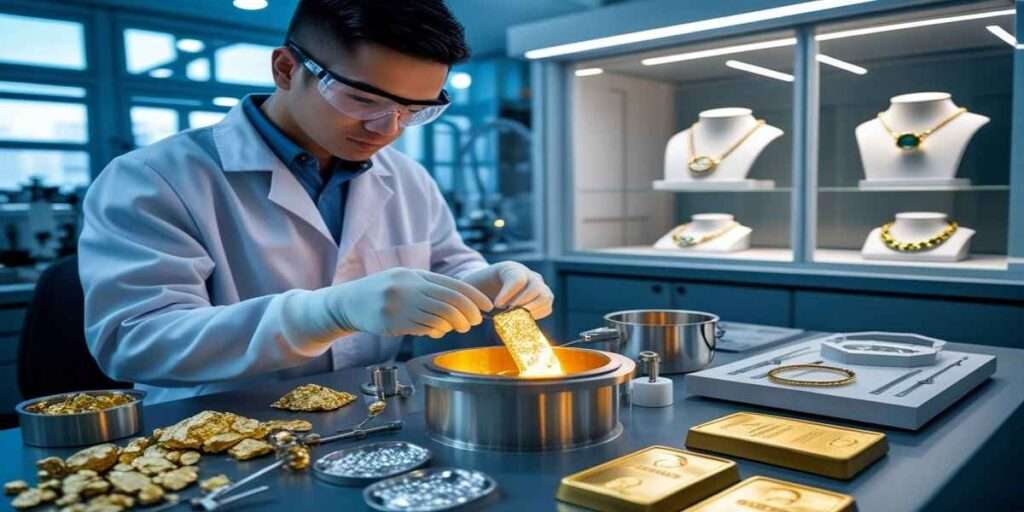
To keep it brief and straightforward, if you want to:
- Ensure the quality of your products.
- Make your jewellery business more profitable and sustainable.
Then, you need to put together a precious metal refining plant right now!
However, the metal refiner machine must be high-performing and innovative to meet the industry’s rising demand.
Our machines ensure both!
Yes, we are a manufacturer, exporter, and supplier of precious metal refinery systems, and we have been serving this industry for the past couple of decades.
Our metal refiners:
- Consumes less acid
- Achieves purity of 95% or more
- Can handle 1kg to 100kg of metals
- Comes in automatic and semi-automatic variants
Connect with us today to discover how we can help you engineer a customized precious metal refinery and give you the Midas Touch!
The Role of Precious Metal Refining In The Jewellery Industry: FAQs
1. Why is refining gold important?
Refining gold is important if it is old or sourced from scrap because it:
- Removes impurities and unwanted substances
- Helps it achieve the internationally recognized 24K standard
- Makes the gold item durable and visually appealing
2. What does a precious metal refinery do?
A precious metal refinery:
- Collects materials containing the precious metals
- Extracts the valuable metals like gold, silver, or platinum
- Refines and purifies to regain their quality and make them reusable
3. What is refining jewellery?
Refining jewellery refers to a complex process that includes:
- Processing old or scrap jewellery
- Recover precious metals from it
- Melting it down to separate the pure metal
- Making it reusable again
4. What is the purpose of refining metals?
The main purpose of refining these precious metals is to:
- Remove impurities
- Isolate the valuable elements
- Make it durable and bring back the aesthetic brilliance
- Ensure that the metals meet the hallmarking standard of the industry