
Jacketed Glass reactors are true modern marvels of engineering.
What's on this page:
It’s fascinating how their simple structures cleverly hide complex material science.
But what are they really made of?
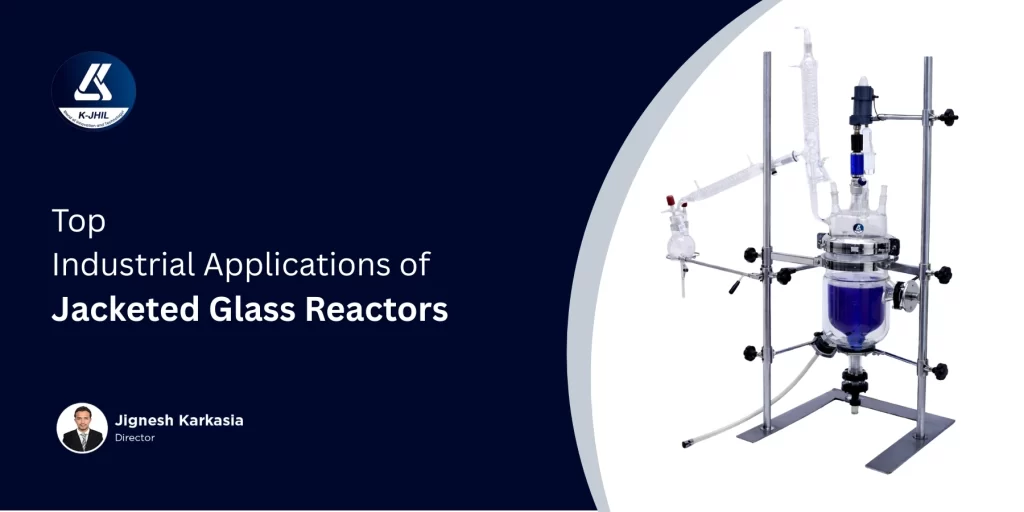
In essence, a Jacketed Glass Reactor is a glass container with two separate walls stuck together.
The “inner chamber” holds the mixture, while the “outer jacket” circulates heating or cooling fluids.
Interested in learning more? Let me walk you through their leading industrial applications to show how they perform in real life.
Top Industrial Applications of Jacketed Glass Reactors
Below are the major industrial applications that utilise the benefits of jacketed glass reactors:
1. Pharmaceutical Applications
One thing I know about pharmaceutical manufacturing is that there is zero room for error.
Every chemical reaction and every output of their manufacturing needs to be perfect. Any mistakes in medicine manufacturing can cause a matter of life and death.
This is why jacketed glass reactors have skyrocketed in popularity for pharmaceutical use cases.
They offer better visibility and more control, allowing higher purity drug development.
Let’s go deeper into how exactly these reactors are being used in the Pharmaceutical industry:
i. API Synthesis:
Creating Active Pharmaceutical Ingredients (API) is a key process that involves multiple steps. Most materials involved in this process are highly sensitive to temperature changes.
This is where the thermal balancing of Jacketed Glass Reactors is required.
Using its advanced structure, chemists can maintain temperatures within ±2°C for hours. Since they need this precision for every reaction, jacketed reactors have become their preferred choice for manufacturing.
ii. Crystallization Processes:
For advanced pharmaceutical processes such as crystallization, uniform cooling of materials is essential.
Using a jacketed reactor, pharmaceutical companies can achieve uniform crystal growth.
The best part? The transparency of jacketed reactors allows operators to monitor crystal formation in real time. This helps them control the temperatures more easily.
iii. Sterile Manufacturing:
There is a reason why chemists use glass containers for most reactions. In addition to transparency, Glass is non-porous and easily sterilizable.
This makes Glass perfect for ensuring no impurities ruin the purity of the reaction’s output. It also actively prevents bacterial growth.
For jacketed glass reactors, these benefits are vital to ensure consistent chemical reactions. It also makes it easier to clean the reactor chamber between batches.
2. Chemical Manufacturing
You may assume that large chemical plants only use giant metal reactors for their everyday reactions.
But you will be surprised to learn how often jacketed glass vessels are now being used for chemical production.
Using Jacketed Glass Reactors, they gain better temperature control. This results in higher-quality chemical products.
Key industrial uses:
i. Specialty Chemical Production:
The chemical resistance of borosilicate glass is truly unique. One of the benefits of jacketed chemical reactors is that they are primarily made from such durable materials.
Using jacketed reactors, your reactions are protected against most corrosive substances. It improves the quality of your output drastically.
Similarly, many facilities also use these reactors to produce impurity-free dyes and organic molecules.
ii. Polymer Development:
Creating new polymers and plastics also requires greater control over temperature. This is where the unique temperature management offered by a jacketed system comes into play.
Jacketed systems ensure consistent temperatures for both endothermic (cooling down) and exothermic (heating up) reactions. This leads to reliable polymer development with precise output quality.
iii. Pilot Plant Operations:
Before scaling up to full production, almost all chemical processes go through pilot testing.
Jacketed reactors are perfect for doing these small-scale testings as they closely mimic large industrial equipment.
Using Jacketed systems, you or your company can easily understand if a reaction can be successful at a mass scale.
Also, it can help identify issues in the reaction well before your company invests in full-scale production.
3. Food, Cosmetic & Biotech Applications
You may not realise this, but jacketed reactors play a very important role in making your daily products.
The food, cosmetic, and biotech industries globally take advantage of the unique benefits of jacketed glass reactors.
Such key industrial use cases include:
i. Food & Flavour Development:
Creating natural flavours, preservatives, and food colouring requires equipment that is non-reactive. This is to ensure near-zero contamination and no added impurities.
The consistent nature of Jacketed Glass Reactors enables companies to develop flavour compounds that are pure and safe for consumption.
ii. Cosmetic Formulations:
Developing creams, lotions, and other personal care products greatly benefits from jacketed reactors.
Cosmetic manufacturers benefit from the excellent mixing and temperature control offered by these systems during daily production.
This is because in the cosmetic industry, mixing the products together requires maintaining the correct temperature. One small slip can ruin the perfect texture and stability of their cosmetics.
iii. Biotech Processes:
You might have heard of technical processes like fermentation and cell culture. These are fairly regular reactions in Biotech used to make new products or innovations.
One thing these processes have in common is that they require a stable reactor to achieve the best possible output.
Many biotech companies thus use jacketed glass systems to ensure they can perform these technical reactions in a controlled environment.
What Makes Jacketed Glass Reactors so Versatile?
The different types of industrial uses above showcase just how adaptable Jacketed Reactors truly are.
But what makes Jacketed Glass Reactors so unique and versatile across industries?
Here are its best features that help it become more adaptable:
FEATURE | PRACTICAL BENEFIT |
Temperature Control | Handles both heating and cooling for sensitive reactions. |
Visual Monitoring | You can observe color changes, precipitates, or phase separations. |
Chemical Resistance | Works with acids, bases, and solvents without corroding. |
Scalable Design | Allows processes to move from lab to production smoothly. |
One of the best things about Jacketed Glass Reactors is that they are also very customisable. You are free to equip your reactor with a range of different accessories to make it more effective for your unique industrial needs.
Accessories like agitators, distillation attachments, and multiple feed ports help further increase their versatility.
This modularity, offered by Jacketed Glass Reactors, unlocks an even wider range of global industrial applications.
Operational Considerations and Best Practices
Anxious if your Jacketed Glass Reactor is performing at its maximum efficiency?
No need to worry! Just make sure you keep the following factors in mind:
- Maintenance and Cleaning: While the glass is durable, it is not shatterproof. Make sure that you handle it properly. Inspections for minor scratches, cracks, and residue are a good habit to maintain the purity of your reactions.
- Safety Aspects: The transparency of jacketed systems does allow precise visual monitoring. But security protocols like secondary containment and pressure relief systems are necessary failsafes. They become even more critical when working with volatile or hazardous materials.
- Process Optimisation: Optimising your reactor can greatly increase your chemical outputs. For example, programming your temperature ramps in a Jacketed Reactor can increase the yield of your crystallization significantly.
Conclusion: From Development to Production
The use cases above show how many global industries continue to benefit from the versatile advantages of Jacketed Glass Reactors. They offer a unique combination of visibility, control, and low maintenance.
This has made them invaluable to global chemical manufacturing processes. You just need to make sure that you choose the right glass jacketed system for your needs.
Better yet, even the materials and designs of these jacketed systems continue to evolve. Every year, we see new innovations being added to these reactors to further improve their efficiency.
Looking to Incorporate Jacketed Glass Reactors in Your Operation?
In my experience, the real performance of a jacketed reactor is completely dependent on how you use it.
It is important to select the right reactor system for your specific application. This makes sure that you are getting the best returns from your investment.
Got further questions on how you can make the right choice? Our experts at K-Jhil are always available to answer your every query.
Connect with our team today and receive a free personalized consultation for your next project.
FAQs
1. What is the main advantage of a double-jacketed glass reactor?
The primary advantage is superior insulation. The outer vacuum jacket acts like a thermos, minimising heat loss to the environment. This allows for operation at more extreme temperatures, provides more consistent heating or cooling, and improves both safety and energy efficiency.
2. What industries most commonly use jacketed glass reactors?
These reactors are workhorses in industries that require precise control and purity, most notably the pharmaceutical industry for synthesising Active Pharmaceutical Ingredients (APIs), and the chemical industry for various synthesis processes. They are also widely used in biotechnology, food and beverage, and cosmetics.
3. How do you clean a jacketed glass reactor vessel properly?
Start by washing the vessel with solvents compatible with your reaction residues. For more stubborn contaminants, use specialised cleaning solutions. Always follow with a thorough rinse with purified water. Never use abrasive cleaners, as they can damage the glass surface. Establishing and following a detailed cleaning procedure is crucial.
4. What is the temperature range for a jacketed glass reactor?
While specific ranges can vary by manufacturer and model, standard borosilicate glass reactors can typically handle temperatures from -20°F (-29°C) up to 500°F (260°C). It is critical to always avoid rapid temperature changes to prevent thermal shock, which can crack the glass.
5. What should I do if my jacketed glass reactor is leaking?
First, identify the source. Common culprits are old or degraded gaskets, which should be replaced proactively, and poorly connected hoses or joints. Ensure all connections are tightened to the manufacturer’s recommended torque values, not just “tight enough.” Using leak detection mats can help you identify faults early.