
Gold is now used in several industrial applications.
What's on this page:
It is no longer just an investment asset.
With industries utilizing it in their product manufacturing, the ability to process gold in-house has become a necessary operational requirement.
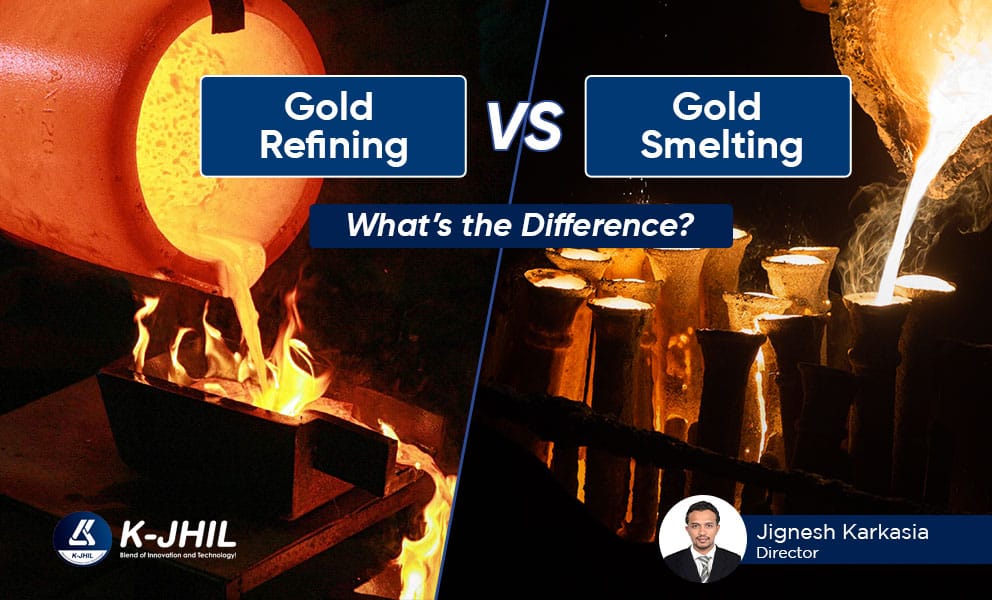
And when it comes to in-house processing, there is confusion between gold smelting and gold refining.
- The gold smelting process requires a high temperature to extract gold from ores or scrap, and produce dore bars with a purity of 80 to 95%.
- Gold refining, on the other hand, uses chemical or electrochemical methods to purify the bar into 99.9% pure gold.
In this blog, we’ll break down the key differences between gold refining and smelting, and evaluate where each method fits in your operation.
Gold Refining vs. Gold Smelting: Table of Contents
- Gold refining vs. gold smelting: Table of differences
- What is gold refining?
- What is gold smelting?
- Smelting vs. refining: What’s the real difference?
- When does gold refining make sense?
- When does Gold smelting make sense?
- The final verdict: Extracted gold isn’t enough
- Gold refining vs. gold smelting: FAQs
Gold Refining vs. Gold Smelting: Table of Differences
If you are in a hurry, I’ve got you covered. Here’s a quick table of differences that provides an overview of the exact areas where they differ.
Parameter | Smelting | Refining |
Goal | Extract gold from ore/scrap | Purify gold to 99.9% + |
Process | High heat + flux to melt metals | Chemical/electrochemical purification |
Purity Output | 80 to 95% | 99.5 to 99.9% |
Equipment | Furnace, crucible, fluxes | Refining vessels, electrolytic cells |
Industry Use | Mining, metal scrap | Jewelry, electronics, pharma |
Regulatory | Low control | Requires high-level compliance |
What is Gold Refining?
Gold Refining is the process of separating impurities from raw gold and achieving a purity level of up to 99.99%.
In the gold recovery lifecycle, this is the only way to produce gold that meets global standards for jewelry hallmarking, electronics and other industrial uses.
This process utilizes advanced chemical and electrochemical methods to isolate gold at the molecular level and remove all contamination.
What is the Process of Gold refining?
There are four gold refining processes, which are as follows:
- Miller Process: This is a rapid method that utilizes chlorine gas to purify molten gold.
- Wohlwill Process: This is a more advanced method that utilizes electrolysis to purify gold by dissolving it in an acid solution and redepositing it as ultra-pure gold.
- Inquartation and Parting: Here, gold is mixed with silver, and then treated with acid to remove the silver and other metals.
- Aqua Regia Process: This process uses a mix of nitric and hydrochloric acid to dissolve gold into a liquid. Gold is then recovered through selective precipitation or solvent extraction.
Also read: The Ultimate Guide to Gold Refining.
What is Gold Smelting?
Gold smelting is the extraction process of gold from raw materials, such as ores, industrial scrap, or waste.
Let me break down the process for you:
- Heat above 1,064°C is applied to the raw material, and gold is separated from it.
- A version of the gold is achieved, which gets purity levels of approximately 80% to 95%, and you can call it semi-pure.
- Now, it proceeds to the next step, which is refinement.
So, smelting is basically the initial purification process, where gold is separated from other metals and prepared for the refining process.
What is the Process of Gold Smelting?
Let’s have a detailed look at the gold smelting process:
- Preparation: The gold ore or scrap is first crushed into small pieces or ground into powder to make it easier to melt.
- Melting: This material is then heated in a high-temperature furnace. Special substances called fluxes—like borax, silica, or soda ash—are added. These help pull out unwanted metals and dirt.
- Separation: As everything melts, the waste materials form a glassy layer called slag, which floats on top. The heavier pure gold sinks to the bottom.
- Pouring: The slag is carefully removed, and the melted gold is poured into molds to cool and harden into bars.
- Cooling and Recovery: Once the bars are cooled, they are extracted for further processing through gold refining.
Smelting vs. Refining: What’s the Real Difference?
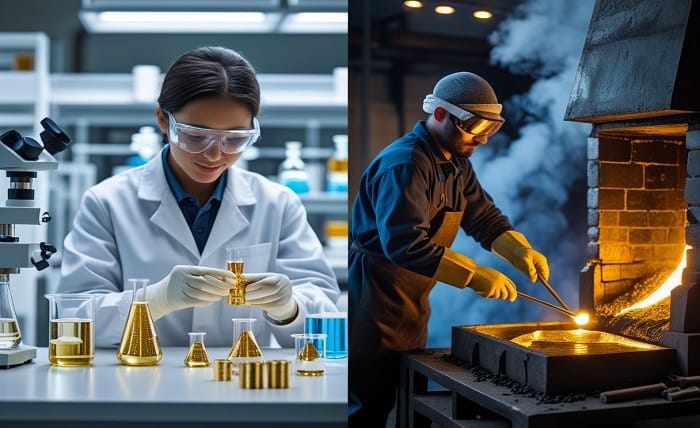
To help you understand exactly where the difference lies between gold smelting and refining, I have broken it down into several key parameters.
1. Objective of the Process
Smelting is the process of extracting gold from ores or scrap and removing bulk impurities, such as iron, zinc, lead, or tin, to form a semi-pure intermediate product. So it gets you gold that you can store.
Refining, on the other hand, is about purification. It transforms the recovered gold into ultra-pure metal with a purity of up to 99.99%. This process gives you the gold that you can ultimately sell.
2. The Process
In smelting, induction furnaces are used at high temperatures to melt the material and separate metals or impurities using fluxes that help form slag.
Refining uses aqua regia, inquartation, or electrochemical Wohlwill, Miller methods to isolate gold at the atomic level.
3. Purity Level
Depending on the material added and the quality of the process, smelting yields gold that’s approximately 80% to 95% pure.
But refining goes one step further.
It makes the gold up to 99.9% pure, which is the standard for gold bars, hallmarking, and certified use.
So, if your goal is high-purity gold, refining is the process you need!
4. Equipment Used
Smelting setups include these components:
- Induction or resistance melting furnaces
- Crucibles, molds, and slag separators
- Flux feeders and basic filtration units
Gold refinery machines have the following components:
- Electrolysis cells or reaction tanks
- Fume scrubbers, ETPs, and chemical dosing systems
- PLC/SCADA automation for accuracy and safety
5. Industry Applications
From what I have seen, gold smelting recovers gold from diverse feedstocks and is widely used in mining, e-waste recycling, and small to mid-scale scrap processing.
- Miners smelt ore into bars for transport.
- Recyclers recover gold from circuit boards and industrial waste.
- Jewelry scrap dealers smelt gold to separate base metals before refining.
Gold refining is essential in industries where even the smallest impurity can lead to rejection.
Take jewelry makers, for example, especially those exporting abroad. They need gold that’s pure enough to pass strict hallmarking checks and mix well with other metals.
Then there are electronics and aerospace industries. They use tiny amounts of gold in parts such as circuits that can’t afford to fail. In those cases, only ultra-pure gold will do.
6. Regulatory Considerations
Gold smelting and refining are tightly regulated due to emissions, hazardous chemicals, and waste byproducts.
Smelting units must comply with the following regulations for emissions and slag disposal:
- CPCB norms
- SPCB approvals
- ISO 14001
Refining units’ adherence to chemical handling rules under Indian and international laws, like:
- REACH
- RoHS
- OECD sourcing guidelines
When does Gold Refining Make Sense?
These are some of the instances when you can go for gold refining:
- You already have dore bars or impure gold from smelting or scrap.
- Your industry demands 99.5 %+ gold purity.
- You want to control your refining in-house instead of outsourcing it.
- You need to maximize returns from recycled gold or e-waste.
When does Gold Smelting Make Sense?
You can go for gold smelting in the following cases:
- You’re working with ore, mining tailings, or electronic scrap.
- Your goal is to separate gold from other base metals.
- You need a quick, first-stage purification to convert materials into bars.
- You’re operating in regions with limited access to refining infrastructure.
- You plan to sell impure gold bars to third-party refiners for further processing.
The Final Verdict: Extracted Gold Isn’t Enough
Gold smelting and refining serve completely different purposes.
But the point is that industries ultimately want the pure form of gold, rather than just the extracted gold.
So, it’s gold refining that delivers what modern businesses actually need.
And when it comes to refining, we have the best machine for the job.
With over three decades of engineering expertise, we specialize in building gold refinery machines that can:
- Deliver gold with 99.95% purity
- Can handle a weight up to 100 kgs
- Reduce acid usage
Looking to set up a gold refining plant? Contact us today and take your operation from extraction to excellence.
Gold Refining vs. Gold Smelting: FAQs
1. What is the main difference between gold smelting and gold refining?
The main difference between gold smelting and gold refining is that:
- Gold smelting melts the gold-bearing material to separate the metal from impurities.
- Gold refining removes the remaining contaminants using acids to achieve high-purity gold of up to 99.9%.
2. Can I use gold directly after smelting?
No, you cannot use gold directly after smelting, as the gold is still impure and needs to be refined for investment, hallmarking, or use in electronics, medical, and aerospace industries.
3. Is refining always necessary after smelting?
Yes, refining is always necessary after smelting because if your end goal is certified, investment-grade, or regulatory-compliant gold, then smelting is a preliminary process. The next step, refining, ensures quality, purity, and traceability.