
Choosing between batch and continuous reactors can be one of the most important, long-term decisions for your business.
What's on this page:
Select the wrong reactor, and you could be stuck with investments that don’t give returns, unexpected and costly downtimes, and even inconsistent products.
So, if you are looking for the differences between batch reactors and continuous reactors, I’m glad you are here!
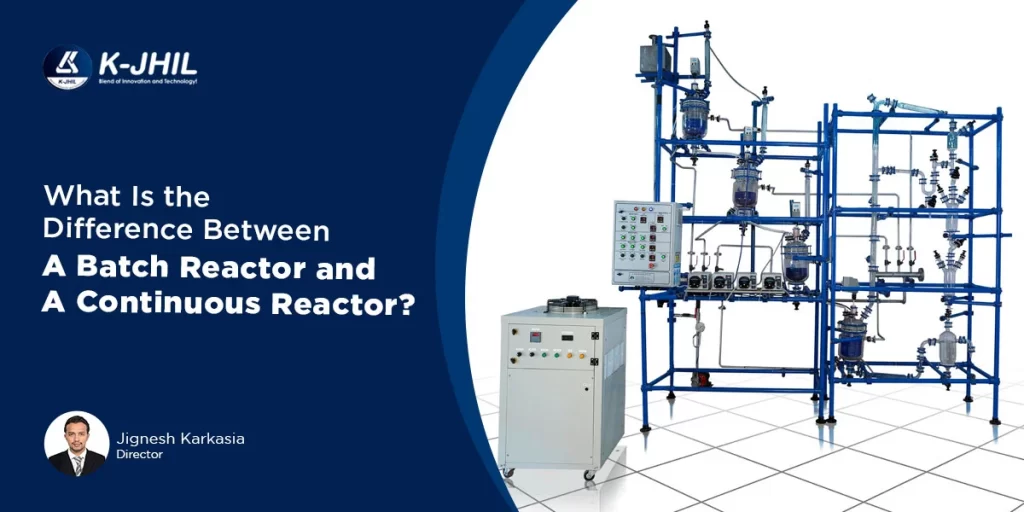
In this blog, I am going to break down the major differences between batch reactor and continuous reactor systems.
We will also take a look at what these reactors do, and then establish the differences based on their features, characteristics, and pros & cons.
Let’s get started.
Batch Reactor vs Continuous Reactor: Table of Contents
- Batch Reactor vs Continuous Reactor: Table of Differences
- What is a Batch Reactor?
- What is a Continuous Reactor?
- What are the Differences Between a Batch Reactor and a Continuous Reactor
- Connect with K-Jhil to Get a Reactor That Works For You
- Batch Reactor vs Continuous Reactor: FAQs
Batch Reactor vs Continuous Reactor: Table of Differences
Short on time?
I’ve got you covered – here’s a table you can quickly scan to find out the major difference between batch reactor and continuous reactor:
Feature | Batch Reactor | Continuous Reactor |
Operation Mode | Closed, unsteady-state system; processes one batch at a time. | Open, steady-state system; continuous inflow and outflow. |
Production Scale | Ideal for small to medium batches and high-value products. | Designed for large-scale, high-volume production. |
Flexibility | Highly flexible; easy to change products between batches. | Inflexible; optimized for a single, consistent product. |
Process Control | Conditions change over time; potential for batch-to-batch variation. | Consistent steady-state conditions ensure uniform product quality. |
Cost Structure | Lower initial investment, but higher operational cost per unit. | High initial capital cost, but lower cost per unit at scale. |
Labor & Automation | More labor-intensive per batch. | Highly automated, requiring less manual intervention. |
Typical Use Cases | Pharmaceuticals, Specialty Chemicals, R&D Labs, Craft Beverages. | Petroleum Refining, Bulk Chemicals, Fertilizers, Water Treatment. |
Also Read: Which is Better for Liquid Extraction – Batch Extraction vs. Continuous Extraction?
What is a Batch Reactor?
A batch reactor is a closed, non-steady-state vessel in which you can mix a specific volume of chemicals for reactions.
You can also set up and control the conditions (the temperature, pressure, and agitation) in a batch reactor for a predetermined period of time.
Once the batch reactor detects that the desired conversion has happened, it will automatically stop the process. After this, the batch reactor will discharge the entire product mixture in one go for subsequent processing.
Crucially, one of the most important features (and disadvantages) of batch reactors is that they operate as an unsteady-state system. This means the composition and reaction rate evolve in the same reaction process.
An Analogy of How a Batch Reactor Works
Think of it batch reactor like a master chef preparing a single, intricate recipe from start to finish:
- All raw materials are loaded at once.
- The reaction process takes place under controlled conditions.
- The product is removed only when the entire batch reactor process is complete.
Simply put, it’s a closed system ideal for one-pot synthesis.
Key Features of a Batch Reactor
- Simple Operation: Batch reactors are easy to set up and clean. They also require less complex control systems.
- High Flexibility: They are perfect for producing different products in the same vessel. All you need to do is change the reaction recipe.
- Single Batch Processing: Each batch is processed separately, so you can attribute product identity and maintain quality control.
Advantages of Batch Reactors
- Ideal for small-scale production and high-value products.
- Offers great flexibility for multiproduct facilities.
- Simpler initial setup and lower initial investment.
- Easier to clean and maintain between reaction processes.
Disadvantages of Batch Reactors
- Lower overall productivity due to idle time for loading and unloading.
- Labour-intensive, requires a separate set-up for each batch cycle.
- You might get slight variations in quality from batch to batch.
- Not suitable for large-volume products that you need to produce continuously.
Who Should Use a Batch Reactor?
- Pharmaceutical and Biotech Industries: For producing specific, high-purity drugs and vaccines in controlled batches.
- Speciality Chemical Manufacturers: Batch reactors are the best equipment you can use to create custom dyes, pigments, and performance chemicals in varying quantities.
- Food & Beverage Companies: Ideal for making limited-edition sauces, craft beers, and speciality products.
- Research & Development Labs: Where small-scale experimentation and frequent formula changes are necessary.
What is a Continuous Reactor?
A continuous reactor is an open, steady-state system that is designed especially to facilitate an uninterrupted inflow of reactants and simultaneous release of products.
The best example of a continuous reactor is the Continuous Stirred Tank Reactor (CSTR).
It maintains perfect mixing conditions, which ensure that the composition and temperature of the effluent stream are identical to those within the reactor.
Using this configuration, a continuous reactor helps you achieve a constant reaction rate and product quality.
This is why a continuous reactor is the most commonly used unit for large-scale, continuous manufacturing processes.
An Analogy of How a Continuous Reactor Works
A continuous reactor, such as a Continuous Stirred Tank Reactor (CSTR), operates like a constantly flowing assembly line:
- Raw materials are continuously fed in.
- The final product is simultaneously withdrawn, maintaining a steady-state operation.
This makes it highly efficient for large-scale, unchanging production.
Check out this blog on CSTR Applications in Industry to find out how different companies use it.
Key Features of a Continuous Reactor
- Steady-State Operation: This is the most important feature of continuous reactors – the concentrations and process conditions remain constant over time.
- Uninterrupted Flow: The reactants are fed and the product is removed simultaneously, which means you can maintain non-stop production.
- Automated Control: Continuous reactors are designed for sophisticated automation. They ensure consistent product quality and require minimal oversight.
Advantages of Continuous Reactors
- Higher + more consistent throughput and productivity.
- Offer superior product quality and uniformity due to steady-state operation.
- Energy-efficient and cost-effective for large-scale production.
- Require less manual labor and are easier to automate.
Disadvantages of Continuous Reactors
- High initial capital investment and complex setup.
- Inflexible: it is difficult to use the same reactors for different processes in a short time.
- You might face significant downtime for cleaning and maintenance.
- Not economical for small production volumes.
Who Should Use a Continuous Reactor?
- Petroleum Refining Industry: Continuous reactors are perfect for large-scale, uninterrupted processes like catalytic cracking.
- Bulk Chemical Manufacturers: Anyone who wants to produce massive volumes of chemicals like ammonia and sulfuric acid.
- Water Treatment Plants: Non-negotiable when you need to chemically treat a constant flow of water.
- Fertilizer and Agro-Chemical Producers: Meeting the high, consistent demand for their products.
What are the Differences Between a Batch Reactor and a Continuous Reactor?
There are five major differences between batch reactors and continuous reactors:
1. Mode of Operation
- Batch Reactor: These operate in a closed, unsteady-state system. All materials are added, reacted, and removed as a single processing batch.
- Continuous Reactor: Like a Continuous Stirred Tank Reactor, these run in an open, steady-state system (constant feed input and product output).
2. Production Scale & Efficiency
- Batch Reactor: Ideal for small-batch production of high-value products. Its efficiency is limited by the downtime required for cleaning and filling.
- Continuous Reactor: Designed for high-volume, constant output. Continuous reactors offer greater efficiency and productivity for large-scale manufacturing.
3. Process Flexibility
- Batch Reactor: Offers high flexibility, allowing for easy changes to the batch reactor process between runs for different products.
- Continuous Reactor: Highly inflexible as they are designed for a single product They are difficult to reconfigure and favour consistency over variety.
4. Process Control & Product Quality
- Batch Reactor: Both reaction conditions and product composition change over time. This can lead to slight batch-to-batch variation in your products.
- Continuous Reactor: Maintains consistent steady-state conditions, ensuring uniform product quality and simplifying automated control.
5. Capital and Operational Costs
- Batch Reactor: Generally has a lower initial investment, making it accessible, but operational costs per unit can be higher.
- Continuous Reactor: Requires a higher capital cost for sophisticated equipment but achieves a lower cost per unit at high volumes.
Connect with K-Jhil Scientific to Get a Reactor That Works For You
Through this blog, I have walked you through the major differences between batch reactors and continuous reactors.
While the former are perfect for small-scale reactions or multi-product operations, the latter are best-suited for large-scale reactions where uniformity, consistency, and continuous processing are non-negotiable.
However, the most important factor that will determine whether you need a batch reactor vs a continuous reactor is your use case.
So, if you are still not sure which reactor will match your requirements, do not hesitate to reach out to us at K-Jhil Scientific.
Over the last 30 years, we have manufactured state-of-the-art batch and continuous reactors for a wide range of industrial applications. We have also helped market leaders across India and abroad select, develop, and install reactors customized to their specific needs.
Connect with our engineers, and we will help you choose and create a reactor tailored to your requirements.
Batch Reactor vs Continuous Reactor: FAQs
1. What is the primary difference between a batch reactor and a continuous reactor?
The core difference between a batch reactor and a continuous reactor is that a batch reactor processes materials in separate, distinct cycles, while a continuous reactor operates non-stop with constant feed and product removal.
2. What is a Continuous Stirred Tank Reactor (CSTR)?
A Continuous Stirred Tank Reactor (CSTR) is a common type of continuous reactor that maintains perfect mixing, ensuring the output product has a consistent composition identical to the contents inside the vessel.
3. What are the main advantages of a batch reactor?
The key advantages of a batch reactor include high flexibility for multi-product facilities, simpler setup with lower initial cost, and suitability for small-scale or high-value product manufacturing.
4. When is a batch reactor process not suitable?
A batch reactor process is not suitable when you need high-volume, constant output, as its main disadvantages of a batch reactor are lower productivity and downtime for loading and unloading between cycles.
5. How do I choose between a batch reactor vs continuous reactor?
The choice in the batch reactor vs continuous reactor debate depends on your production scale, product flexibility needs, and capital. Batch is for versatile, smaller-scale production, while continuous is for high-volume, uniform output.