
By the K-Jhil Scientific technical team, drawing on 30+ years of building borosilicate and glass-lined batch reactors for pharma, agrochemical, and specialty chemical plants.
QUICK ANSWER
SCADA (Supervisory Control and Data Acquisition) is used across almost every process industry, power, water, oil and gas, manufacturing, transportation, food, and pharma, to run equipment from one screen. On a batch reactor, the application of SCADA is to hold temperature, pressure, agitation, pH, and dosing to the recipe through every phase of the batch, drive it through the PLC, alarm on any drift, and log the run for the batch record. That is the line between a batch you can repeat and one you are guessing at.
SCADA turns up wherever a plant needs to watch and control equipment from one place. Power grids, water networks, pipelines, factory lines, they all run on it, and so do the reactors inside a chemical or pharma plant.
This guide opens with that broad picture, then goes deep on one application we know from the inside: monitoring and controlling a batch reactor. That is where the reactor and the control system have to be designed together, not bolted together later.
We build the vessels that get instrumented this way, so the view here is from the equipment side, not a software brochure.
Where SCADA Is Applied, Across Industries
The wider picture matters before the reactor detail, because SCADA is not a chemical-plant tool. It is an everywhere tool, running the same core job across very different industries: watch the process, control it, record it.
It has done that job since the 1960s, when computer-based control began replacing manual panels, and it has only spread since. The table below maps where the application of SCADA system shows up most across industry.
Industry | What SCADA Does |
|---|---|
Power and energy | Monitors generation, controls substations, transmission, and distribution |
Water and wastewater | Runs pumping, treatment stages, reservoir levels, and pipe pressure |
Oil and gas | Supervises pipelines, wells, storage, and refinery units, often remotely |
Manufacturing | Controls production lines and watches machine condition |
Transportation | Manages traffic signals, rail, and transit systems |
Food and beverage | Holds cook, mix, and pasteurizing time and temperature, and CIP cycles |
Pharma and chemical | Runs batch reactors, recipe control, and the compliance record |
The last row is where this guide lives. In a pharma, agrochemical, or specialty chemical plant, the sharpest application of SCADA is on the batch reactor, so that is where the rest of this goes.
What SCADA Actually Is?
SCADA is short for Supervisory Control and Data Acquisition. In plain terms, it is the software and the screen that let one operator run a whole process without walking the floor reading dials.
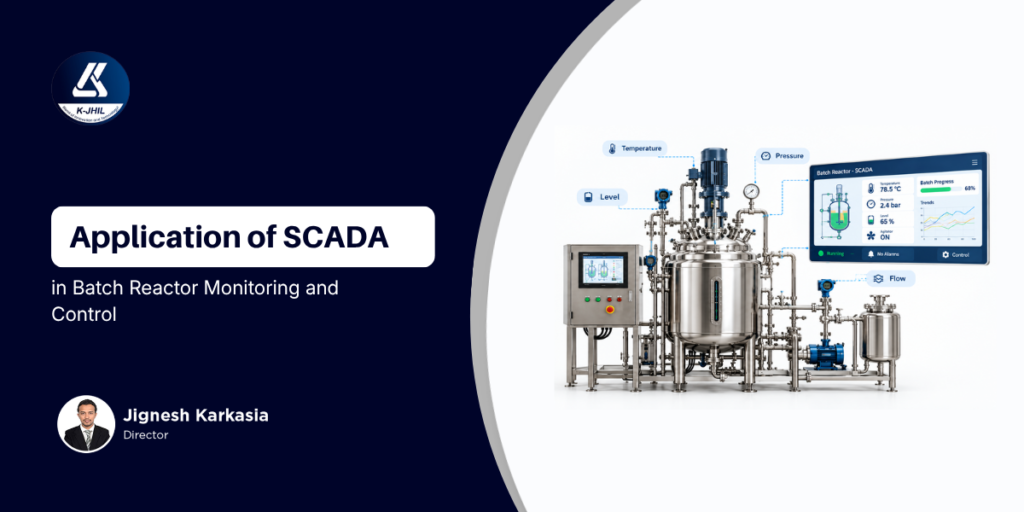
Under that screen sits a stack of hardware. Sensors on the equipment feed PLCs or RTUs, those talk to the SCADA server over a network, and the server drives the operator’s HMI. The diagram lays out how the layers sit on a reactor.
So the application of SCADA system to a reactor is really about wiring that stack to the vessel, until its condition is live on a screen and controllable from there. Three jobs run underneath all of it.
- Acquire. Pull live readings off the instruments on the vessel.
- Supervise. Show them to the operator and hold each one to its setpoint.
- Record. Log every value and action for the batch history.
Why Batch Reactors Need SCADA More than Most
A continuous reactor runs at a steady state, so once it is tuned, it mostly holds. A batch reactor never gets that luxury.
Every batch walks the same run of phases, and each one carries its own targets:
- Charging, raw materials into the vessel.
- Heating, up to reaction temperature.
- Reaction, holding the exotherm inside its window.
- Hold, keeping conditions steady for the set time.
- Cooling, bringing it down under control.
- Discharge, emptying and cleaning for the next run.
Miss the temperature window during the reaction phase and you can lose the batch, or worse. That shifting profile is what makes a batch reactor hard to run on manual gauges and a natural fit for SCADA.
The contrast is clearest against continuous equipment. A continuous stirred tank reactor holds one operating point, while a batch reactor walks a recipe. Our note on the difference between batch and continuous reactor lays out why that shapes the control system you need.
What SCADA Monitors and Controls on a Batch Reactor
On a working reactor, SCADA watches and holds the handful of variables that decide the batch. Each one is read live and adjustable from the screen.
Variable | What SCADA Does on the Reactor |
|---|---|
Temperature (reactor and jacket) | Reads both and drives heating or cooling to the setpoint |
Pressure | Watches against limits and alarms on a rise |
Agitation | Sets and holds the stirrer speed |
pH | Tracks it and triggers dosing |
Level | Follows charge and discharge |
Dosing | Meters reagent additions to the recipe |
Temperature is the one that bites. Control there is safety, not just quality, because an exotherm can run away faster than an operator can react.
The control loop itself is simple in shape:
- A sensor reads the live value off the vessel.
- The PLC compares it against the recipe setpoint.
- The PLC nudges a valve or a drive to pull it back in line.
- SCADA supervises the loop and logs every move.
Trend that data across the batch and a problem shows itself long before an alarm ever trips. That early warning is half of why the system pays for itself.
PRO TIP Instrument for the step that bites, not the average. The exothermic reaction phase is where control gets tested, so size your temperature sensing, jacket capacity, and dosing control for that moment, not for the gentle hold that follows.
SCADA vs PLC and DCS
People blur SCADA, PLC, and DCS together. On a reactor the split is simple enough, and it decides what you actually buy.
System | What It Is | Where It Leads |
|---|---|---|
PLC | A controller running real-time loops | Fast local control in milliseconds, out on the equipment |
SCADA | Supervisory software sitting above the PLCs | The operator screen, recipes, logging, alarms, and wide-area view |
DCS | Control and supervision built into one system | Large continuous plants that need both tightly coupled |
On a batch reactor, you usually run a PLC for the control and SCADA on top for the recipe and the record. Our breakdown of chemical plant PLC and SCADA systems covers how the two layers divide the work.
Recipe Management and Batch Process Automation
Recipe management is where a reactor becomes a repeatable process. It is the core of batch process automation, the sequence of setpoints and steps that makes batch after batch come out the same.
The ISA-88 standard shapes this. It separates the recipe, what you want to make, from the equipment, what you make it with, so one reactor can run several products without rewriting the control code. That separation is what lets batch process automation scale past a single product.
For a producer, that separation pays off in a few concrete ways:
- One reactor can run several products without anyone recoding the control logic.
- Changeover speeds up, since you load a recipe instead of re-tuning the machine.
- Every batch lands on the same numbers, with far less room for a manual slip.
WATCH OUT: Automation does not fix a process you have not defined. If the recipe, the setpoints, and the exception handling are vague, SCADA will only execute the vagueness faster, so lock the process down on paper before you automate it in software.
Data, Traceability, and Compliance
For regulated work, the record is half the reason to buy SCADA at all. Every batch generates a complete, timestamped log of what happened, which is the batch record an auditor will ask to see.
In pharma, this ties to electronic records and signatures under standards like 21 CFR Part 11, with an audit trail no paper log can match. The system captures the whole run on its own:
- Who ran the batch, and who signed off on it.
- What was made, and to which setpoints.
- When each phase started and finished.
- Every deviation and alarm along the way.
For an Indian pharma or specialty plant, that traceability is often what turns a manual reactor into a compliant one.
QUICK STAT: A SCADA batch record captures every setpoint, deviation, and operator action with a timestamp, on its own. That is the audit trail a standard like 21 CFR Part 11 expects, and the reason many pharma plants automate the reactor before anything else.
Application of SCADA in the Food Industry
The application of SCADA in the food industry runs on the same logic as a chemical batch reactor, with different rules laid over the top. Food and beverage plants batch-process too, through cooking, mixing, fermentation, and pasteurizing, and they lean on SCADA to hold the time and temperature windows that decide safety and shelf life.
The difference is the compliance frame. Food work answers to hygiene and food-safety standards and to clean-in-place cycles, which SCADA sequences and records the same way it records a reaction. So the application of SCADA in food industry is less about exotherm control and more about repeatable time and temperature with a clean audit trail.
SCADA Within Industrial Process Control Systems
A reactor is one node in something larger. SCADA is one layer of the industrial process control systems that run a whole plant, sitting above the PLCs and below the plant-wide MES or business systems.
That hierarchy matters when you scope a project. The reactor SCADA has to talk to the rest of the plant, over protocols like Modbus or OPC, so the batch data lands where planning and quality can use it. Good industrial process control systems are built as one stack, not a set of islands.
WATCH OUT: This is the part vendors gloss over. The moment SCADA goes on your reactor it is also a live node on your plant network, and a flat, unpatched network is a way in. Lock down segmentation and access rights while you spec the system, because bolting security on afterward is how plants end up in the news.
PRO TIP: Buy the reactor and the controls as one job. I have watched plants try to bolt SCADA onto a vessel that was never drilled for it, and it runs over budget and fits badly next to a reactor built with the thermowells and tapping points already in. Sort the instrumentation at the vessel stage, not after.
How to Approach SCADA on Your Batch Reactor
Strip it back and the decision is about scope, not brand. Match the control system to the reactor and the product, and it comes together in four moves:
- Start with the process, not the software. Define the recipe, the critical setpoints, and what has to happen when something goes wrong, before anyone quotes a SCADA package.
- Instrument the reactor properly. Thermowells, pressure taps, level and pH sensing, and drive feedback have to be built into the vessel, which is a reactor decision as much as a controls one.
- Match compliance to your market. Pharma needs the audit trail and electronic records, while a specialty chemical batch may not, so buy the compliance you actually need.
- Plan for the whole plant. Make sure the reactor SCADA can hand its data up to the rest of your industrial process control systems.
Getting a Reactor Ready for SCADA
Take away the software talk and the application of SCADA on a batch reactor comes down to two things built together: a reactor instrumented for control, and a control system built around the process. Get the vessel right and the automation has something solid to sit on.
At K-Jhil Scientific, we build borosilicate and glass-lined batch reactors instrumented for PLC and SCADA control, for pharma, agrochemical, and specialty chemical producers. If you are planning an automated reactor and want the vessel and its tapping points specified for it from the start, Contact Us before you finalize the design.
Frequently Asked Questions About the Application of SCADA
1: What is the application of SCADA?
A: SCADA is applied to monitor and control industrial processes from a central screen, across power, water, oil and gas, manufacturing, transport, food, and pharma. In a process plant, one of its sharpest uses is running and recording a batch reactor.
2: What is the main application of SCADA in a batch reactor?
A: Real-time monitoring and supervisory control, holding temperature, pressure, agitation, pH, and dosing to the recipe through every phase of the batch, while logging the run for the batch record.
3: What is the difference between SCADA and PLC?
A: A PLC runs the fast, real-time control loops on the equipment, while SCADA sits above it for the operator screen, recipe management, data logging, and alarms. On a reactor you usually use both together.
4: What is the application of SCADA system in industry?
A: A SCADA system acquires data from equipment, displays and supervises it for operators, and drives control actions back down. It is used across chemical, pharma, food, water, power, and oil and gas plants.
5: Why do batch reactors use SCADA?
A: Because a batch moves through changing phases, each with its own setpoints, which is hard to run reliably on manual gauges. SCADA holds each setpoint, sequences the recipe, and records the batch.
6: What is batch process automation?
A: It is the recipe-driven control of a batch process, where the system runs the reactor through its steps to the same setpoints every time. The ISA-88 standard separates the recipe from the equipment so one reactor can run several products.
7: How does SCADA help with compliance?
A: It generates a complete, timestamped batch record with an audit trail, supporting electronic records and signatures under standards like 21 CFR Part 11. That traceability is central to pharma and food-grade work.
8: What is the application of SCADA in food industry?
A: Food and beverage plants use SCADA to hold time and temperature windows in cooking, mixing, fermentation, and pasteurizing, and to sequence and record clean-in-place cycles. It supports both product consistency and food-safety traceability.
9: What variables does SCADA monitor on a reactor?
A: Typically temperature at the reactor and jacket, pressure, agitation speed, pH, level, and reagent dosing, each read live and adjustable from the screen. Temperature control is the most critical during exothermic steps.
10: Where does SCADA sit in industrial process control systems?
A: It is the supervisory layer, above the PLCs that run real-time control and below plant-wide systems like MES. It communicates over protocols such as Modbus and OPC.
11: What is the difference between SCADA and DCS?
A: SCADA supervises and records over a wide area above separate PLCs, while a DCS builds control and supervision into one integrated system, better suited to large continuous plants.
12: Can SCADA be added to an existing reactor?
A: Yes, but retrofitting is usually costlier and fits less cleanly than instrumenting the reactor from the start. Thermowells, pressure taps, and sensor points are best built into the vessel.