
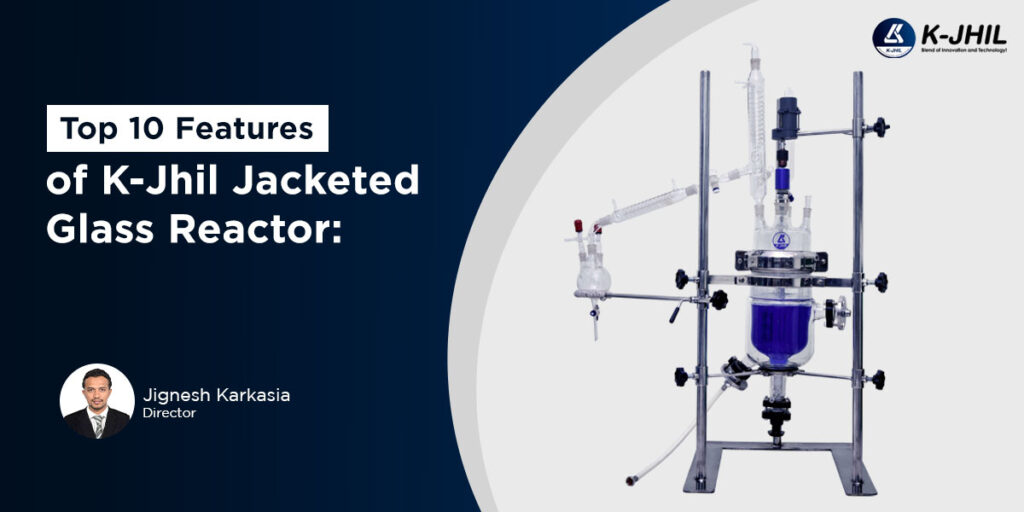
Quality Glass Jacketed Reactors are key to achieving successful and uniform chemical reactions. Without it, your synthesis, agitation, or distillation processes will either not yield the results you want or (even worse) end up causing damage to your personnel and facilities.
What's on this page:
At Kjhil, we’ve experienced and overcome these challenges first-hand by working with pharmaceutical companies, researchers, agrochemical corporations, and food & beverage enterprises. Over time, we’ve perfected the art and science of manufacturing highly sophisticated and secure glass reactor assembly systems.
In this blog, I’m going to highlight 10 key features of jacketed glass reactors that we’ve built over time. I’ll break down each feature and tell you how and why it can benefit your industrial or lab-grade operations.
Features of KJhil Jacketed Glass Reactors: Table of Contents
- Top 10 Features of KJhil Jacketed Glass Reactors
- KJhil: Your Reliable Jacketed Glass Reactor Provider
- Features of KJhil Jacketed Glass Reactors: FAQs
Top 10 Features of KJhil Jacketed Glass Reactors
Here’s a detailed breakdown of the 10 best features of our industrial- and lab-grade jacketed glass reactors:
1. Precision Jacketed Design
Our reactors are meticulously designed to ensure optimal circulation of thermal fluids with uniformity.
They ensure that you’re able to create precise and consistent temperature control for highly exothermic or sensitive reactions.
As a result, KJhil jacketed glass reactors can ensure process integrity and produce consistent results batch after batch.
Plus, our engineering process guarantees that the jacketed reactors we produce can handle complex syntheses with absolute confidence, directly enhancing your R&D and operations.
2. Modular System for Flexibility
Whether you need a jacketed reactor for pharmaceutical R&D or chemical manufacturing, flexibility is key to ensuring a system you can tailor to your own requirements.
That’s where the modular design of our jacketed glass reactors is very useful. It empowers you to set up your reactor to align with highly specific processes like reflux, distillation or extraction.
This feature is particularly invaluable for pharmaceutical research. For example, our reactors have helped labs scale their new APIs by enabling predictable tech transfer from small-scale synthesis to pilot plant production.
For speciality chemical manufacturing, the flexibility of our reactors means one system can perform multiple duties. Thus, you get to maximise ROI and save critical floor space.
From research labs to small-batch production facilities, our modular design thus future-proofs your investment and accelerates process development.
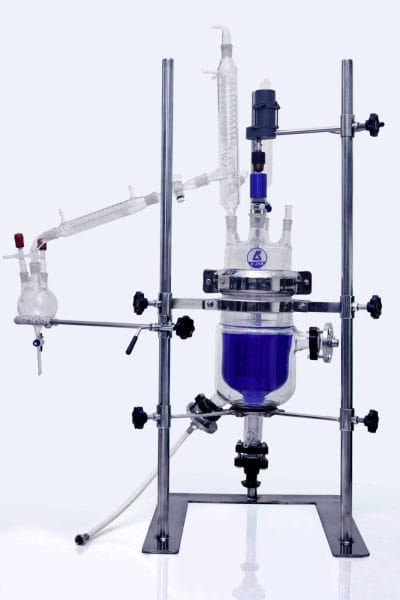
3. Real-Time Monitoring
One of the key strengths of jacketed glass reactors is that you can perform an “eye-test” to see whether the reaction is proceeding as it should.
At Kjhil, we design single and double-jacketed glass reactors that take this concept even further. They are equipped with advanced sensors that provide live, precise data on key parameters like temperature, pressure, and stirring torque directly to your control interface.
This means you are no longer working blind. This could be extremely helpful for you as a plant manager, as it provides a continuous data stream for rigorous Quality-by-Design (QbD) principles.
It’s also critical for accurate data collection if you’re a researcher or scientist. Our jacketed reactor system provides an unambiguous digital record of a reaction’s profile.
So, KJhil’s system is more than a simple jacketed glass reactor vessel. It’s an intelligent data hub that helps you make proactive decisions that prevent costly batch failures and ensure on-time development.
4. Control System Compatibility
Precise monitoring is only half the equation. The other half is the ability to act on that data and quickly adjust reaction conditions through control systems.
Our reactor systems are designed to solve both sides of this equation. They can be integrated with sophisticated control strategies, including precise PID (Proportional-Integral-Derivative) loops.
Plus, they are also equally compatible with other advanced automation protocols.
This means you can program exact setpoints and allow the system to self-regulate, maintaining reaction conditions within a razor-thin margin of error.
For industrial pilot plants, KJhil’s glass reactors thus offer automation that ensures consistency and reduces operator workload.
For R&D engineers, it enables the execution of complex, multi-stage reactions with precise temperature ramps and dynamic pressure changes that would be impossible to manage manually.
As a result, our reactor systems can help you implement sophisticated and reproducible process designs.
5. Integrated Heat Exchanger
Efficient temperature management is at the heart of any successful reaction.
That’s why our systems feature a precision-engineered integrated heat exchanger. They are designed to rapidly and uniformly transfer thermal energy into or out of the reaction jacketed glass reactor vessel.
But our heat exchanger components are designed for more than just heating or cooling processes. They guarantee control and efficiency.
For example, KJhil’s integrated heat exchanger ensures optimal nucleation and consistent product quality for processes like crystallisation or polymerisation, where precise thermal profiles are critical.
In industrial settings, precise heat exchangers lead to shorter production cycles, higher throughput, and significant energy savings.
For lab researchers, they enable accurate replication of thermal conditions essential for scaling up reactions.
So, whether you’re dissolving compounds or managing exothermic reactions, Kjhil jacketed glass reactors featuring an integrated heat exchanger are perfect for obtaining the reliability and performance needed for both R&D and production environments.
6. Variable Size Range
Finding scalable jacketed reactors that can replicate lab-grade reactions at scale is one of the biggest challenges that our clients are facing.
Based on this feedback, we have engineered jacketed glass reactors that are available in a comprehensive range of sizes, from compact 5L lab-grade units to larger 30L pilot-scale systems.
Our aim was to ensure a perfect transfer of technology and reaction conditions for both scientists and production managers.
So, a process chemist can use our 5L reactors to develop and optimise a reaction with confidence, knowing the identical engineering principles and control systems are available in the 30L reactor.
This dramatically reduces scaling risks and accelerates time-to-production. For facility managers, the vast range of our reactors means you can select the perfect vessel for your specific throughput needs while maximising efficiency and floor space utilisation.
7. Mobile Architecture
To operate successfully in dynamic lab and pilot plant environments, flexibility and safety are not just valuable – they’re often non-negotiable.
And that’s exactly what our jacketed glass reactors offer. They are built with a mobile, caster-wheel-based architecture that we can configure to align perfectly with your workspace.
This mobility ensures that you can quickly and safely relocate your entire system for cleaning, reactor maintenance, or to adapt to new process layouts.
For industrial safety officers, this is a critical feature. It allows you to quickly remove a reactor in the event of a contingency, thus guaranteeing safety under all circumstances.
For lab technicians and researchers, it means that our glass reactors can be easily moved to a fume hood for hazardous reactions or simply to optimise lab workflow.
This design eliminates the need for fixed, dedicated installations, transforming your reactor from a static piece of equipment into a versatile and adaptable process tool!
8. Optional Condenser Module
One of the most popular features of our jacketed glass reactors is the optional condenser module.
It’s designed to help you expand your operational capabilities beyond basic mixing and heating. The condenser integrates with the main vessel to enable processes like reflux condensation and vacuum distillation.
For pharmaceutical and organic chemists, this feature is simply indispensable. It helps them conduct prolonged reflux reactions safely and purify compounds/solvents under reduced pressure. All of this without needing a separate, dedicated, and expensive setup.
In pilot-scale production, the condenser module helps you recover valuable solvents directly within the same system, improving efficiency and reducing waste.
By adding this module, you can effectively transform a standard reactor into a multi-purpose purification workstation.
As a result, our condenser-backed glass reactors can increase both the functionality and return on investment of your equipment.
9. Completely Customizable Design
At Kjhil, one thing we understand better than anyone else is that no two processes are exactly alike. And our jacketed glass reactors are built to reflect this fact.
So, each system we build is fully customised, allowing you to tailor every critical parameter (stirring speed, temperature profiles, pressure setpoints and feed rates) to the unique requirements of your reaction or production process.
This level of control is especially valuable for all conditions where predefined settings won’t be enough:
- Speciality chemical manufacturers are developing novel formulations.
- Academic researchers exploring reaction kinetics.
But some of our biggest clients are industrial operators. For them, this customisation ensures that their new reactor systems align with existing automated production lines, supporting consistent and repeatable batch outcomes.
By putting precise adjustability in your hands, we empower you to innovate freely while maintaining the reliability and reproducibility demanded that are crucial to modern laboratory and pilot-scale environments.
10. High Durability
A jacketed glass reactor is a long-term investment.
So, its durability directly impacts operational safety, downtime, and total cost of ownership.
KJhil jacketed glass reactors are therefore engineered for resilience, using only high-quality borosilicate glass 3.3 for the vessel, known for its exceptional thermal shock resistance and chemical inertness.
The framework of our systems is constructed from corrosion-resistant stainless steel (e.g., 316/304 SS), ensuring structural integrity and longevity even in demanding environments.
For plant managers, our high-grade construction materials mitigate the risk of material failure. As a result, you can expect reduced reactor maintenance costs, minimal downtime, and enhanced operator safety.
Plus, as a researcher, you can benefit from a reliable vessel that maintains purity and performance over countless experimental runs.
This commitment to premium materials and superior craftsmanship ensures that every Kjhil reactor delivers not just precision, but also the unwavering reliability required for both sensitive R&D and rigorous large-scale production.
KJhil: Your Reliable Jacketed Glass Reactor Provider
Through this article, I’ve walked you through the top 10 features of our precision-crafted chemical synthesis reactors.
At Kjhil, we’ve not developed highly sophisticated jacketed reactor systems all on our own – our clients have played a critical role in pushing us to create solutions that continuously meet and surpass industry standards.
Where perfection and reliability are expected, relentless innovation is non-negotiable.
And that’s how we have acquired a deep expertise in manufacturing, process automation, and custom fabrication is embedded in every jacketed glass reactor we produce.
So, whether you work in the agrochemicals, pharmaceuticals, or biotech industries, we are here to help you elevate your processes to new heights.
Connect with our engineers, tell us about your requirements, and let us build a reactor system for you that will set your processes apart from the market!
Features of KJhil Jacketed Glass Reactors: FAQs
1. What is a double-jacketed glass reactor?
A double-jacketed glass reactor features an outer vessel that circulates thermal fluid, providing precise temperature control for sensitive chemical reactions inside the inner glass reactor vessel.
2. What are the main benefits of a glass reactor vessel?
The main benefits are superior chemical resistance, visual monitoring of reactions, and precise thermal control, making them ideal for R&D and pilot-scale production.
3. How does KJhil ensure reactor durability?
We use high-grade borosilicate glass 3.3 and corrosion-resistant stainless steel frameworks to ensure long-lasting performance and minimal reactor maintenance.
4. Can your jacketed glass reactors handle vacuum distillation?
Yes, with our optional condenser module, our reactors are fully equipped for processes like vacuum distillation and reflux, expanding their functionality.
5. Are your systems suitable for scaling up from lab to production?
Absolutely. Our range from 5L to 30L allows for seamless scale-up, ensuring process consistency from laboratory research to pilot plant production.