

Whether you’re conducting experiments, educating future chemists, or running a commercial production unit, the right jacketed glass reactor can help you oversee successful chemical reactions.
What's on this page:
However, with the widespread use of both single- and double-jacketed glass reactors, you might be confused about which one to use.
In this blog, we’re going to help you pick the right jacketed glass reactor that suits your requirements.
We’ll cover:
- The definition and design of single and double-jacketed reactors.
- The key differences between the two jacketed reactor types.
- The different use cases of the two jacketed reactors.
Dive in to find out which one best aligns with your needs.
Single vs Double Jacketed Glass Reactors: Table of Contents
- Single vs Double Jacketed Glass Reactors: Quick Comparison Table
- What is a Jacketed Glass Reactor?
- Single-Jacketed Glass Reactor
- Double-Jacketed Glass Reactor
- Single vs Double Jacketed Glass Reactors: Detailed Comparison
- Choose the Right Jacketed Reactor Vessels with K-Jhil
- Single vs Double Jacketed Glass Reactors: FAQs
Single vs Double Jacketed Glass Reactors: Quick Comparison Table
In a hurry? We’ve got you covered!
Here’s a quick but detailed comparison of the two jacketed reactor types based on the key features that separate them:
Feature | Single Jacketed | Double Jacketed |
Temperature Control | Basic | Precise, uniform |
Heat Transfer | Direct, less efficient | Indirect, efficient |
Reaction Complexity | Simple | High (e.g., exothermic) |
Cost | Lower | Higher |
Use Case | Small-scale, budget-limited projects and processes like crystallization, electrochemistry, and producing cosmetics. | Sensitive projects that need precision temperature control, like R&D and industrial production |
Also Read: How to Choose the Right Jacketed Glass Reactor?
What is a Jacketed Glass Reactor?
A jacketed glass reactor is a lab-grade vessel that helps you perform controlled chemical reactions. The use of glass is particularly important: it ensures minimal reactivity of the vessel surface, while letting scientists, engineers and innovators see exactly what’s happening inside!
But a jacketed glass reactor does more than that: after all, even a beaker, test tube, and other vessels can help you oversee chemical reactions.
A jacketed glass reactor vessel is different from other lab equipment because it allows you to control the temperature of the chemical reaction.
This makes it perfect for heat-sensitive chemical reactions that need to be conducted within extremely precise temperature windows.
But not every jacketed glass reactor vessel offers the same amount of temperature control.
In fact, that’s one of the main differences between single vs double double-jacketed glass reactors.
To understand this and other differences, let’s quickly explore the two reactor jacket types.
Single-Jacketed Glass Reactor
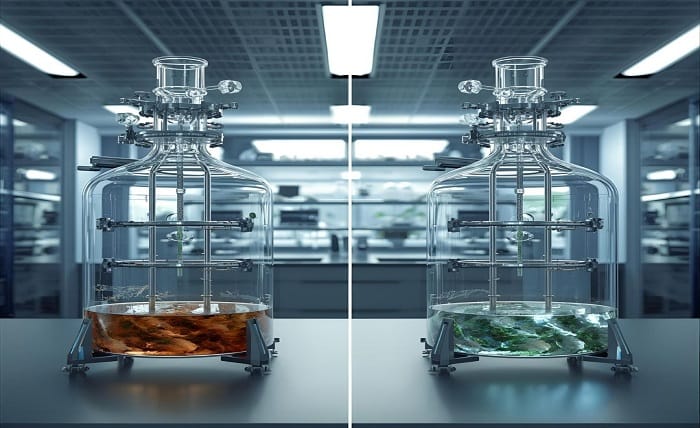
A single jacketed glass reactor has a single outer layer that helps you control the temperature of your chemical reaction.
Think of it like a combination of a lab-grade thermos and a hotplate.
Like a thermos, it ensures temperature stability for limited periods of time. And like a hotplate, it has a single source of heat that’s applied unevenly but steadily throughout the glass reactor.
It’s the more common of the two laboratory glass reactors because it is cheaper, easier to clean, and simple to operate.
Single jacketed glass reactor vessels are thus very useful for chemical reactions where temperature control is necessary but doesn’t require too much precision.
On the other hand, it struggles with extreme temperatures and thermal shocks while also losing heat faster than double-jacketed glass reactors.
Let’s find out why.
Double-Jacketed Glass Reactor
As its name suggests, a double-jacketed glass reactor has two outer layers compared to a single-jacketed reactor’s one.
The first layer helps you control the heat, and the second layer has a circulating fluid that helps you control the heat of your chemical reactions.
Think of it as a highly advanced thermos with precision temperature control.
The outer layer will circulate heated fluid, like water or oil, around the inner chamber. This will ensure steady and uniform temperature throughout the vessel.
Additionally, you never get any hot or cold spots that might compromise the stability of your chemical reaction.
It is thus the ideal glass reactor vessel for handling volatile reactions, thermal shocks, and extreme heat.
However, it is also harder to maintain and clean, and more expensive than single-jacketed glass reactors.
Single vs Double Jacketed Glass Reactors: Detailed Comparison
Next, let’s understand the key differences between the two jacket reactor types based on their performance and characteristics:
1. Temperature Control
If thermal efficiency is very important to your chemical reaction or use case, find out which one aligns best with your use case:
- Single-Jacketed Reactor: Offers decent temperature control, including quick heating. But since it only has one source of heat (typically at the bottom of the reactor), the heating is uneven. This means you don’t have complete control over the temperature at every single point in time throughout the reaction.
- Double-Jacketed Reactor: Gives you a high degree of control over the temperature in your jacketed reactor vessel. It also ensures smooth, even, and uniform heating without any hot or cold spots.
2. Heat Loss
The temperature control features of the two jacketed reactor types are closely linked with their ability to retain heat. Here’s how they differ:
- Single-Jacketed Reactor: A single-layer reactor loses heat faster than a double-jacketed vessel. This isn’t just because it has a single layer of glass: after all, a thicker outer layer can help you retain heat for longer. It’s more because the single-jacketed reactor doesn’t have a layer dedicated to maintaining the heat within the vessel!
- Double-Jacketed Reactor: A double-jacketed glass reactor loses heat very slowly due to its dedicated heating/cooling layer. This allows it to perform highly complex chemical reactions through a high level of thermal efficiency.
3. Cost
Here’s a quick breakdown of the cost difference between the two reactor jacket types:
- Single-Jacketed Reactor: Budget-friendly reactor vessels that are both easier & inexpensive to operate and maintain.
- Double-Jacketed Reactor: Expensive because they are made of highly durable materials. They also require more effort and money to operate and clean.
4. Use Cases
Lastly, let’s take a quick look at the major use cases of both types of jacketed glass reactors:
- Single-Jacketed Reactors: Typically used for lab-grade reactions that don’t require precise temperature control. Also useful for processes like creating experimental dyes, educational purposes, and projects with limited budgets.
- Double-Jacketed Reactors: Since they’re more expensive but also offer precision, double-jacketed reactors are ideal for industrial-grade pharmaceutical production, research and development projects, and heat-sensitive operations.
In short, if you need complete control over your chemical reaction and need to produce uniform batches of the same reaction at an industrial scale, go for double-jacketed reactors.
If you only need to conduct laboratory experiments for teaching or small-scale production on a limited budget, single-jacketed reactors will get the job done!
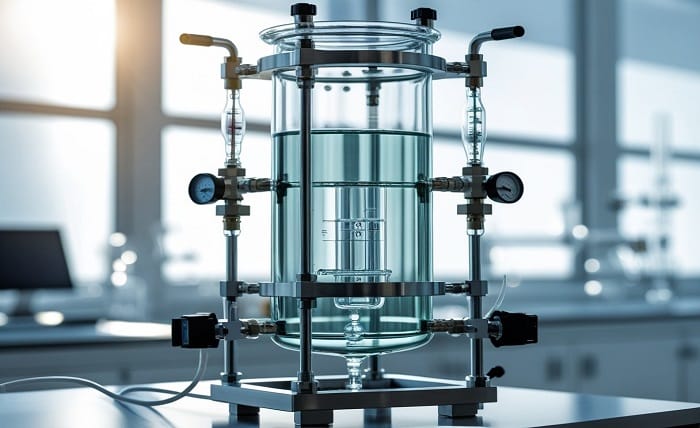
Choose the Right Jacketed Reactor Vessels with K-Jhil
Whether you need a cost-effective single-jacketed reactor for lab experiments or a high-precision double-jacketed vessel for industrial-scale production, you want to work with a reliable partner who can deliver quality instruments for your processes.
With 30+ years of experience, that’s exactly what we at K-Jhil Scientific offer.
We craft customized, high-quality chemical synthesis reactors for pharmaceuticals, chemicals, R&D, and more.
So, whether you need some help identifying which jacketed glass reactor will suit your needs or want to procure reactor vessels for your project, reach out to us right away!
Please share your requirements with us, and we’ll get back to you with samples and a customised proposal for high-quality glass reactor vessels.
Single vs Double Jacketed Glass Reactors: FAQs
1. Which reactor is better for extreme temperatures?
Double-jacketed reactors are much better for handling extreme temperatures. This is because their fluid-circulating design handles extreme heat/cold far better than single-jacketed ones.
2. Are double-jacketed reactors worth the extra cost?
Yes, double-jacketed glass reactors are definitely worth the extra cost if you need precision temperature control (e.g., pharma production)! On the other hand, single-jacketed reactors can be effective and affordable solutions for basic lab work.
3. Can I use a single-jacketed reactor for sensitive reactions?
While you can use single-jacketed reactor vessels for sensitive reactions, they’re not ideal for such use cases as they lack uniform heating. Double-jacketed reactors prevent hot/cold spots, which makes them much safer and more effective for sensitive processes.
4. Single vs double jacketed glass reactor: which one loses heat faster?
Single-jacketed reactors lose heat quicker than double-jacketed reactors due to simpler insulation. Double jackets retain temperature stability longer as they have two layers, along with a mechanism for uniform heating.
5. How do I choose between a single-jacketed vs double-jacketed glass reactor?
We suggest choosing between a single and a double-jacketed glass reactor based on your use cases. Pick a single-jacketed reactor for conducting simple reactions on a limited budget. They’re ideal for chemical reactions related to agricultural and cosmetic products. Opt for a double-jacketed reactor for industrial-grade precision and complex processes. They offer more temperature control and sensitivity for pharmaceutical and industrial-grade production.