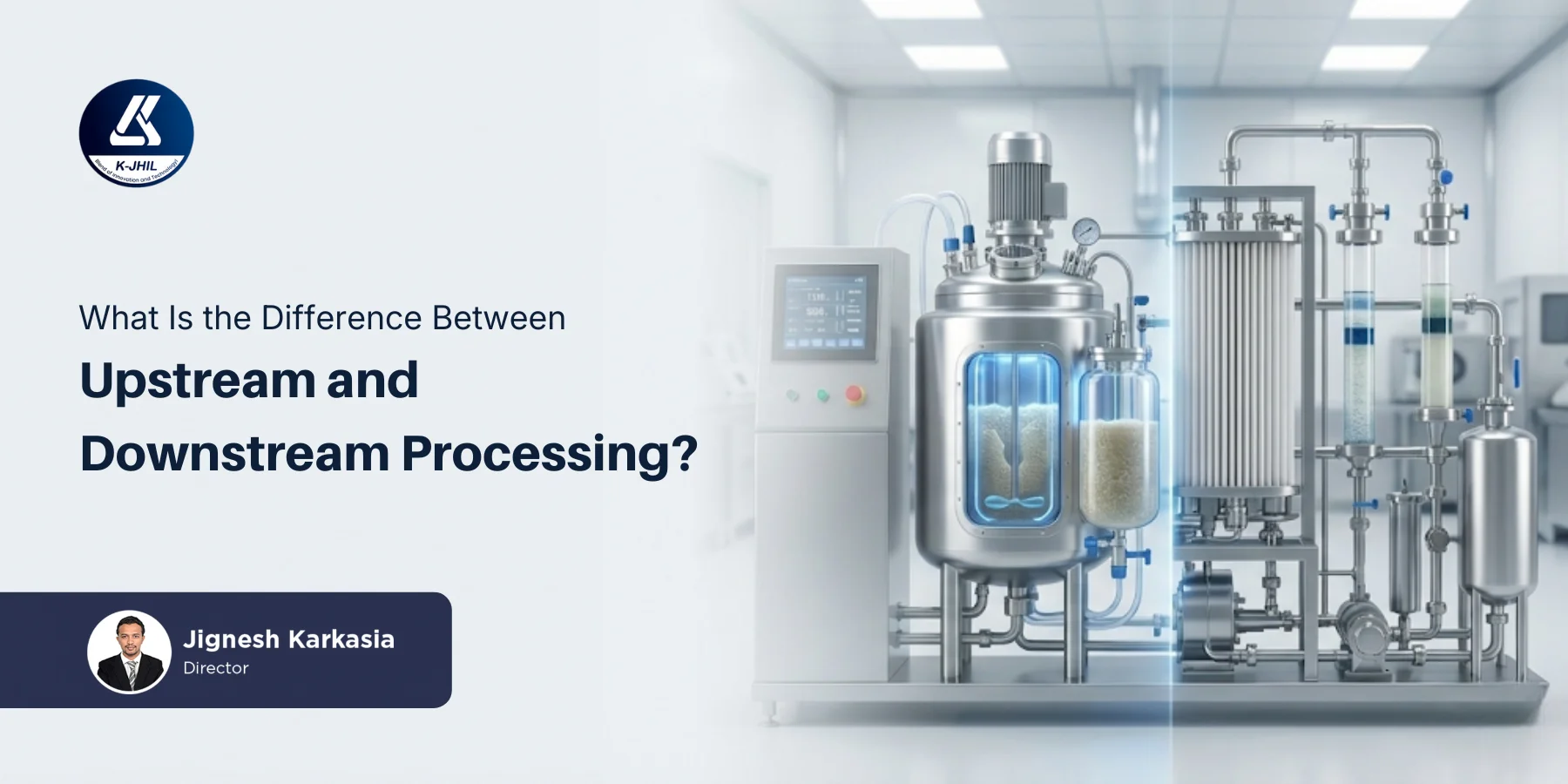

Have you ever thought about how medicines and vitamins are made on a mass scale?
What's on this page:
While they often start with tiny living bacteria and yeast, turning these into usable products requires two complex processes.
These are called upstream and downstream processing. Many industries use them to make organic medicines and natural flavoring products.
In this detailed guide, we will understand each process in more detail.
Let’s begin!
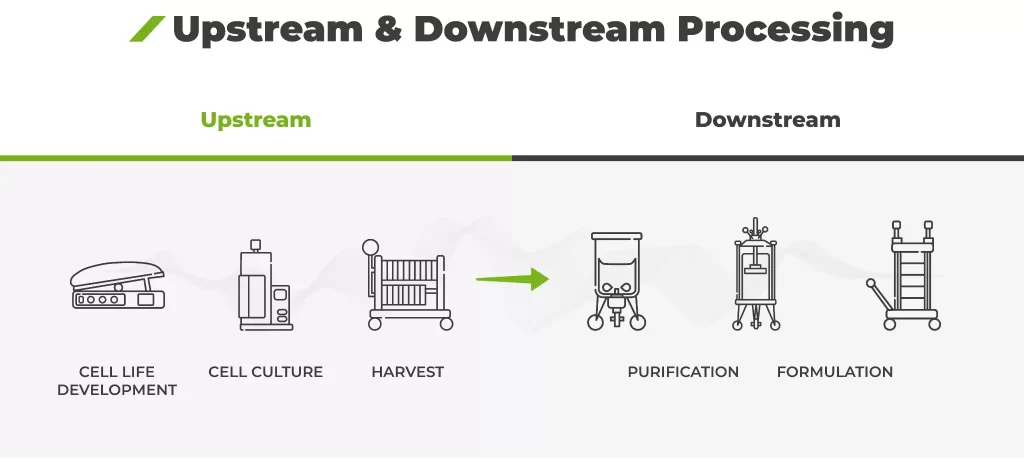
(Source: https://www.susupport.com/blogs/manufacturing-processes/what-is-upstream-and-downstream-processing)
Part 1: Upstream Processing
This stage is all about growing as many healthy cells as possible. This will decide the quality of the final product and its efficiency.
Much like how cheese is made from starter cultures, organic medicine also requires cells to multiply. Upstream processing is how they grow trillions of yeast cells in large tanks to manufacture medicines at scale.
What Happens During Upstream Processing?
Here are the key steps associated with this process:
Starting a Culture:
The process begins with a tiny number of pure cells. These are placed in a special nutrient soup called “media” to promote their growth.
Prepare the Food:
With this nutrient soup, the cells get everything they need to multiply. It includes sugar, salts, and vitamins. This soup is kept in a sanitised environment to prevent the spread of germs.
Fermentation Process:
As the cells continue to multiply, this nutrient soup is transferred into a large sterile tank called a bioreactor. In this tank, scientists can control its propagation.
These controlling factors used by scientists include:
- Temperature
- Oxygen
- Food / Nutrients
- pH levels
Final Stage:
After the cells have made enough product, the process is stopped. The leftover nutrient soup in the tank is now called the ‘broth’. It includes a mix of cells, the product we are after, and leftover food.
Part 2: Downstream Processing
Now that our broth is prepared, it is time to extract the product from it.
The second stage of this entire process is downstream processing. It is all about cleaning the broth and extracting our target product from it.
For this separation, targeted processing is used to remove all impurities from the broth.
This includes using advanced separation techniques, such as different types of liquid-liquid extraction, to purify the material.
What Happens in Downstream Processing?
This stage mainly involves steps to clean and separate the product:
Steps | Simple Goal | How It’s Done |
1. Solid-Liquid Separation | Remove the whole cells from the liquid broth. | Spinning very fast in a centrifuge or using filters. |
2. Cell Breakage (if needed) | Used if the product is trapped inside the cells. | Using high-pressure machines or special chemicals to crack the cells open. |
3. Capture | Grab hold of the product molecules from the messy liquid. | Methods such as solvent extraction are used to target the product. |
4. Purification | Remove the final, tiny impurities to get a very pure product. | Chromatography to remove impurities. |
5. Final Polish | Get the product ready for use by turning it into powder. | Using special filters, freeze-drying, or crystallization. |
Comparing Upstream vs. Downstream Processes
Here is how the two processes differ from each other:
Feature | Upstream Processing | Downstream Processing |
Main Goal | To grow cells and make the product. | To purify the product from the mixture. |
What It Handles | Living cells in a nutrient soup. | A chemical mixture from the upstream tank. |
Key Focus | Keeping cells alive, healthy, and productive. | Separating, cleaning, and concentrating molecules. |
Final Result | A tank of “broth” containing the product. | A pure, stable, and finished product. |
Typical Cost | About 20-30% of the total cost. | About 70-80% of the total cost. |
Note how downstream processing is far more complicated and expensive than upstream processing.
This is because extracting the main product is much more complex than simply starting the culture.
But if the upstream process is not done correctly, the broth becomes even more impure.
This leads to additional costs in the downstream process.
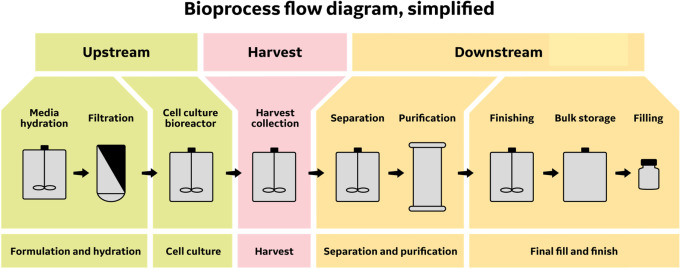
How do the Upstream and Downstream Processes Work Together?
(Source: https://www.sciencedirect.com/science/chapter/edited-volume/pii/B9780081006238000244)
It is essential to clarify that although these two processes differ, they are part of the same system.
They depend entirely on each other to provide the actual output during manufacturing.
The two processes are also co-dependent, wherein:
- A great upstream process will be entirely wasted if the downstream cannot purify it.
- On the other hand, even the best downstream process is wasted if the upstream side cannot provide a good quality broth.
This means that scientists involved in both processes need to work together constantly to ensure the best results.
Conclusion
Upstream processing is the growing stage of living cells in a tank. Downstream processing is the final cleaning stage that extracts the product.
Together, upstream and downstream processing are the main factors that provide us with vital products in real life. This includes everything from antibiotics to natural flavorings in our snacks.
For efficient outputs, a key requirement is finding a manufacturer and supplier experienced in separation processes. You will require a robust separation chamber to ensure you obtain the highest-purity product from the broth during the downstream process.
This is where a veteran supplier like K-Jhil Scientific comes into the picture.
As a leading supplier of specialised chemical separators, they can offer solutions that help make your solvent extraction process in pharma much more efficient.
Moreover, they offer a strong commitment to the quality and reliability of these products. They are internationally known for their high-grade biotech and pharmaceutical solutions.
With their expertise, your upstream and downstream processing will benefit significantly in overall manufacturing performance. They are known for helping transform scientific processes into real-world applications.
Looking for a dependable provider of chemical separators? Contact K-Jhil today to discuss your exact needs!
FAQs
1. What’s the simple difference between upstream and downstream processing?
The main difference between upstream and downstream processing is their job. Upstream processing is like farming, as it grows the cells and makes the product. Downstream processing is like a factory. It cleans the mixture to produce the pure, final product ready for use.
2. What happens during the upstream process?
The upstream process is all about growing. Scientists put tiny cells (such as bacteria) into a large tank with special food. They carefully control the environment so the cells multiply and make as much of the desired product as possible. The result is a broth full of cells, product, and leftovers.
3. What is an example of a method used in downstream processing?
A standard method in downstream processing is the solvent extraction process. Think of it like using oil to pull garlic flavor out of water. A special liquid (solvent) is added to the mixture; the product dissolves into it, making it easy to separate from the rest of the waste.
4. Why is the downstream part often the most expensive?
Downstream processing is usually the costliest part because “cleaning” is hard work. Isolating a single pure molecule from a complex soup requires many high-tech steps and expensive equipment, such as chromatography systems. This purification accounts for most of the total manufacturing cost.
5. How do upstream and downstream depend on each other?
Upstream and downstream processing are a team. A good upstream process produces a lot of product, giving the downstream more to work with. A good downstream process can efficiently clean the product, even if the upstream mixture is a bit messy. They are designed together for the best result.